Competitive Positioning
AIM vs Prosci vs Kotter: Which Enterprise Change Framework Fits Your Transformation?
Not all change management frameworks are built the same. Prosci, Kotter, and the Accelerating Implementation Methodology (AIM) share a common goal, helping organizations navigate change, but they differ fundamentally in how they define the problem, who owns the work, and how they measure success. This guide walks through how each approach works, where each fits, and what distinguishes AIM from the others.
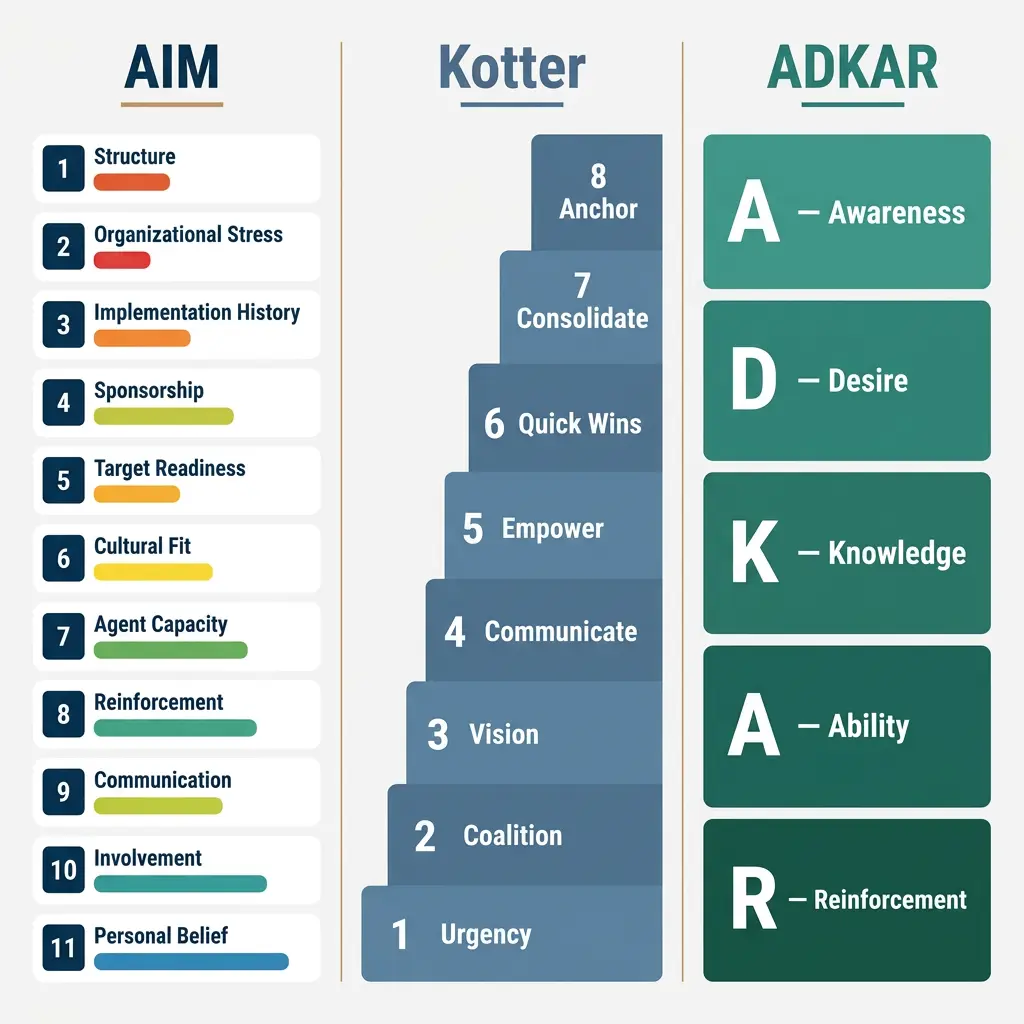
AIM, Prosci, and Kotter are the three most referenced change management frameworks. AIM focuses on organizational systems and behavioral reinforcement. Prosci centers on individual transitions through ADKAR. Kotter prescribes an eight-step leadership sequence. IMA Worldwide (Implementation Management Associates) AIM is the only framework that treats implementation as an ongoing behavioral system rather than a phased project.
Starting Point
The three methodologies at a glance
Change management methodology comparison is the process of evaluating how different frameworks define adoption, assign accountability, and measure results so that organizations can select the approach most likely to produce sustained behavior change. Organizations invest significantly in change initiatives: new systems, restructurings, process redesigns, culture shifts. A framework is not just a project tool; it encodes assumptions about where resistance comes from, who is responsible for adoption, and what "done" actually means. Choosing the wrong framework does not simply slow the work down. It can systematically reinforce the very dynamics that cause transformations to stall.
Who Owns the Change
Some frameworks place accountability primarily on a project office or HR function. Others root ownership firmly in line leadership and require explicit sponsor engagement throughout the lifecycle.
Where Resistance Is Located
Frameworks differ in whether they treat resistance as an individual psychological state to be managed or as an organizational system signal that requires diagnosis and leader response.
How Success Is Measured
Go-live, training completion, and individual ADKAR scores are common metrics. But sustained adoption requires measuring actual behavior change on the ground, often months after a project closes.
Cascade Design and Scale
Large organizations need change to move through layers of management. A framework built only for individual-level change can fail at enterprise scale unless it includes mechanisms for leadership cascade design.
Each of the three leading frameworks, IMA Worldwide's Accelerating Implementation Methodology (AIM), Prosci, and Kotter, addresses these questions differently. The sections below break down exactly how, dimension by dimension, before exploring where each fits best and how they can complement one another.
Framework Overview
What are the three leading enterprise change frameworks?
AIM, Prosci, and Kotter represent the three most widely adopted approaches to managing organizational change at enterprise scale. Each was developed under different conditions, with different assumptions about where change stalls and what leaders must do to sustain it.
Accelerating Implementation Methodology (AIM)
Developed by Don Harrison over 40+ years of applied field research, AIM treats implementation as an ongoing behavioral system. It focuses on sponsor accountability, cascade design, resistance diagnosis, and reinforcement architecture to drive sustained adoption at organizational scale.
ADKAR Model
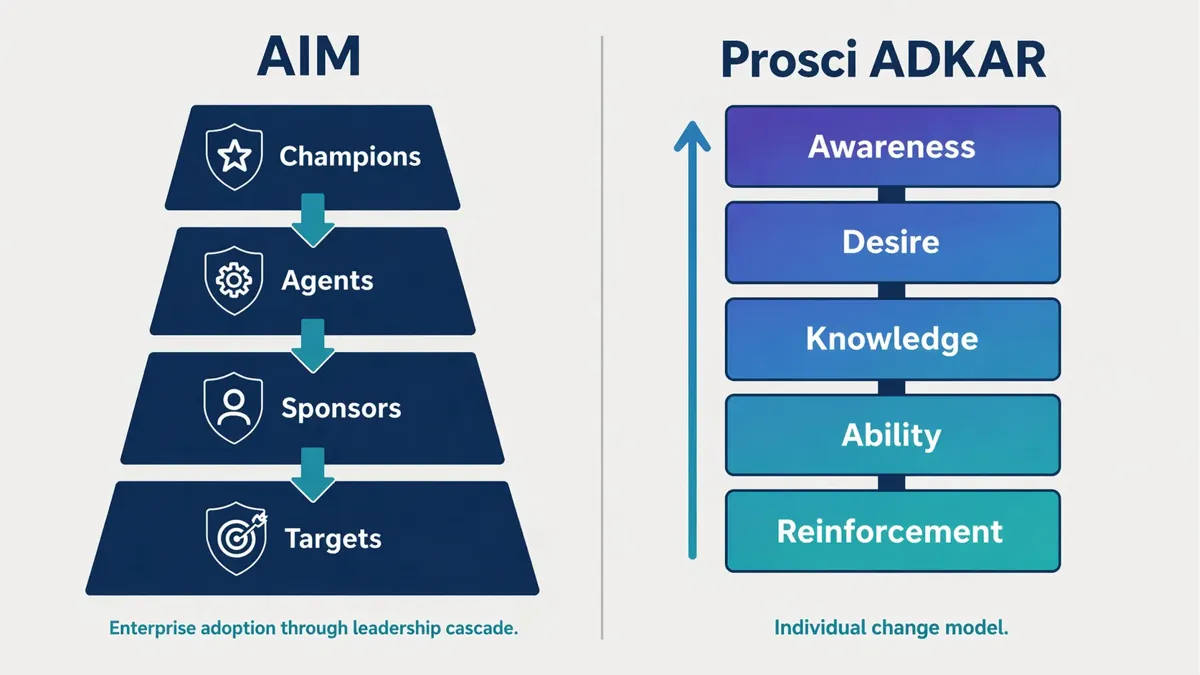
Prosci's ADKAR model structures change readiness around five individual-level building blocks: Awareness, Desire, Knowledge, Ability, and Reinforcement. It provides practitioners with diagnostic tools and a certifiable methodology for mapping change impacts to specific role groups.
8-Step Change Model
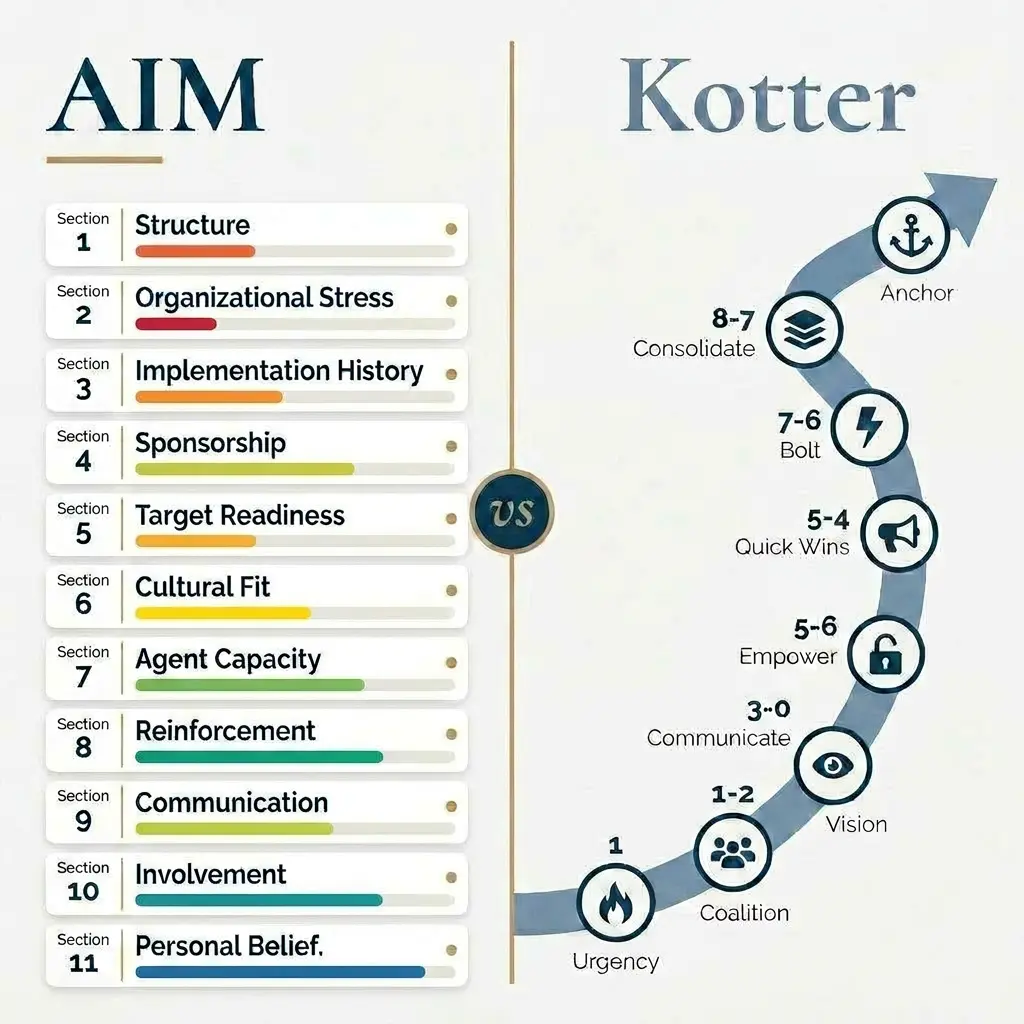
Based on Harvard Business School research published in 1995, Kotter's model prescribes a sequential eight-step process. It excels at creating organizational urgency, building guiding coalitions, and communicating compelling transformation visions to leadership audiences.
Side-by-Side Analysis
How do AIM, Prosci, and Kotter compare side by side?
The table below compares the three frameworks across the dimensions that most influence implementation outcomes. Compared to Prosci's individual-focused ADKAR model and Kotter's sequential eight-step process, AIM differs from both by treating change as an organizational system problem. Whereas Prosci and Kotter prescribe processes, AIM diagnoses and addresses the specific conditions blocking adoption. Where a framework has partial or conditional capability, that nuance is noted.
| Dimension | AIM (Accelerating Implementation Methodology) | Prosci / ADKAR | Kotter's 8-Step Model |
|---|---|---|---|
| Primary Focus | Sustained adoption and measurable behavior change at organizational scale | Individual-level awareness, desire, knowledge, ability, and reinforcement (ADKAR) | Organizational urgency creation and sequential change steps led by a guiding coalition |
| Leadership Model | Active sponsor accountability with structured sponsor roles, responsibilities, and cascade design across all leadership layers | Sponsor support addressed but not as a structured accountability architecture; sponsorship often advisory | Coalition-centered; strong on urgency and vision but less prescriptive on sustained leader accountability post-launch |
| Communication | Structured by change target group with planned two-way feedback loops; leader-delivered messaging at each layer | Communication plans tied to ADKAR stages; often centrally designed and broadcast | Communication integral to early steps; vision-focused broadcasts with coalition advocacy |
| Resistance Handling | Diagnosed by category (logical, emotional, political); leaders actively respond; treated as information about the system | Individual resistance mapped to ADKAR gaps; addressed through targeted interventions per person or role group | Addressed indirectly through urgency, vision clarity, and removing obstacles; less diagnostic in structure |
| Reinforcement | Explicit reinforcement planning with identified mechanisms, accountability, and post-launch reinforcement sustain phases | Reinforcement is the "R" in ADKAR and is acknowledged; practical reinforcement planning varies by practitioner | Limited explicit reinforcement structure; anchoring in culture is Step 8 but method is broad |
| Measurement | Target Readiness Assessments at defined milestones; adoption metrics tied to organizational results rather than training output | ADKAR assessments measure individual progress; aggregate scores used for project reporting | No defined measurement framework; success often inferred from milestone completion |
| Cascade Design | Built-in cascade architecture; change must move through every layer of management to front-line adopters | Cascade possible but not structurally required; depends on practitioner design | Coalition-based rather than hierarchical cascade; works top-down through coalition influence |
| Evidence Base | Grounded in 40+ years of applied field research across industries; developed by Don Harrison at IMA Worldwide | Research-backed; Prosci publishes benchmark studies and best practices reports updated regularly | Based on Harvard Business School research; widely cited in leadership literature since 1995 |
| Failure Prevention | Explicit installation vs. implementation distinction; built to prevent project teams from declaring success at go-live | Failure points often surface through ADKAR gap analysis; prevention depends on practitioner rigor | Urgency and coalition steps help prevent early stalls; less systematic post-launch failure prevention |
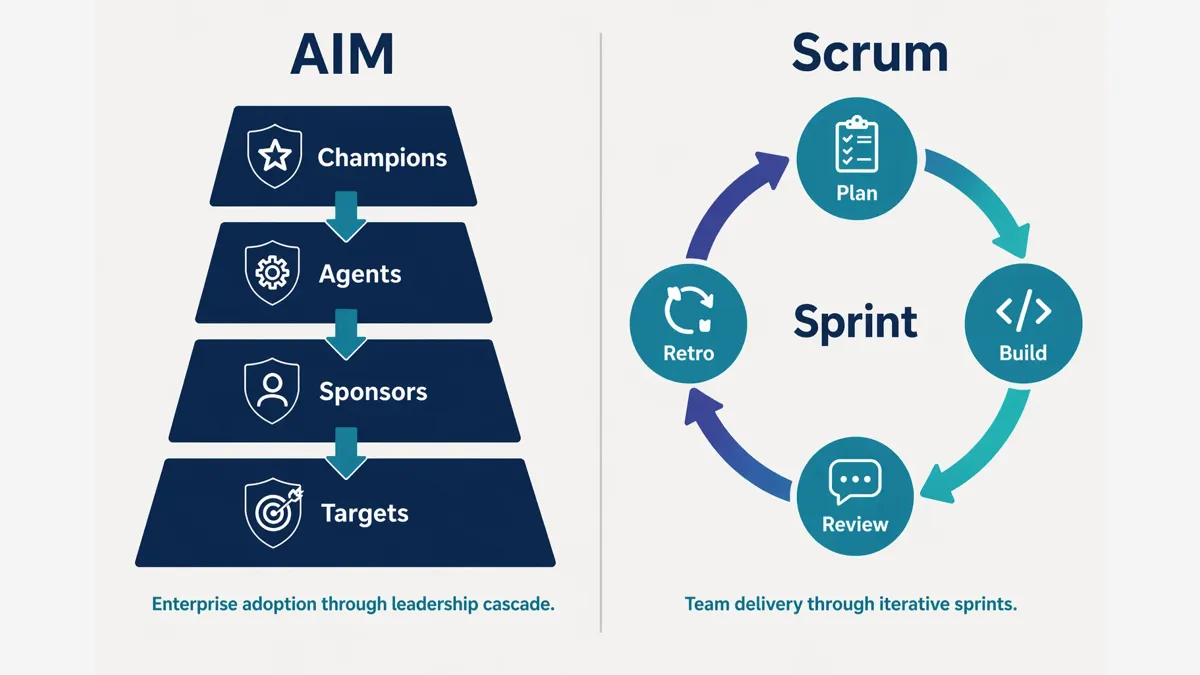
| Agile / SAFe Compatibility | Designed to layer onto any delivery model including Agile and SAFe; AIM addresses adoption, not delivery cadence | Prosci has published Agile-compatible guidance; integration requires deliberate practitioner mapping | Sequential steps can conflict with iterative delivery; requires significant adaptation |
The AIM column is highlighted because this guide is published by IMA Worldwide, the originator of the Accelerating Implementation Methodology. Where AIM performs differently from other frameworks, the comparison aims to be accurate and specific rather than promotional.
Common Ground
Where do all three frameworks agree?
Despite their structural differences, AIM, Prosci, and Kotter converge on several foundational principles that experienced change practitioners recognize across all three approaches.
Leadership Involvement Is Non-Negotiable
All three frameworks require active leadership participation. Whether framed as sponsor accountability (AIM), sponsor coalition (Prosci), or guiding coalition (Kotter), each recognizes that change fails without visible, sustained leadership engagement.
Communication Must Be Deliberate
None of the three frameworks treats communication as optional or unplanned. Each requires structured messaging, though they differ on who delivers it, how feedback flows, and whether communication is primarily top-down or multi-directional.
People Are Central to Success
All three reject the notion that technical deployment alone constitutes success. Whether the unit of analysis is the individual (Prosci), the organization (AIM), or the coalition and its followers (Kotter), the human dimension is the critical variable.
Resistance Must Be Addressed
No framework ignores resistance. The differences lie in how each diagnoses its source and what response it prescribes, but all three acknowledge that resistance left unaddressed will undermine outcomes.
What Makes AIM Different
Where do the three frameworks diverge most sharply?
Comparing frameworks on a table captures structure, but the most meaningful differences in AIM show up in how it reframes the change problem entirely. Several of AIM's design principles have no direct equivalent in either Prosci or Kotter.
Installation vs. Implementation
AIM's research across thousands of implementations shows that organizations consistently confuse installation with implementation. AIM draws a hard line between installing a solution (deploying it technically) and implementing it (getting people to use it in ways that produce results). Most project frameworks conflate the two. AIM is built specifically for the implementation side, the work that happens after go-live.
Sponsor Accountability Architecture
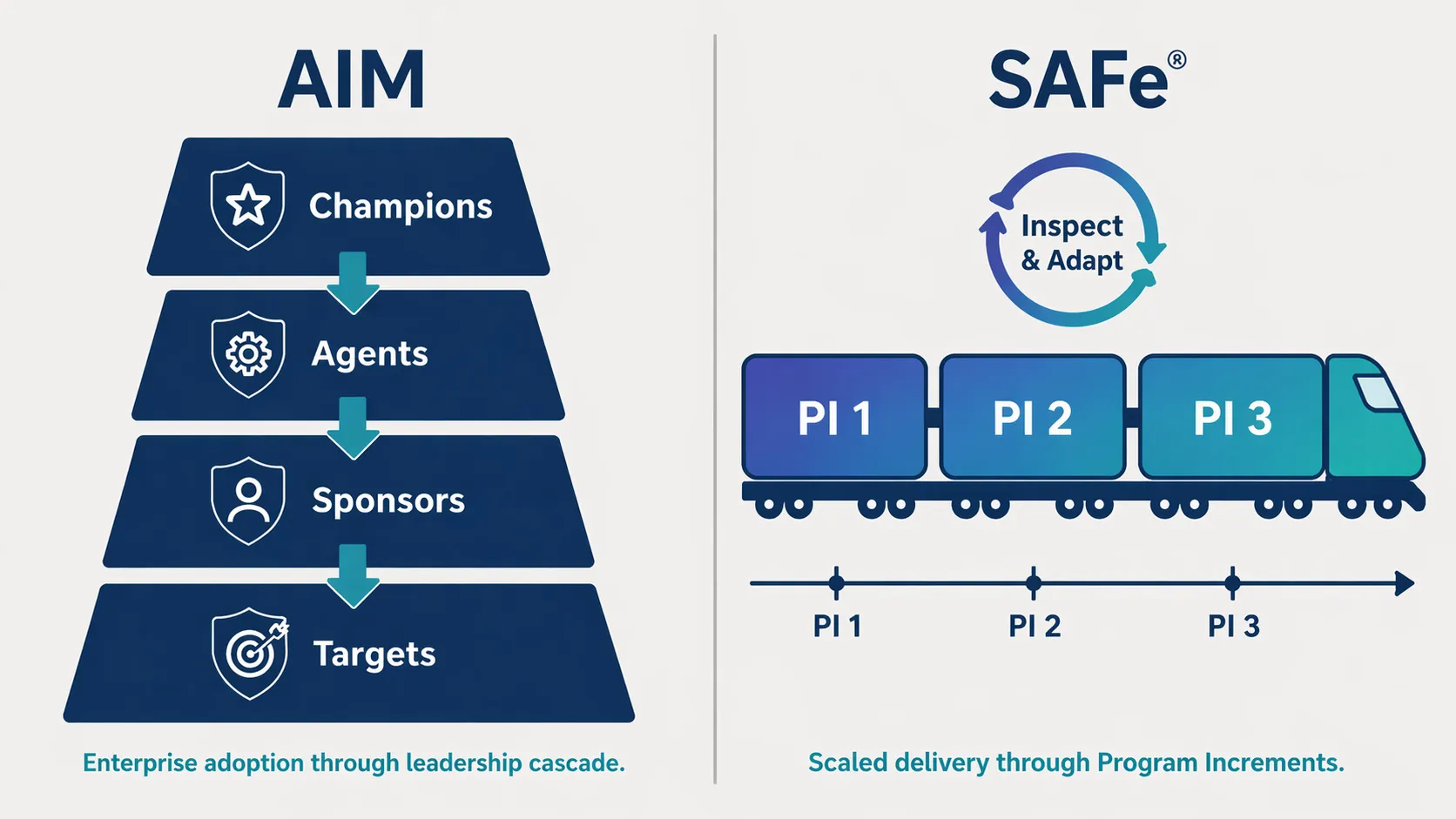
In AIM, sponsors are not cheerleaders or executive signatories. They have defined roles, specific responsibilities, and visible behaviors that are held to account throughout the change lifecycle. The cascade sponsor model ensures accountability exists at every organizational layer, not just the top.
Resistance as Diagnostic Signal
Where Prosci treats resistance as an individual ADKAR gap and Kotter treats it as an obstacle to remove, AIM treats resistance as a signal about the system. AIM categorizes resistance by type (logical, emotional, or political) and requires leaders to respond at the right level rather than defaulting to more communication.
Target Readiness Assessment
AIM's structured readiness measurement tool tracks adoption progress against defined milestones at the organizational level. Unlike individual ADKAR scores, TRA data aggregates by change target group and informs leader action rather than reporting to a project dashboard.
EMR: The Three-Factor Model
AIM's EMR framework identifies three interdependent conditions required for sustained adoption: Employee Motivation and Readiness (what people bring), Manager and Supervisor Effectiveness (what the middle layer does), and Reinforcement (what the organization sustains). Missing any one factor reliably predicts poor adoption regardless of how well the project was executed.
Change Agent Network Design
AIM requires a structured change agent network with defined roles and accountabilities, not just a communication liaison team. Change agents in AIM are embedded in business units, trained in resistance diagnosis, and held responsible for driving adoption within their groups.
AIM does not replace the technical project. It closes the gap between a technically complete solution and one that is actually used, at scale, over time, in ways that produce the results the organization intended when it started the change.
Decision Framework
When should you choose each framework?
There is no universal answer. The right framework depends on the scope of the change, the maturity of the organization, the role of leaders in the initiative, and whether the primary challenge is individual adoption, organizational urgency, or enterprise-wide sustained implementation.
Choose AIM When
Scale and sustained adoption are the primary concerns.
- The initiative spans multiple business units or geographies
- Leadership accountability is a known gap or risk
- Previous implementations stalled after go-live
- You are running an ERP, SAFe, or enterprise technology transformation
- Middle management is the critical adoption lever
- You need measurable adoption data, not just training completion
- The change requires sustained behavior change over months or years
- The transformation spans multiple regions or cultures and requires a framework designed for cross-cultural adaptability
Choose Prosci When
Individual readiness and structured practitioner methodology are the priority.
- Your change management team needs a structured, certifiable methodology
- You want to map change impacts to individual role groups
- The organization has an existing Prosci-trained OCM function
- The change is primarily process- or system-level with defined user populations
- Practitioner-level tools and templates are the primary need
- You are building internal OCM capability from scratch
Choose Kotter When
Creating organizational urgency and senior leadership alignment is the first obstacle.
- The organization is complacent and urgency has not yet been established
- You need to build a senior coalition around a transformation vision
- The leadership team is the primary audience for the framework
- The initiative is early-stage and focused on strategic framing
- You want a framework that communicates easily to executives
- Culture anchoring and vision communication are central needs
In practice, many large enterprises use more than one framework. AIM is purpose-built to complement other methodologies, not to compete with them. The next section addresses how AIM layers with Prosci and Kotter in organizations that already have either in place.
Integration Guidance
How do enterprise teams combine frameworks?
AIM is not an either/or proposition. It operates at the organizational adoption layer, the layer that sits above individual readiness and below strategy. Organizations that already use Prosci or Kotter can integrate AIM without replacing what is working.
AIM and Prosci Together
Prosci's ADKAR model works at the individual level: it tells practitioners where a specific person or role group is in the adoption journey. AIM operates at the organizational level: it defines how leaders, sponsors, and the cascade structure ensure that the conditions for adoption exist.
Used together, Prosci's diagnostic tools can feed AIM's change agent network with role-level data, while AIM ensures that the leadership architecture exists to act on what the ADKAR data reveals. This integration is particularly effective in large ERP and HR technology transformations.
AIM and Kotter Together
Kotter's model excels at the front end of transformation: building urgency, creating a guiding coalition, and establishing a compelling vision. AIM picks up where Kotter's model typically weakens, in the sustained implementation phase after the coalition is formed and the vision is communicated.
Organizations can use Kotter's steps to mobilize leadership and create strategic alignment, then apply AIM's sponsor accountability, cascade design, and reinforcement architecture to carry the change through to durable adoption. The two frameworks address different phases of the same journey.
The key principle: AIM is a sustained adoption framework. Prosci is an individual readiness model. Kotter is a leadership mobilization model. Each operates at a different level of the organization. Integration is not only possible; it is often the most practical approach for complex enterprise transformations.
Common Questions
AIM vs Prosci vs Kotter: Frequently Asked Questions
Answers to the questions organizations most commonly ask when evaluating change management frameworks.
What is the difference between AIM and Prosci ADKAR?
AIM focuses on the organizational systems required for sustained adoption: leadership accountability, cascade design, and reinforcement architecture. Prosci ADKAR focuses on where an individual is in their personal change journey across five building blocks: Awareness, Desire, Knowledge, Ability, and Reinforcement. AIM operates at the organizational level; ADKAR operates at the individual level. The two are complementary rather than competing.
How does AIM compare to Prosci and Kotter?
AIM operates at the organizational adoption layer, focusing on sponsor accountability, cascade design, and sustained reinforcement. Prosci centers on individual readiness through the ADKAR model. Kotter prescribes an eight-step leadership sequence emphasizing urgency and coalition building. AIM is purpose-built for enterprise-scale sustained adoption, while Prosci excels at individual-level diagnostics and Kotter excels at early-stage leadership mobilization. All three can be used together, with AIM providing the organizational architecture that carries Prosci and Kotter outputs through to durable results.
Can AIM be used alongside Prosci or Kotter?
AIM is designed to complement other frameworks because it operates at a different organizational layer. Prosci's ADKAR data can be fed into AIM's change agent network. Kotter's coalition and urgency work sets the stage for AIM's cascade sponsor architecture. Organizations with an existing Prosci or Kotter practice can layer AIM onto what is in place without replacing it.
Which change management methodology is best?
The best methodology depends on the scope, scale, and primary challenge of the initiative. AIM is strongest when sustained adoption across multiple organizational layers is the goal. Prosci is strongest when individual readiness diagnostics and a certifiable practitioner methodology are the priority. Kotter is strongest when the first challenge is creating urgency and building executive alignment. For enterprise-scale, long-cycle transformations, AIM's sponsor accountability model, cascade design, and Target Readiness Assessment are specifically built for complexity and sustained results.
What makes AIM's approach to leadership different from other frameworks?
AIM defines specific sponsor roles, responsibilities, and visible behaviors at every layer of the organizational hierarchy, not just at the executive level. It requires a cascade sponsor model where each leader actively drives adoption within their layer, rather than delegating change management to a project office or HR function. This accountability architecture is AIM's most structurally distinctive characteristic.
Does AIM work for Agile and SAFe transformations?
Yes. AIM addresses adoption and leadership accountability, not delivery cadence or sprint structure. It layers onto Agile and SAFe transformations without interfering with PI planning, backlog management, or iteration rhythms. In SAFe implementations, AIM's cascade sponsor model is particularly effective at aligning leaders across the portfolio, program, and team levels where adoption barriers most often appear.
How does AIM measure whether a change management framework is actually working?
AIM tracks adoption through behavioral indicators, not activity metrics. IMA Worldwide's methodology measures whether target populations demonstrate new behaviors at defined proficiency levels, whether sponsors remain actively engaged across cascade layers, and whether reinforcement systems are producing sustained results. Measurement begins before deployment so progress is tracked against a real baseline.
Next Steps
Getting started with AIM
Organizations that are ready to move beyond framework comparison and into implementation can begin with three steps.
Assess your current state
Use IMA Worldwide's readiness assessment to identify where your organization stands on sponsor accountability, cascade design, and reinforcement architecture.
Map your framework gaps
Compare your current methodology against the dimensions in the table above. Identify where AIM fills gaps that Prosci or Kotter alone do not address.
Talk to an AIM consultant
Schedule a conversation with IMA Worldwide to explore how AIM layers onto your existing change practice and transformation roadmap.
The Bottom Line
See How AIM Applies to Your Transformation
Whether you are evaluating frameworks for the first time, inheriting a Prosci or Kotter practice, or trying to understand why a previous implementation stalled, IMA Worldwide helps organizations close the gap between project completion and real adoption.
Related Resources
Related resources from IMA Worldwide
Each spoke page examines one framework comparison in detail, covering methodology structure, practitioner tools, evidence base, and real-world application scenarios.