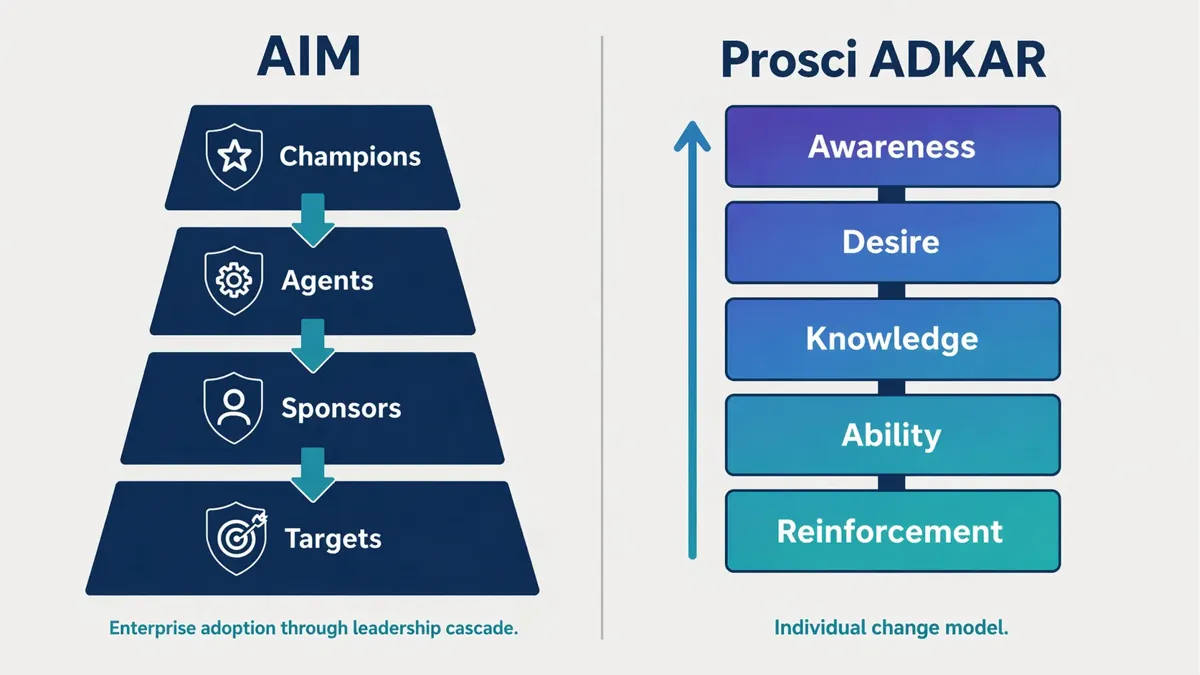
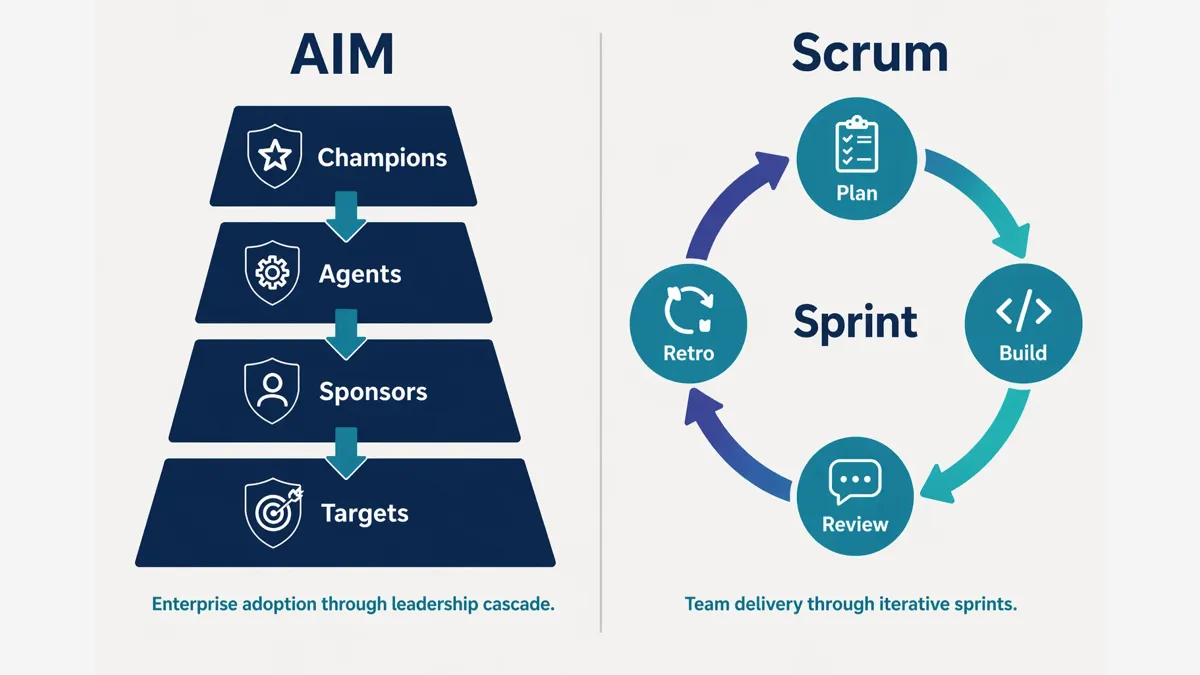
Enterprise Implementation vs Team-Level Delivery
AIM vs Scrum Adoption: Enterprise Implementation Methodology vs Team-Level Delivery Framework
Scrum defines how a team delivers work iteratively. AIM addresses why organizations struggle to sustain the behaviors Scrum requires. The two operate at different levels and layer cleanly together: Scrum inside the team, AIM across the leadership chain that determines whether the team's new way of working actually persists.
At a Glance
The Two Approaches at a Glance
AIM and Scrum address different levels of the organizational change problem. Scrum is a lightweight team-level framework for delivering complex products through iterative sprints, defined roles, and inspect-and-adapt ceremonies. IMA Worldwide (Implementation Management Associates) AIM provides the leadership accountability and reinforcement architecture that determines whether Scrum adoption sustains beyond the trained team.
AIM (IMA Worldwide)
- Origin: Don Harrison, IMA Worldwide, 40+ years of field research
- Primary unit: The organization as a system
- Structure: 10 Practice Areas, 35+ validated assessments
- Best fit: Enterprise behavioral adoption that crosses leadership levels
Scrum
- Origin: Ken Schwaber and Jeff Sutherland, Scrum Guide, 1995 onward
- Primary unit: The single Scrum team
- Structure: 3 roles, 5 events, 3 artifacts
- Best fit: Team-level iterative product delivery
Framework Overview
What is Scrum as a Team-Level Framework?
AIM vs Scrum is a comparison between a structured enterprise implementation methodology and a lightweight team-level delivery framework that differ in whether they address organizational adoption or team-level product delivery.
Scrum is a lightweight team-level framework for delivering complex products through iterative development. Originally described by Ken Schwaber and Jeff Sutherland in The Scrum Guide, Scrum defines three roles (Product Owner, Scrum Master, Developers), five events (Sprint, Sprint Planning, Daily Scrum, Sprint Review, Sprint Retrospective), and three artifacts (Product Backlog, Sprint Backlog, Increment). Scrum does an excellent job of answering one specific question: how should a team organize and deliver work iteratively.
Scrum is intentionally silent on what directors, VPs, and executives must do to support Scrum adoption. That is by design: Scrum is a team framework, not an enterprise change framework. But it means that the organizational leadership behaviors that determine whether Scrum persists are left to other approaches.
Core Scrum Elements
Three Defined Roles
Product Owner, Scrum Master, and Developers form a self-managing team with clear accountability boundaries for what to build, how to build it, and how the process runs.
Five Events
Sprint, Sprint Planning, Daily Scrum, Sprint Review, and Sprint Retrospective create a regular cadence for planning, executing, inspecting, and adapting.
Three Artifacts
Product Backlog, Sprint Backlog, and Increment provide transparency into what is planned, what is in progress, and what has been delivered.
Inspect and Adapt
Sprint retrospectives and reviews create feedback loops that allow the team to continuously improve its own practice and delivery.
Scrum Core Strengths
- Clear, minimal framework that is easy to understand and adopt at the team level
- Regular cadence creates predictable delivery rhythm and transparency
- Inspect-and-adapt ceremonies enable continuous team-level improvement
- Self-management empowers teams to own their process and commitments
- Widely adopted with extensive community, tooling, and certification infrastructure
Scrum Key Limitations
- Silent on executive and management behavior required to sustain adoption
- Does not address organizational reward systems, performance reviews, or promotion criteria
- No framework for cascading sponsorship through the leadership hierarchy
- Team-level feedback loops do not diagnose organizational system barriers
- Trained teams routinely revert when the surrounding environment contradicts Scrum values
Methodology Overview
What is AIM?
IMA Worldwide's AIM (Accelerating Implementation Methodology), created by Don Harrison on the basis of 40+ years of applied research across 12+ industries, is a structured implementation methodology designed to ensure successful adoption by addressing both technical and human dimensions of transformation. AIM treats the organization as a system and makes leadership accountability the primary driver of sustained adoption.
The core principles include defining change in observable behavioral terms, building agent capacity, generating active sponsorship, developing communication, and engineering reinforcement. AIM is the only widely used change methodology that prescribes specific non-delegable tasks for sponsors and uses validated diagnostic instruments to measure whether those tasks are actually being performed in the field.
AIM addresses the question Scrum leaves open: why are people not actually adopting the new way of working, and what specific leadership actions will close the gap? It treats resistance as predictable and proportional to disruption rather than as a personality problem.
Where Scrum asks "how should the team organize and deliver work iteratively?", AIM asks "why is the organization not adopting this change, and who is accountable for fixing that?"
Side-by-Side Analysis
How do AIM and Scrum compare side by side?
| Dimension | Scrum | AIM |
|---|---|---|
| Primary Focus | Team-level iterative delivery through self-management | Structured change management addressing human and organizational factors |
| Origin and Authorship | Ken Schwaber and Jeff Sutherland, Scrum Guide, 1995 onward | Don Harrison, IMA Worldwide, 40+ years of field research |
| Cultural Change Approach | Assumes team self-management will produce cultural change | Explicitly manages resistance through stakeholder engagement and reinforcement |
| Executive Sponsorship | Not directly defined; left external to the framework | Central role with 6 non-delegable tasks and ongoing accountability |
| Training and Support | Role-based training (Product Owner, Scrum Master) focused on team practices | Comprehensive change programs integrated across the leadership cascade |
| Measurement Approach | Sprint retrospectives, velocity, and team-level inspect-and-adapt | 35+ validated assessments including TRI and IRF |
| Approach to Change | Iterative sprints with continuous team-level inspection and adaptation | Iterative, with emphasis on behavioral adoption across the enterprise |
| Best Fit | Team-level iterative product delivery | Enterprise behavioral adoption that crosses leadership levels |
Common Ground
Where do AIM and Scrum agree?
Despite operating at different levels of the change problem, AIM and Scrum share several foundational beliefs about how change should be approached.
Shared Principles
- Change is fundamentally iterative and feedback loops, not one-time launches, move adoption forward
- Measurement is essential, even though each measures different things
- A single launch event does not deliver value: AIM through its installation-versus-implementation distinction (deploying a solution technically versus getting people to use it in ways that produce results), Scrum through its sprint cadence
- Both have evolved from decades of field experience rather than academic theory alone
- Both place high value on observable behavior over stated intent
Shared Rejections
- Both reject the idea that awareness and training alone produce lasting behavior change
- Both reject rigid, waterfall-style implementation plans that ignore real-time conditions
- Both reject the assumption that initial planning can anticipate all implementation challenges
- Both reject measuring change success solely through activity completion rates
Worth noting. Most Scrum adoption challenges are not actually Scrum problems. The framework is sound. What stalls is the organizational reinforcement environment around the team: performance reviews, promotion criteria, resource allocation, and management expectations that still reward pre-Scrum behaviors.
The Core Distinction
Where do AIM and Scrum diverge most sharply?
The single sharpest divergence is what each treats as the primary lever. Scrum treats team self-management and the sprint cadence as the primary levers. AIM treats leadership reinforcement as the primary lever, applying the Express-Model-Reinforce (EMR) framework which quantifies the relative impact of three leader behaviors: what leaders express has 1x impact, what leaders model has 2x impact, and what leaders reinforce has 3x impact. McKinsey research on transformation success rates consistently finds that programs without structured reinforcement architecture fail at significantly higher rates.
Scrum Addresses:
- How a team should organize and deliver work iteratively
- What roles, events, and artifacts create delivery transparency
- How sprint retrospectives enable continuous team-level improvement
- How self-management empowers teams to own their commitments
- How velocity and predictability metrics track team performance
AIM Addresses:
- Why trained teams revert to pre-Scrum behaviors within months
- Which leadership behaviors actively undermine or reinforce adoption
- Whether performance reviews and promotion criteria support the new way of working
- Whether sponsors are performing the six non-delegable tasks
- Whether organizational reward systems align with team-level expectations
The second sharp divergence is executive sponsorship. AIM defines six non-delegable leadership tasks that only the leader can perform: communicating the business case, participating in goal setting, allocating resources, aligning reward systems, cascading involvement to direct reports, and monitoring progress constantly. Prosci's Best Practices in Change Management research identifies active and visible executive sponsorship as the single strongest predictor of project success. Scrum is silent on executive behavior. Leaders often unintentionally undermine Scrum adoption by continuing to assign work directly to individuals, demanding fixed-scope commitments, and rewarding individual heroics.
The third divergence is diagnostic precision at the organizational level. AIM provides 35+ validated assessment tools across 10 practice areas, including the Targeted Reinforcement Index (TRI), the Implementation Risk Forecast (IRF), and the Cultural Assessment Survey Tool (CAST). These tools diagnose the specific constraint blocking adoption. Scrum relies on the sprint retrospective and velocity metrics. Both kinds of measurement are valuable, but they answer different questions: Scrum measures whether the team is improving its own practice, while AIM measures whether the surrounding organization is reinforcing that practice. IMA's analysis of why transformation changes fail shows that adoption fading is almost always traceable to reinforcement gaps that team-level retrospectives cannot detect.
Choosing the Right Framework
When should an organization choose AIM over Scrum alone?
The framing is rarely AIM-instead-of-Scrum, because they operate at different levels. Choose to lead with AIM when the primary risk is organizational rather than delivery-related. Specific indicators include:
Past Scrum Rollouts Have Stalled
Despite well-trained Scrum Masters and Product Owners, teams have reverted to waterfall behaviors within a quarter of certification.
Leaders Say the Right Things but Reward the Old Behaviors
Executive sponsors verbally support Scrum but performance reviews, promotion criteria, and resource allocation still reward pre-Scrum behaviors.
Change Crosses Multiple Business Units
The transformation affects multiple business units, geographies, or functional areas that require coordinated leadership alignment across the management hierarchy.
Team Maturity Has Not Produced Business Outcomes
A prior agile rollout has reached team maturity but is not producing the business outcomes the original business case promised. The bottleneck is the leadership cascade, not the team-level practice.
Integration Approach
How do enterprise teams combine AIM and Scrum?
The strongest agile transformations combine both. Unlike frameworks that are in direct competition, Scrum and AIM address sufficiently different levels of the change problem that they layer cleanly together when deployed with clear intent about what each is being used for.
Scrum Contributes:
- Clear team-level roles, events, and artifacts for iterative delivery
- Sprint cadence that creates predictable delivery rhythm
- Retrospectives that enable continuous team-level improvement
- Self-management that empowers teams to own their commitments
- Velocity and predictability metrics for delivery transparency
AIM Contributes:
- Executive sponsorship with six non-delegable leadership tasks
- Express-Model-Reinforce framework to align leadership behavior
- 35+ validated diagnostic tools that pinpoint organizational barriers
- Performance management alignment to structurally reinforce new behaviors
- Management-layer engagement that team-level ceremonies do not reach
The Combined Value
Establish executive sponsorship early using AIM so that commitment is in place before the first Scrum team launches. Teach leaders the six non-delegable sponsor tasks and the EMR framework so they understand which of their behaviors actively undermine Scrum and which actively reinforce it. Combine Scrum's sprint retrospective with AIM's reinforcement diagnostics so the team is not the only feedback loop in the system.
Frequently Asked Questions
AIM vs Scrum: Frequently Asked Questions
What is the difference between AIM and Scrum?
AIM (Accelerating Implementation Methodology) is a structured implementation methodology that addresses the human and organizational factors determining whether change is sustained at the enterprise level. Scrum is a lightweight team-level delivery framework defining roles, events, and artifacts for iterative product development. AIM provides leadership accountability and reinforcement architecture; Scrum provides the team structure for iterative delivery.
Why do Scrum adoptions stall outside the trained team?
Trained Scrum teams routinely revert to pre-Scrum behaviors when the organizational environment around them still rewards individual heroics, fixed-scope commitments, and direct task assignment that bypasses the Product Owner. Scrum does not prescribe what directors, VPs, or executives must do to support adoption. AIM identifies the specific leadership and reinforcement gaps that cause regression.
How does AIM complement Scrum?
AIM addresses the leadership behaviors and reinforcement systems Scrum leaves outside its scope. AIM defines six non-delegable executive sponsor tasks, embeds the Express-Model-Reinforce framework, and provides validated diagnostic tools that pinpoint why adoption is fading. Combining the two increases the likelihood that team-level Scrum practice translates into sustained enterprise adoption.
Can AIM and Scrum be used together?
Yes. Scrum supplies the team structure, ceremonies, and artifacts for iterative delivery; AIM supplies the executive sponsorship, behavioral change management, and reinforcement architecture that determine whether Scrum adoption sustains beyond the trained team. The two operate at different levels and layer cleanly together.
Which approach is better for organizational change?
The most effective Scrum rollouts combine both. Scrum delivers team-level discipline and a cadence for inspect-and-adapt. AIM addresses the broader organizational change management and leadership behaviors that determine whether Scrum adoption persists. Change management research consistently finds that active executive sponsorship cascading through every leadership level is the single strongest predictor of sustained adoption.
Summary
The Bottom Line
AIM and Scrum are complements, not competitors. Scrum defines how a team delivers work iteratively. AIM addresses why organizations often struggle to sustain the behaviors Scrum requires. Most Scrum adoption challenges are not Scrum problems; they are leadership reinforcement gaps. The framework is sound. The adoption methodology is often the missing piece, and it is the missing piece AIM was built to provide.
- AIM is the right choice when the leadership cascade and reinforcement are the bottleneck
- Scrum is the right choice when team-level delivery discipline is the bottleneck
- The two layer cleanly together in enterprise agile transformation
Methodology Comparison Series
Related resources from IMA Worldwide
AIM goes head-to-head with the most widely used change management frameworks. Explore each comparison or see the full overview.