
Accelerating Implementation Methodology
Resistance to Change: Why It Happens, What Actually Works, and What Doesn't
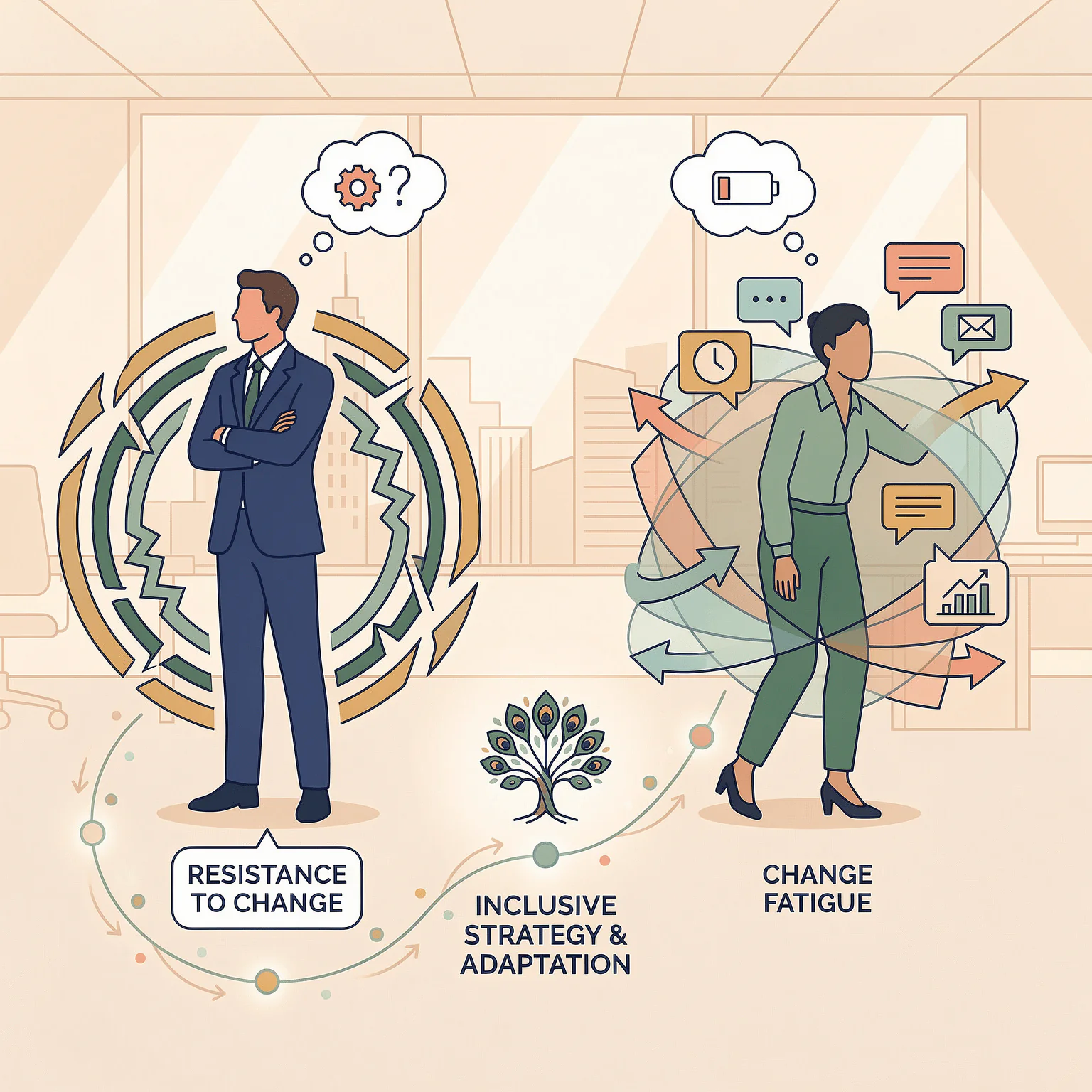
Resistance is not an attitude problem. It is diagnostic data about gaps in your implementation system.

Common Resistance Patterns
Before diagnosing causes, recognize what resistance looks like in practice. These five patterns appear across industries and organization sizes.
Lip-Service Support
Leaders say the right things in meetings but do not change their own behavior. Teams notice the disconnect and mirror it.
Training Without Adoption
Completion rates look strong but day-to-day behavior remains unchanged. The knowledge exists; the reinforcement does not.
Silent Resistance
No vocal opposition, but adoption never materializes. This is the most dangerous form because it avoids detection until it is too late.
Compliance Without Commitment
People follow the new process when watched but revert as soon as oversight lifts. Surface adoption masks deep resistance.
Selective Adoption
Teams adopt the easy parts and skip the behaviors that require the most disruption. Partial adoption delivers partial results.
The 5 Real Causes of Resistance to Change
Resistance is not one thing. AIM identifies five distinct root causes, each requiring a different intervention. Treating them as interchangeable is why generic approaches fail.
Perceived Loss
The change threatens something the person values: status, autonomy, expertise, relationships, or job security. The loss does not need to be real. It needs to be perceived.
Trust Deficit
Past experiences with poorly managed change create skepticism. People who have been burned by failed initiatives protect themselves by disengaging early.
Low Confidence in Personal Ability
The person doubts their capacity to succeed in the new environment. This is not about willingness. It is about perceived competence.
Substantive Disagreement
The person genuinely believes the change is wrong. This is the most rational form of resistance and often contains valid feedback about design flaws.
Poor Change Experience Design
The implementation itself creates unnecessary friction: confusing timelines, contradictory communications, inadequate support. The change is fine; the rollout is not.
The Psychology Behind Resistance
The five causes above manifest through well-documented psychological mechanisms. Understanding the science helps leaders depersonalize resistance and treat it as system feedback.
Loss Aversion
People feel losses roughly twice as intensely as equivalent gains. A change that takes away familiar routines is felt more deeply than the benefits it promises.
Status Quo Bias
The current state is the reference point. Any deviation carries perceived risk, even when objective analysis favors the change.
Fear of the Unknown
Ambiguity about future roles, responsibilities, and expectations triggers threat responses. Clarity is the antidote, not persuasion.
Identity and Competence Threats
When a change redefines what "good performance" looks like, people who excelled under the old system feel their professional identity is at risk.
Resistance is not irrational. It is a rational response to perceived threats in the system. The goal is not to overcome the person. It is to fix the system.
Disruption Predicts Resistance
AIM's core insight: resistance intensity correlates directly with disruption level. The greater the change to someone's daily work, the stronger the resistance. This is not a character flaw. It is physics.
| Disruption Level | What Changes | Expected Resistance | Intervention Required |
|---|---|---|---|
| Low | Tools or processes | Minor friction | Communication + training |
| Medium | Workflows and reporting | Active questioning | Involvement + goal setting |
| High | Roles and responsibilities | Organized pushback | Sponsor cascade + reinforcement |
| Extreme | Identity, culture, values | Deep, sustained resistance | Full EMR deployment + ongoing monitoring |
What Doesn't Work and Why Organizations Keep Trying It
Before discussing what works, it helps to name the four approaches that consistently fail. Organizations default to these because they feel productive, not because they are effective.
More Communication
Communication addresses only the Express layer (1x impact). Without modeling and reinforcement, messages become noise. People do not resist because they lack information. They resist because the system has not changed around them.
More Training
Training builds knowledge and ability but fails when the real gap is willingness or missing reinforcement. People complete courses and return to an environment that rewards the old behavior.
Mandating Compliance
Mandates produce surface-level conformity that reverts the moment external pressure lifts. Compliance without commitment is not adoption. It is delayed resistance.
Ignoring It
Unaddressed resistance goes underground where it hardens and spreads. What starts as individual hesitation becomes cultural norm. Early intervention is orders of magnitude cheaper than late rescue.
Each of these approaches treats symptoms rather than root causes. Effective resistance management requires diagnosing which of the five causes is driving the behavior and matching the intervention accordingly.
The Communication Trap
Communication is necessary but grossly insufficient. AIM's Express-Model-Reinforce framework explains why:
Express
What leaders say. Communication, announcements, town halls. Most organizations over-invest here.
Model
What leaders do. Resource allocation, personal adoption, visible behavior change.
Reinforce
What leaders reward. Aligned performance reviews, recognition, consequences. Carries 3x the weight of communication.
When leaders communicate the change but continue rewarding old behavior, the message is clear: this change is optional. Reinforcement is where adoption becomes permanent.
Why Middle Managers Get Crushed
Pressure From Above
▼ ▼ ▼
▲ ▲ ▲
Resistance From Below
Middle managers experience the most role disruption while simultaneously being asked to lead their teams through change. They are caught between executive expectations and team resistance, expected to champion something they may not yet understand themselves.
The squeeze: Executives set direction. Front-line employees follow it. Middle managers must translate strategy into daily operations while their own roles are being redefined underneath them.
The result: Without explicit sponsorship from above and structured support, middle managers become the bottleneck, not because they resist, but because they are under-resourced for a dual role nobody designed.
This is why AIM's sponsor cascade treats middle management as the critical layer. Skip it, and you create the Black Hole.
Resistance Reflects Organizational Culture
The form resistance takes is shaped by the organization's culture. Interventions must match the culture, not fight it.
Analytical Culture
Resistance appears as endless requests for data, pilot studies, and proof of concept. These organizations need evidence before commitment. Provide it early.
Risk-Averse Culture
Resistance appears as process delays, committee reviews, and consensus-seeking. Reduce perceived risk through incremental rollouts and reversibility.
Hierarchical Culture
Resistance appears as waiting for permission and upward delegation. The sponsor cascade must be explicit and visible. If leadership does not move, nobody moves.
The 5 Elements of Change Readiness
Resistance is the symptom. Readiness gaps are the diagnosis. AIM measures five elements to identify exactly where intervention is needed.
Information
Do people understand what is changing and why?
Willingness
Are they motivated to participate?
Ability
Do they have the skills and resources?
Confidence
Do they believe they can succeed?
Control
Can they influence how change happens?
The Implementation Risk Forecast measures these elements across the organization and maps gaps to specific interventions.
5 Evidence-Based Strategies for Managing Resistance
Each strategy targets a specific root cause and readiness gap. Apply the right strategy to the right problem.

Sponsor-Led Direct Engagement
Leaders with positional authority engage targets face-to-face. Addresses trust deficit and perceived loss. Change agents cannot substitute for leadership presence.
Structured Involvement
Bring affected groups into the design process. Addresses substantive disagreement and increases control. People support what they help create.
Skill-Building and Support
Targeted training paired with on-the-job reinforcement. Addresses low confidence and builds ability. Training alone is not enough; practice environments and coaching close the gap.
Transparent Communication
Honest, specific, ongoing information about what is changing, what is not, and what is still undecided. Addresses information gaps and reduces fear of the unknown.
Improved Change Experience Design
Fix the rollout itself: clarify timelines, reduce unnecessary disruption, provide adequate resources. Addresses poor change experience design directly.
5 Monday Morning Actions
Strategy is long-term. These are immediate. Five actions any leader or change agent can execute this week.
Ask the Disruption Question
Ask employees directly: "What specifically changes in your daily work, and what concerns you most?" Listen for perceived loss, not just logistics.
Audit Reinforcement
Check whether consequences actually reward adoption and penalize non-adoption. If the old way is still easier and carries no downside, adoption is optional.
Check One Level Up
Verify the direct manager above the resistance is actively expressing, modeling, and reinforcing the change. Most resistance traces to a sponsorship gap one level above.
Depersonalize It
Stop framing resistance as an attitude problem. Treat it as diagnostic data about system gaps. This single reframe changes how leaders engage with resistant teams.
Contract Behaviors
Replace vague "support the change" commitments with specific, time-bound behavioral agreements. "For the next two weeks, you will use the new system for all customer entries." Concrete beats aspirational.
Measuring Success: Three KPI Categories
You cannot manage what you do not measure. Track these three categories throughout the change lifecycle.
Pulse surveys measuring sentiment, willingness, and understanding at regular intervals throughout the change process.
Speed and depth of new process or system adoption. Not completion rates. Actual behavioral change in daily work.
Productivity, quality, and efficiency data before and after implementation. The business case lives or dies here.
Who Owns What: Sponsors vs HR
Executive Sponsors
- Provide authority and organizational mandate
- Allocate budget, people, and time
- Align change with strategic goals
- Perform the 6 non-delegable tasks
HR Leaders
- Facilitate communication and engagement strategies
- Partner with sponsors on the people dimension
- Design training and skill-building programs
- Monitor readiness data and surface gaps
AIM vs. Traditional Approaches to Resistance
Three widely used frameworks. One is structured for measurable adoption. The others offer guidance without diagnostic specificity.
| Dimension | AIM | Kotter (8-Step) | Lewin (Unfreeze-Change-Refreeze) |
|---|---|---|---|
| Resistance model | 5 diagnosed root causes with matched interventions | Addressed through urgency and coalition | Addressed during "unfreeze" phase |
| Sponsor accountability | Structured cascade with 6 non-delegable tasks | Coalition of "powerful" stakeholders | Not explicitly addressed |
| Readiness assessment | 5-element diagnostic (Information, Willingness, Ability, Confidence, Control) | General readiness via urgency gauge | Readiness implied by successful unfreeze |
| Measurement | Leader 360, Implementation Risk Forecast | Milestone tracking | No formal diagnostic tools |
| Reinforcement | EMR framework: Express 1x, Model 2x, Reinforce 3x | "Anchor in culture" (step 8) | "Refreeze" as final phase |
| Evidence base | 40+ years of field research across industries | Case study driven | Foundational social psychology |
For a deeper comparison, see AIM vs. Prosci vs. Kotter.
Frequently Asked Questions
What causes resistance to change in organizations?
Five root causes drive resistance: perceived loss of something valued, trust deficit with leadership, low confidence in personal ability to succeed, substantive disagreement with the direction, and poor change experience design. Each cause requires a different intervention. Treating resistance as one phenomenon is why most approaches fail.
Why do employees resist change even when it benefits them?
People feel losses roughly twice as intensely as equivalent gains. A change that removes familiar routines, relationships, or expertise is experienced as a real loss even when the future state promises greater rewards. Acknowledging what is being lost is the first step toward moving through resistance.
Why doesn't more communication reduce resistance to change?
Communication operates at the lowest impact level. Without leaders modeling the change and reinforcing it through aligned consequences, messages become noise. People watch what leaders do and what gets rewarded, not what gets announced. Reinforcement carries three times the impact of communication.
Why do middle managers resist change more than other employees?
Middle managers face the highest role disruption while simultaneously being expected to lead the change for others. They are both targets whose work changes and sponsors who must cascade change downward. Without explicit support for this dual role, resistance at this layer is predictable.
How do you measure resistance to change?
Track three categories: employee engagement through sentiment data, adoption rates measuring actual behavioral change rather than training completion, and performance metrics comparing productivity before and after. Ongoing measurement detects silent resistance that surveys and feedback channels miss.
Why do people revert to old behaviors after adopting a change?
People revert because the reinforcement system still rewards old behavior. Without aligned consequences, performance goals, and recognition tied to the new way of working, employees naturally return to what the system incentivizes. Reinforcement, not communication, is what makes adoption permanent.
What is the difference between overcoming resistance and managing resistance to change?
Overcoming implies resistance is a barrier to defeat. Managing treats it as diagnostic data revealing system gaps. Resistance is a symptom, not the problem itself. You manage it by identifying which readiness gaps are producing it and closing those gaps through targeted leadership action.
How do you get employees to buy into organizational change?
Stop trying to sell it. Instead, involve employees in the design, equip them with needed skills, have their direct leader set clear expectations, and align rewards with adoption. Buy-in is a consequence of a well-designed system with proper leadership reinforcement, not a communication campaign.
You've Tried Communication. It's Not Working.
Find What's Actually Driving the Resistance
Diagnose the real gaps, align leadership involvement, and build a reinforcement system that makes adoption permanent.
No pitch. No pressure. Just clarity on what is actually happening.
Continue Learning
Leadership Involvement in Change Management
The 6 non-delegable tasks and how sponsorship cascades prevent the Black Hole.
Why Employees Resist Change
The employee-centric lens: 5 behaviors that look like resistance but are not.
Why Middle Managers Resist Change
The dual-role squeeze and how to support the most critical adoption layer.
The EMR Framework
Express-Model-Reinforce: why reinforcement carries 3x the impact of communication.
Reinforcement in Change Management
How to build reinforcement into organizational systems so adoption sticks.
What Is AIM?
The full Accelerating Implementation Methodology and how resistance management fits within it.
AIM vs. Prosci vs. Kotter
Side-by-side comparison of leading change management frameworks.
AIM Tools and Assessments
Leader 360, Implementation Risk Forecast, and the full diagnostic suite.