
What Is AIM? › Installation vs. Implementation
Installation vs Implementation: Closing the Gap Between Go-Live and Go-Adopt
Installation puts the system in place. Implementation gets people using it. One is a technical milestone. The other determines whether you see a return on your investment.
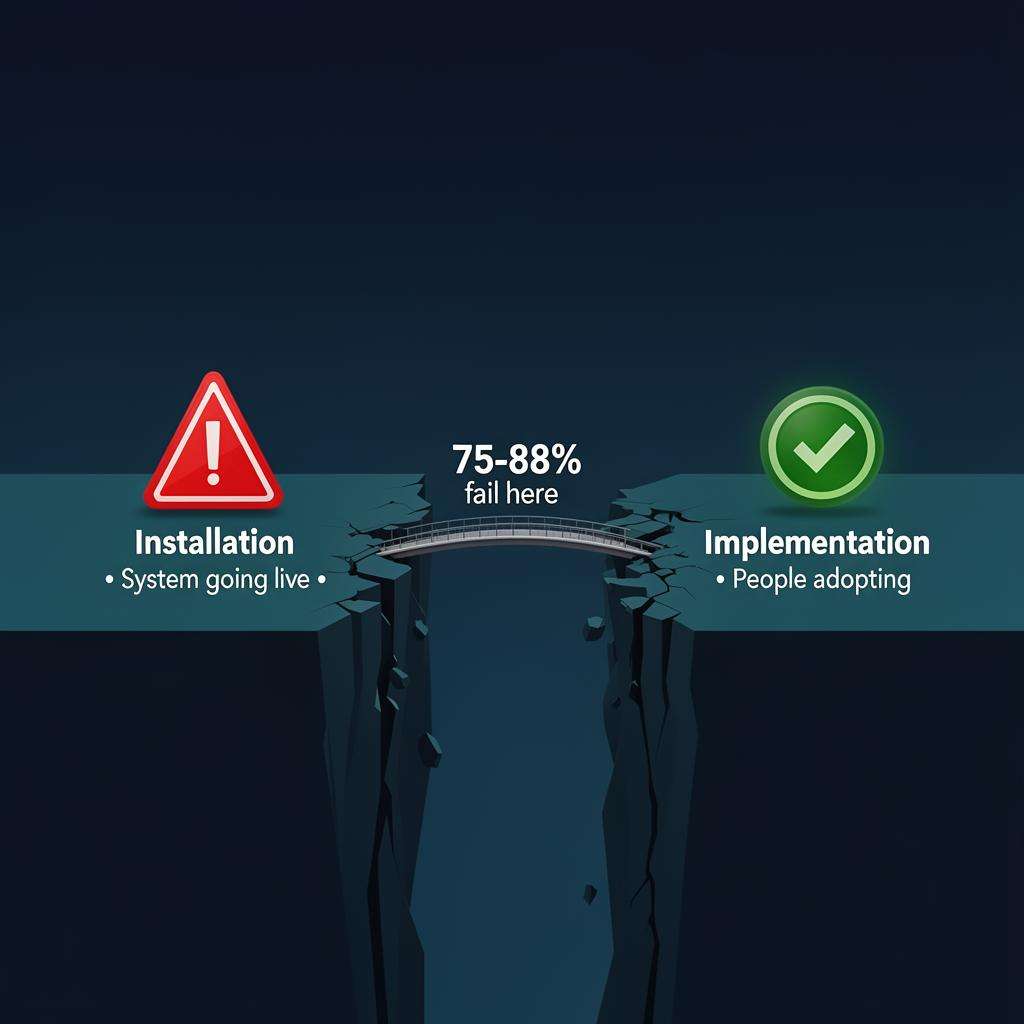
Setup vs Adoption ROI | IMA Worldwide
Installation covers the technical steps: configuring software, migrating data, and ensuring the new tools run as intended. Implementation is the human work that follows: changing habits, decisions, and daily routines so people actually use the new capabilities. Both are required for impact. Technology without behavior change delivers little sustained value.
What organizations typically measure and celebrate
The technical milestone. Necessary but not sufficient.
- System goes live on schedule
- Technical requirements met
- Users trained on features
- Documentation delivered
- Go-live celebrated
- Project team disbanded
What actually determines success
The human milestone. Where ROI is won or lost.
- People actually use the system
- Old behaviors replaced with new
- Business outcomes achieved
- Reinforcement systems active
- Adoption sustained over time
- ROI realized

Installation is necessary but not sufficient. You can have a perfect technical deployment and still fail to achieve a single business objective if people do not change their behaviors. Installation delivers capability. Behavioral adoption converts capability into outcomes.
Why Most Change Management Initiatives Fail After Go-Live
Many initiatives stall after go-live because they underestimate the behavioral work needed post-deployment. Without continued investment, initial momentum fades and intended benefits never materialize. The go-live milestone is not the endpoint. It is the handoff to sustained adoption.
Training Complete — 100% ready
Project team celebrates. System is live. Everyone trained. Adoption assumed.
Workarounds start. Usage dropping.
Friction surfaces. People find shortcuts. Old habits begin competing with new ones.
Old habits return. Adoption stalls.
Without reinforcement, the default is reversion. New behaviors never became habits.
Business case erodes. ROI at risk.
Promised benefits have not materialized. Stakeholders question the investment. The gap between installation and implementation has cost the organization its return.
Common Post Go-Live Challenges
Some groups embrace the new way quickly while others lag, creating operational gaps and uneven results.
Unclear roles or unresolved process questions slow decisions and disrupt workflows just when momentum is needed.
Even with metrics in place, organizations miss targets because users have not fully adopted new practices. The system is installed. The behavior is not.
Sponsors who endorsed the change at launch move on. Without continued visible leadership, teams lose clarity and the effort fades into business as usual.
How to Measure Implementation Success: The 5 Metrics
IMA's AIM defines success by five metrics. All five must be achieved for implementation success. Most organizations measure only the first two and declare victory without confirming the last three.
Did the project launch on schedule?
Did the project stay within financial constraints?
Does the system function as designed and specified?
Are the intended business outcomes being achieved?
Are people performing the specific observable behaviors that make the change work? This is where most organizations have no answer.
If You Can't See It, You Can't Change It
AIM requires that human objectives be defined in observable, specific terms. The test: if you walked past someone's workspace, could you observe whether the new behavior is happening? If you cannot observe it, you cannot measure it. If you cannot measure it, you cannot reinforce it. And if you cannot reinforce it, you cannot sustain it.
Abstract — Cannot Be Managed
- "People have buy-in"
- "Teams are engaged"
- "Leaders are aligned"
- "People embrace the new system"
- "Commitment exists"
You cannot see these from across the room.
Observable — Can Be Measured and Reinforced
- Sales team logs CRM entries daily
- Managers conduct safety briefings weekly
- Nurses use the new handoff protocol
- Engineers submit code reviews before merge
- Finance team runs month-end close in the new system
You CAN see these from across the room.
"A behavior is something you can see from across the room. Abstract concepts like buy-in, engagement, and alignment cannot be observed, measured, or reinforced. If you define success in terms you cannot observe, you have no way to know whether implementation is actually occurring — only whether installation was completed."
Express, Model, Reinforce: The EMR Framework
What leaders say has the least impact on adoption. What they do matters more. What they reward and reinforce matters most. AIM's EMR framework quantifies this relationship.
If the organization continues to reward old behaviors through performance reviews, resource allocation, promotions, and attention, people will return to old behaviors regardless of training or communication. Changing the reinforcement system is not optional. It is the mechanism through which installation becomes implementation.
The 6 Non-Delegable Leadership Tasks
The installation-implementation gap exists largely because modern delivery frameworks systematically removed visible leadership from implementation work. Leaders were taught to delegate to project teams. But behavioral adoption requires leaders to personally perform six tasks that no project manager or consultant can perform on their behalf.
Leaders must personally communicate why the change is necessary, with specificity and conviction. Not delegating to communications teams.
Leaders must be personally involved in shaping what implementation success looks like, including the human objectives.
Real resource allocation signals real commitment. Leaders who claim the change is a priority but fund it minimally undermine adoption.
If performance systems reward old behaviors, the change will fail regardless of training. Reinforcement systems must change.
Sponsorship cannot jump organizational levels. Leaders must activate the managers below them. This is how adoption scales.
Active monitoring lets leaders intervene before implementation stalls. Waiting for quarterly reviews is too late.
These tasks can be supported by change agents but cannot be performed by them.
Why Organizations Stop at Installation
The reasons are structural, not intentional:
"The distinction between installation and implementation was developed through more than 40 years of research at IMA into why changes fail. This research revealed that most organizations measure installation success while failing to measure or manage implementation success."
Peacock Hill Consulting powered by IMA WorldwideHow AIM Closes the Installation-Implementation Gap
The Accelerating Implementation Methodology bridges technical delivery and human adoption. AIM puts leadership accountability, targeted reinforcement, and continuous feedback at the center of implementation. Closing the gap requires three specific shifts.
Define Human Objectives
Identify the specific, observable behaviors that must change alongside technical and business objectives. If you cannot describe the new behavior in terms you could see from across the room, you do not yet have a human objective. Without these, implementation has no target.
Activate Leadership Involvement
Deploy AIM's 6 non-delegable leadership tasks so that sponsors personally express commitment, model new behaviors, and reinforce adoption with their direct reports. Cascade this involvement through every organizational level. Adoption cannot outrun sponsorship.
Design Reinforcement Systems
Using the EMR framework, redesign what gets measured, rewarded, and recognized so it supports the new way of working, not the old. This means changing performance reviews, recognition programs, resource allocation signals, and the daily conversations leaders have with their teams.
AIM Diagnostic Tools
AIM provides validated diagnostic tools to identify exactly where gaps exist before they stall adoption: the Implementation History Assessment (IHA), the Implementation Risk Assessment (IRA), the Target Readiness Indicator (TRI), and the Implementation Readiness Forecast (IRF). These tools surface structural blockers early, when intervention costs less.
Frequently Asked Questions: Installation vs Implementation
Find Out Where Your Initiative Sits on the Installation-Implementation Spectrum
In a 30-minute call, we will identify where your initiative sits on the installation-implementation spectrum and show you which AIM diagnostics apply to your situation.