
They’re not blocking progress. They’re absorbing disruption from every direction while being told to lead others through it.
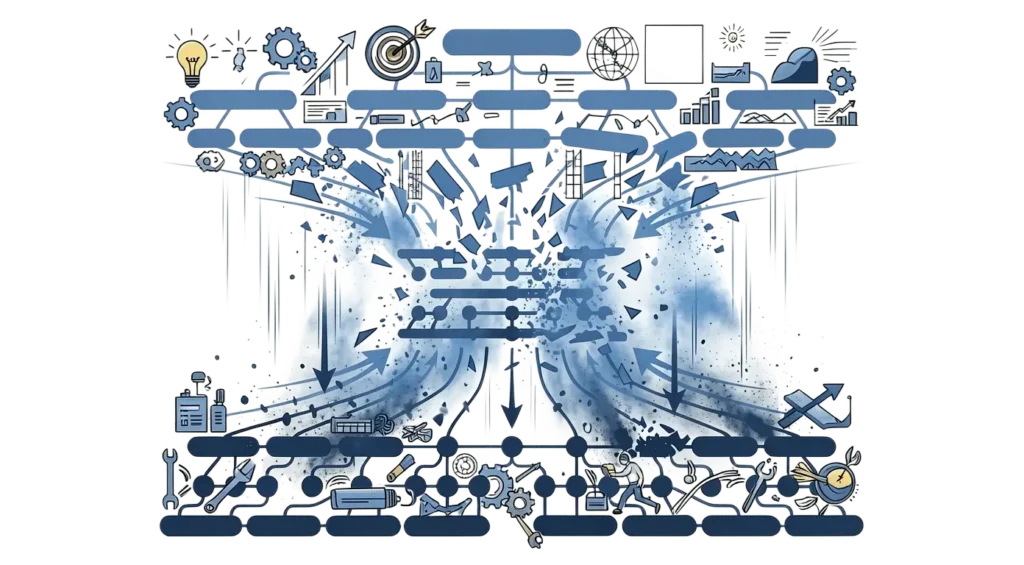
She built the team, designed the workflows, trained every person in it. Last Thursday, her VP pulled her into a conference room and told her the company was moving to a new platform. Now she has to get her team to adopt it by Q3.
Nobody asked for her input on the decision. Nobody adjusted her targets. And the question of what happens to her role when the system she built gets replaced — that still hasn't come up.
She went back to her desk and started figuring out how to make it work — with everything else still on her plate.
Peacock Hill Consulting applies the Accelerating Implementation Methodology (AIM), developed through 40+ years of research at Implementation Management Associates (IMA). That research has a name for what Sarah is experiencing. Specifically, it's not resistance. It's the predictable result of structural conditions that nobody addressed before asking her to lead.
What's Really Happening?
Four structural conditions create middle manager resistance. None of them are about attitude.
- "I learned about the change the same week my team did — there wasn't time to prepare."
- "My targets haven't changed, but now I'm also measured on adoption metrics I don't directly control."
- "When I raise operational concerns, they're interpreted as resistance rather than risk identification."
- "The expectations changed, but the support structure around me stayed the same."
1
What It Actually Feels Like in the Middle
▾
A middle manager during a transformation isn't operating in one role. In practice, they're juggling at least four at once: target of the change (their own work is disrupted), agent (expected to drive adoption), sponsor (supposed to reinforce new behaviors), and still a performer (held to every operational metric they had before).
As a result, AIM identifies this as the "manager squeeze" — the pressure that builds when someone is expected to sponsor change they haven't been prepared for, with resources that haven't been adjusted, under timelines they didn't set.
Source: McKinsey, "Stop Wasting Your Most Precious Resource: Middle Managers," 2023
The people with the highest vested interest in the current system are typically the ones who built their success inside it.
Why This Isn't About Attitude
Middle managers didn't just learn the existing way of working. They mastered it. That's not a small disruption — it's a direct threat to professional identity.
2
The Rules Changed, the Scoreboard Didn't
▾
The organization announced a transformation. Leadership told everyone to adopt new behaviors. But when the middle manager looks at their performance review, their bonus structure, their dashboards — nothing has changed. In other words, they're hearing "change" and experiencing "more of the same, plus this."
Meanwhile, the manager heard the message (Express = 1×). But their VP hasn't visibly adopted the new way of working (Model = 2× — missing). And the reward system still reflects the old expectations (Reinforce = 3× — missing).
The Numbers Tell the Story
"If you do not change the reinforcement, you do not get the change."
— AIM Implementation Research
3
The Question That Rarely Gets Asked
▾
Underneath the operational pressure and the misaligned metrics, however, is something that rarely makes it into a steering committee deck: the middle manager is facing an identity crisis.
They built their career inside the current system. In fact, they were promoted because they excelled at it. Now someone is telling them the way things work today is wrong — and they need to lead the replacement.
That's not a knowledge gap. It's a deeper question: Will I still matter after this is done?
As a result, the identity threat doesn't just affect them privately. It also affects their ability to commit — and their team's willingness to follow:
The question that most often goes unasked: "What do you need in order to commit?" Not "do you understand." Not "are you on board." A genuine inquiry into the conditions that would make adoption possible.
4
What Would Actually Help Them
▾
The fix isn't persuasion or motivation or better talking points. Instead, it's structural repair — closing the gap between what the organization asks and what it has done to prepare them.
In AIM's framework, this gap has a name: the black hole. It forms when active sponsorship drops out at a level in the management chain — because the leader wasn't prepared, wasn't equipped, or wasn't clear on what sponsorship requires.
When sponsorship breaks at any level, every level below it goes dark.
The Manager's Diagnostic View
If you're a middle manager recognizing your own experience, this is a structural pattern, not a personal failure. The sponsorship cascade likely has a gap above your level.
Ask yourself: Has your direct leader personally shown the new behaviors? Have your metrics shifted to reflect the change? Did anyone give you genuine preparation before asking you to lead your team through this?
If the answer to any of these is no, then the sponsorship cascade broke before it reached you.
Treat as Targets First
Before asking managers to champion change, their own leader must help them through it — addressing information, willingness, ability, confidence, and control.
Contract for Specifics
"Please support this" is not a plan. Instead, define exactly what behaviors you expect, what resources you're providing, and what changes in their metrics.
Build Through Them
Sponsorship must flow through each level in sequence. Otherwise, skipping the middle creates excitement at the top and confusion where it matters.
"If you do not take the time to build the circuitry — cascading sponsorship — when you flip the switch at the top, the lights will not come on."
— AIM Implementation Research
5 Things Their Leaders Can Do This Week
This isn't a list for middle managers — they've already been given enough lists. Rather, these are the actions Peacock Hill Consulting sees transform adoption rates when organizations commit to them.
Ask each manager: "What would you need to commit to this?" Not "are you on board" — the real question.
Audit what's measured, rewarded, and recognized. When reinforcement still reflects previous priorities, the system signals the old way while the strategy asks for the new.
Every transformation adds work. Identify one responsibility that can be deferred, delegated, or paused. If everything is a priority, nothing is.
Visible leadership adoption carries twice the impact of communication. Using the new tools and following the new process gives managers the proof point they need to commit — and to lead.
Map the sponsorship chain from authorizing leader to frontline. Identify where active commitment thins out and strengthen the cascade at that level.
Why Implementation Sponsorship Fails
The six non-delegable tasks most leaders don't know they're skipping — and the cascade pattern that determines adoption.
Change Fatigue Is a Capacity Problem
When organizations launch more than people can absorb, sequencing — not communication — is the fix.
AIM (Accelerating Implementation Methodology) is applied by Peacock Hill Consulting and is grounded in 40+ years of implementation research from Implementation Management Associates (IMA).
resistance, change management, middle managers, employees, middle management, organizational change
middle management reistance to change, the crisis deck sarah mitchell, IMA Worldwide emr
Frequently Asked Questions on Why Middle Managers Resist Change
Why do middle managers resist change?
Middle managers resist change because they experience the most structural disruption during transformations. They are expected to maintain operational results while leading teams through changes they may not have been prepared for. According to AIM (Accelerating Implementation Methodology), applied by Peacock Hill Consulting, resistance is a function of disruption — not understanding or personality — and middle managers occupy the position of highest disruption in most organizational changes.
What is a black hole in implementation?
A black hole is a commitment vacuum that forms when a leader in the management chain opts out of active sponsorship or tries to delegate it to a change team. When sponsorship breaks at any management level, every level below loses access to genuine commitment. The result: the change stalls and the levels below the black hole never fully adopt.
What is cascading sponsorship?
Cascading sponsorship is the process of building commitment level by management level down an organization. Unlike cascading messages, cascading sponsorship requires each leader to personally Express, Model, and Reinforce the change for their direct reports. It cannot skip levels — doing so creates a black hole where commitment disappears.
Why doesn't more communication fix middle manager resistance?
More communication assumes the problem is a knowledge deficit. But implementation research through AIM (Accelerating Implementation Methodology) shows resistance is driven by disruption, not understanding. Middle managers who resist often understand the change clearly — they are responding to structural conditions like unchanged performance metrics, unreduced workloads, and misaligned reward systems. Communication without changed reinforcement increases cynicism rather than adoption.
What is the Express-Model-Reinforce (EMR) framework?
EMR is a framework within AIM (Accelerating Implementation Methodology), applied by Peacock Hill Consulting, that defines how leaders build commitment during change. Express means what leaders say (1x impact). Model means what leaders visibly do (2x impact). Reinforce means what leaders reward, recognize, and apply consequences for (3x impact). When these three elements are misaligned — when leaders say one thing but reinforce another — adoption fails because the system sends contradictory signals.
What does "treat managers as targets first" mean?
It means that before asking middle managers to lead change for their teams, their own leaders must first help them through the adoption process. Managers need five elements of readiness: information about why the change is happening, willingness to participate, ability to perform new behaviors, confidence they can succeed, and a sense of control over their environment. Until these are addressed, asking managers to sponsor change produces resistance.
How do you activate middle managers during a transformation?
Activate middle managers by treating them as targets first, contracting for specific sponsorship behaviors instead of vague support, and cascading sponsorship level by management level. Additionally, audit reinforcement systems to confirm new behaviors are actually being rewarded, and reduce operational demands to create capacity for the change work.
What are the six non-delegable leadership tasks in change?
According to AIM research, the six non-delegable leadership tasks are: establish the business case for the change, participate in goal setting, allocate adequate resources, align reward systems with adoption, cascade sponsorship through the management chain, and monitor progress constantly. These tasks cannot be handed off to change agents or communication teams.
What is the difference between installation and implementation?
Installation means the technical deployment of a change — the system goes live, the process launches, the reorganization takes effect. Implementation means people actually change their behavior and sustain new ways of working. Most organizations declare success at installation, but the real value comes from implementation. The gap between the two is where middle manager resistance lives.
How do you know if your organization has a sponsorship black hole?
Common symptoms include: senior executives are committed but frontline employees are confused, implementation is moving slowly despite strong CEO support, managers say they support the change but take no visible action, change agents are working harder with decreasing results, and there is confusion about priorities below a certain management level. Mapping the sponsorship cascade and assessing each level reveals where commitment breaks down.
Stop Blaming the Middle. Start Diagnosing the Structure.
Peacock Hill Consulting helps organizations identify the structural gaps that create middle manager resistance — and close them using diagnostic assessments, not assumptions.
Why Choose AIM?