

Structural Accountability vs Adaptive Experimentation
AIM vs Lean Change Management: Structural Accountability vs Adaptive Experimentation
Lean change management optimizes how you deliver change initiatives. AIM addresses whether people in your organization are actually changing their behavior. Both matter, and knowing when to apply each one is the difference between efficient activity and real adoption.
At a Glance
AIM vs Lean: The Two Approaches at a Glance
AIM and Lean Change Management address different dimensions of organizational transformation. Lean optimizes processes by eliminating waste and improving flow. Unlike process-focused approaches, the AIM methodology from IMA Worldwide (Implementation Management Associates) uniquely diagnoses why people do not adopt new behaviors and what organizational systems must change to make adoption permanent.
Lean Change Management
- Origin: Jason Little, 2014 book and ongoing community practice
- Primary unit: The local change context and stakeholder group
- Structure: Insights, Options, Experiments cycle
- Best fit: Emergent, exploratory, team-level change
AIM (IMA Worldwide)
- Origin: Don Harrison, IMA Worldwide, 40+ years of field research
- Primary unit: The organization as a system
- Structure: 10 Practice Areas, 35+ validated assessments
- Best fit: Complex, multi-stakeholder enterprise transformation
Methodology Overview
What is Lean Change Management?
AIM vs Lean change management is a comparison between structured and flexible change methods: a structured organizational implementation methodology and an iterative process-optimization approach that differ in whether they address the change delivery process or the organizational system barriers to adoption.
Lean change management applies the principles of Lean thinking, rooted in the Toyota Production System and later adapted for knowledge work, to the practice of managing organizational change. Rather than deploying large, pre-planned change programs based on assumptions about what people need, Lean change management uses short feedback cycles to learn what is working, what is creating resistance, and how the change approach should be adjusted in real time.
The methodology was formalized by Jason Little in his work on Lean Change Management and draws on concepts from Lean, Agile, and organizational learning. Its central mechanism is the change canvas, a visual planning tool that helps change teams co-create interventions with employees rather than delivering change to them. The emphasis is on minimum viable change and iterative experimentation: delivering the smallest intervention that produces the desired shift and iterating from there.
Core Lean Principles
Iterative Experimentation
Test small change interventions, gather feedback, and adjust rather than executing large pre-planned programs.
Eliminate Waste
Remove change activities that do not add value, including unnecessary meetings, redundant communications, and over-engineered plans.
Co-creation
Involve employees in designing change interventions rather than delivering change programs designed solely by leadership or practitioners.
Just-in-Time
Deliver change support and training at the moment it is needed, not weeks in advance when it will be forgotten before use.
Fast Feedback Loops
Build mechanisms to surface what is and is not working quickly, so adjustments can be made before resistance becomes entrenched.
Continuous Improvement
Apply the same kaizen mindset to the change process itself: always seek to improve how the organization manages change.
Lean CM Core Strengths
- Iterative delivery reduces the risk of large, misdirected change programs
- Co-creation builds employee ownership and reduces resistance
- Aligns naturally with agile software delivery and continuous improvement cultures
- Fast feedback loops surface problems early when they are easier to address
- Reduces waste in change management activities
Lean CM Key Limitations
- Primarily optimizes the change process, not the organizational system
- Does not provide a structural framework for sponsor accountability
- Cultural and structural barriers require systemic intervention, not iteration
- Middle management resistance is not addressed by process efficiency
- Business outcome measurement requires supplemental frameworks
Methodology Overview
What is AIM?
The AIM methodology (Accelerating Implementation Methodology) from IMA Worldwide, created by Don Harrison, creator of the Accelerating Implementation Methodology and founder of IMA Worldwide, is an organizational change framework designed to diagnose and address the system-level factors that prevent behavior adoption in complex organizations. AIM's research across thousands of implementations shows that change fails not because the change process is inefficient, but because the organizational system, including leadership behavior, cultural norms, performance management structures, and management layer resistance, is working against adoption.
AIM uses organizational diagnostic assessment tools to surface these barriers at the start of and throughout implementation, then assigns clear accountability to sponsors and line managers for addressing them. Success is measured not through process quality or training completion, but through whether target populations are performing the new required behaviors and whether those behaviors are producing the business outcomes that justified the change investment.
Because AIM targets universal organizational system factors rather than culturally specific process assumptions, it has been applied successfully across industries and geographies, making it adaptable to cross-cultural implementation environments where local management norms vary significantly. Organizations seeking to build internal capability can pursue AIM change management training and certification.
Where Lean asks "how can we improve how we are running this change?", AIM asks "why is the organization not adopting this change, and who is accountable for fixing that?"
Side-by-Side Analysis
How do AIM and Lean Change Management compare side by side?
| Dimension | Lean Change Management | AIM |
|---|---|---|
| Primary Focus | Optimizing the change delivery process through iteration | Diagnosing and removing organizational system barriers to adoption |
| Core Mechanism | Minimum viable change, fast feedback, co-creation | Organizational diagnostic, sponsor cascade, adoption measurement |
| Leadership Model | Co-creation and employee engagement; leaders as enablers | Structured sponsor accountability cascade through management hierarchy |
| Measurement | Change process effectiveness; feedback loop quality | Business outcomes and adoption indicators tied to case for change |
| Continuous Improvement | Core principle applied to the change process itself | Applied through ongoing diagnostic re-assessment during implementation |
| Resistance Handling | Surface early through short feedback loops; adjust approach | Diagnose systemic sources; assign sponsor accountability to address them |
| Alignment Context | Agile, DevOps, continuous improvement cultures | Complex enterprise transformation, embedded behavior change |
| Reinforcement | Iterative learning and process adjustment | Performance management alignment and structural consequence systems |
Common Ground
Where do AIM and Lean Change Management agree?
Despite operating at different levels of the change problem, AIM and Lean Change Management share several foundational beliefs about how organizational change should be approached.
Shared Principles
- Pre-planned, assumption-heavy change programs carry significant failure risk
- Feedback from the people affected by change must inform implementation decisions
- Resistance is a signal to be understood, not a problem to be overcome through force
- Continuous improvement applies to both the change process and the change outcomes
- Traditional top-down, communication-heavy approaches are insufficient on their own
Shared Rejections
- Both reject the idea that awareness and training alone produce lasting behavior change
- Both reject rigid, waterfall-style implementation plans that ignore real-time conditions
- Both reject the assumption that initial planning can anticipate all implementation challenges
- Both reject measuring change success solely through activity completion rates
Worth noting. People can co-create a new process and still revert to old behaviors if the reward system reinforces the old way. Co-creation builds commitment. Reinforcement sustains behavior. AIM addresses both.
The Core Distinction
Where do AIM and Lean Change Management diverge most sharply?
When comparing structured and flexible change approaches, the most important distinction between Lean change management and AIM is the level of the problem each is designed to solve. Lean optimizes the change process itself. AIM addresses the organizational conditions that determine whether behavior change actually occurs.
Lean Change Management Addresses:
- How efficiently change interventions are designed and delivered
- Whether employees are co-creating change or receiving it passively
- Whether feedback loops are short enough to enable rapid adjustment
- Whether change activities are delivering value or generating waste
- How well change management integrates with agile delivery cycles
AIM Addresses:
- Which organizational system factors are blocking adoption
- Whether sponsors are actively and visibly accountable for adoption
- Whether management layers are aligned or creating mixed messages
- Whether performance management systems reinforce new behaviors
- Whether the cultural environment supports or undermines the change
The AIM methodology addresses this gap directly: McKinsey research confirms that organizations with strong implementation discipline are 5.4x more likely to succeed, yet an organization can run a highly efficient, iterative, waste-free change process and still fail to achieve adoption if the organizational system is working against it. Prosci's Best Practices in Change Management research consistently identifies active and visible executive sponsorship as the top contributor to success, and Conversely, strong sponsor accountability and reinforcement architecture can produce adoption even without a perfectly optimized change process. When adoption fades after initial momentum, the root cause is almost always structural, as IMA's analysis of why transformation changes fail demonstrates. Understanding which problem is the bottleneck determines which framework to deploy.
Lean Limitations
When is Lean Change Management not enough on its own?
Lean change management works well for optimizing how change interventions are designed and delivered. However, certain organizational conditions require intervention at a level that process optimization alone cannot reach.
Sponsor Disengagement
When senior leaders are not visibly and consistently reinforcing the change, iterating on the change process faster will not compensate for the lack of leadership accountability.
Management Layer Resistance
Middle managers who are actively or passively blocking adoption require structural intervention, not process optimization. No amount of iteration addresses a manager who is undermining the change.
Cultural Misalignment
When the organizational culture, reward systems, or performance metrics actively contradict the desired behaviors, process improvements cannot overcome systemic structural conflicts.
Choosing the Right Framework
When should an organization choose AIM over Lean Change Management?
Organizations should choose the AIM methodology when the change challenge involves systemic organizational barriers rather than process inefficiency. Specific indicators include:
Multiple Stakeholder Groups
The change affects multiple business units, geographies, or functional areas that require coordinated leadership alignment across the management hierarchy.
Behavioral Adoption Required
Success depends on people actually performing new behaviors, not simply accepting a new tool or process. The gap is between knowing and achieving behavioral adoption.
Sponsor Cascade Needed
The change requires visible, active sponsorship at multiple levels of the organization, and that sponsorship is currently absent or inconsistent.
Structural Reinforcement
Performance management systems, cultural norms, or incentive structures need structural reinforcement to be realigned to support the desired new behaviors.
Integration Approach
How do enterprise teams combine AIM and Lean Change Management?
Unlike frameworks that are in direct competition, Lean change management and AIM address sufficiently different levels of the change problem that they can be genuinely complementary when deployed with clear intent about what each is being used for.
Lean CM Contributes:
- Iterative planning that responds to real-time feedback from employees
- Efficient design of communication, training, and support interventions
- Co-creation practices that build employee ownership and reduce passive resistance
- Natural alignment with agile delivery teams and sprints
- Waste reduction in the change management function itself
AIM Contributes:
- Organizational diagnostic that identifies systemic blockers before they derail the project
- Structured sponsor accountability that the iterative process alone cannot create
- Performance management alignment to reinforce new behaviors structurally
- Business outcome measurement framework that validates adoption
- Management-layer engagement that co-creation practices may not reach
The Combined Value
Organizations running agile transformations or technology implementations often find that Lean change management surfaces adoption issues quickly while AIM provides the organizational accountability structures to actually resolve them. Together they address both the process and the system.
Frequently Asked Questions
AIM vs Lean Change Management: Frequently Asked Questions
What is Lean change management?
Lean change management applies Lean thinking principles, originally developed for manufacturing process improvement, to the practice of managing organizational change. It emphasizes iterative experimentation, eliminating waste from change processes, co-creating change with employees rather than deploying it top-down, and using short feedback loops to adapt quickly. It is closely associated with agile and continuous improvement environments.
How does AIM differ from Lean change management?
Lean change management focuses on optimizing the change process itself through iteration and waste elimination, adapting approaches based on rapid feedback loops. AIM focuses on diagnosing and removing the organizational system barriers that prevent behavior adoption. Lean asks how to run the change process more efficiently; AIM asks what in the organization is blocking people from actually changing their behavior.
Can AIM and Lean work together?
Yes, and they often complement each other well. Lean change management's iterative process design and fast feedback loops can surface implementation issues early. AIM's organizational diagnostic and sponsorship framework then provides the structural accountability and systemic intervention needed to address those issues at the leadership and management layer rather than through process adjustment alone.
Which approach is better for digital transformation?
Digital transformations typically require both levels of intervention. Lean change management aligns well with agile delivery cycles and technology rollouts that evolve iteratively. AIM addresses the organizational side of digital transformation: sponsor engagement, management accountability, cultural resistance to new ways of working, and ensuring that technology adoption translates into actual business behavior change rather than shelfware.
How does Lean change management differ from AIM in its focus on process vs behavior?
Lean change management treats the change process itself as the subject for optimization, applying principles like minimum viable change, just-in-time delivery of interventions, and continuous feedback. AIM focuses on the behavioral and organizational system outcomes of the change, diagnosing why people are not adopting new behaviors and assigning structural accountability to address those barriers.
How do AIM and Lean change management differ in their measurement approach?
Lean change management typically measures the effectiveness and efficiency of change interventions themselves, using feedback loops to iterate and improve the change delivery approach. AIM measures adoption outcomes linked to the business case for the change, tracking whether target groups are actually performing the new required behaviors and whether those behaviors are producing the expected business results.
Summary
The Bottom Line: Structured vs Flexible Change Methods
Lean change management and AIM are not competing methodologies but rather structured and flexible change methods that operate at different levels of the organizational change problem. Lean focuses on process optimization in delivery. AIM addresses the organizational system conditions that determine whether adoption actually happens.
For organizations running agile or continuous improvement initiatives, Lean change management provides an efficient, iterative approach to delivering change interventions. When the challenge extends beyond process efficiency into leadership accountability, management alignment, cultural barriers, and structural reinforcement of new behaviors, AIM provides the diagnostic and accountability framework needed to produce lasting adoption.
The most effective enterprise implementations combine both: using Lean's iterative process design to deliver interventions efficiently while relying on AIM's organizational diagnostic and sponsor cascade to ensure the system itself supports the change. To explore how this integration applies to your organization, learn about IMA's change management consulting services.
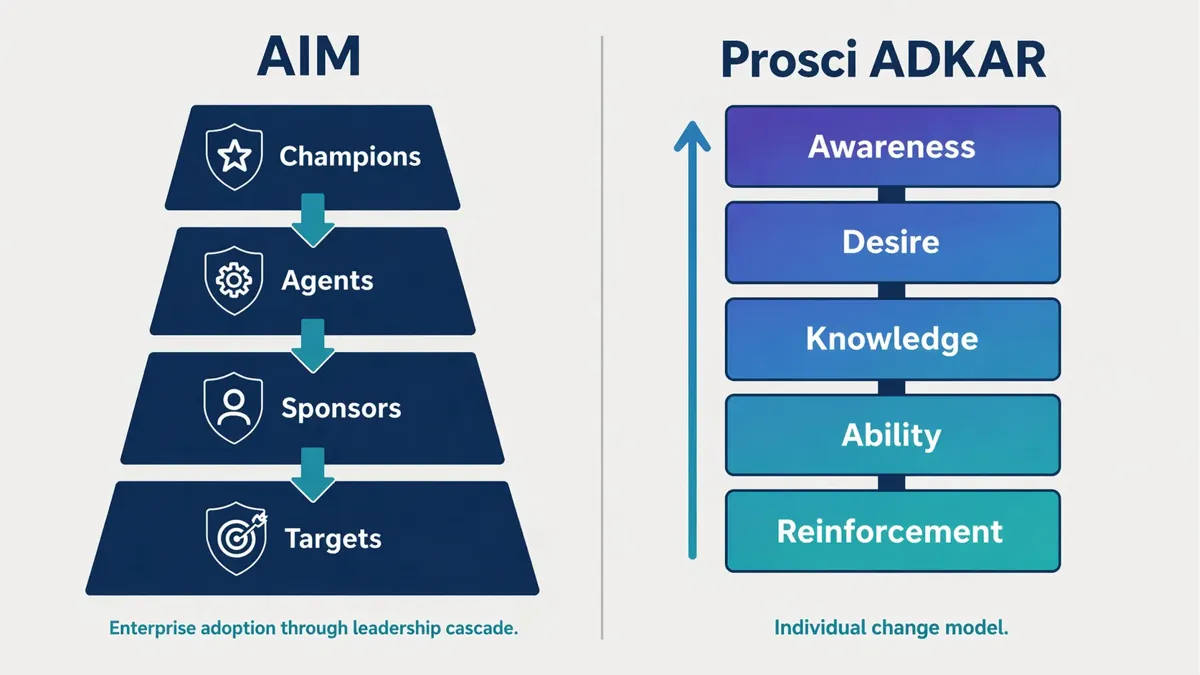
- AIM is the right choice when leadership cascade and reinforcement are the bottleneck
- Lean Change Management is the right choice when emergence and co-creation are the bottleneck
- The two layer cleanly together in complex enterprise transformation
Methodology Comparison Series
Related resources from IMA Worldwide
AIM goes head-to-head with the most widely used change management frameworks. Explore each comparison or see the full overview.

Combine Process Excellence with Behavioral Implementation
IMA Worldwide consultants use the AIM methodology to help organizations running Lean or agile initiatives address the organizational system barriers that process optimization alone cannot remove. Contact us to discuss your implementation challenge.