
Comparing Change Management Models
AIM Methodology vs Kotter's 8-Step Process: Diagnostic Accountability vs Sequential Momentum in Organizational Change
Kotter's 8-Step process creates urgency and momentum. The AIM methodology diagnoses what is actually blocking adoption and assigns accountability to fix it. Understanding the difference changes how you approach complex organizational change and change management strategy.
Two Organizational Change Approaches at a Glance
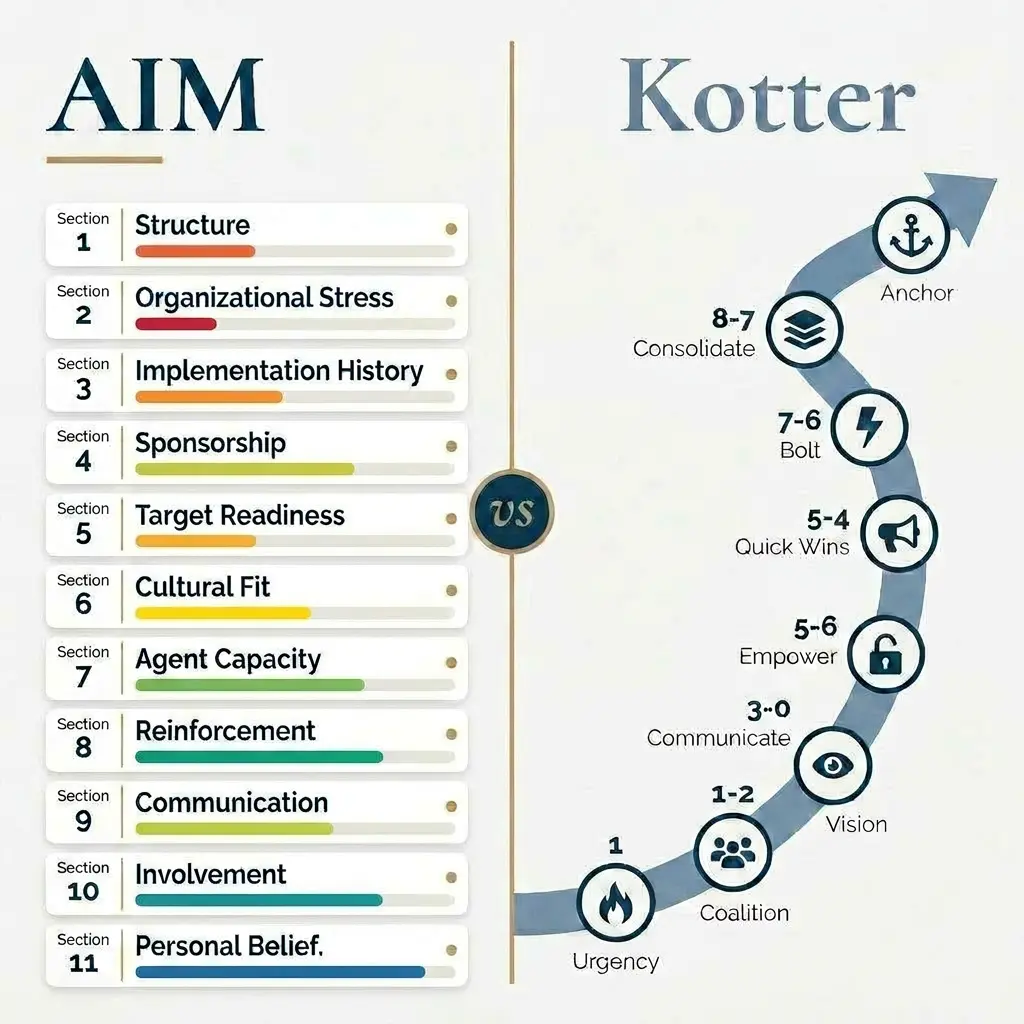
The AIM methodology and Kotter's 8-Step process differ in how they structure organizational change management. Kotter prescribes a linear, top-down sequence from urgency to anchoring. Unlike sequential models, the AIM methodology from IMA Worldwide (Implementation Management Associates) is purpose-built as a diagnostic system that identifies which organizational conditions are blocking adoption and addresses them simultaneously rather than in fixed phases. This distinction matters for any change management strategy involving complex workflows, software adoption, or enterprise-wide organizational behavior shifts.
Kotter: Sequential Momentum
- Origin: John Kotter, 1996 book Leading Change; 2014 update Accelerate
- Primary unit: The guiding coalition and the change narrative
- Structure: 8 sequential steps
- Best fit: Stable, top-down transformation needing urgency and coalition
AIM: Diagnostic Accountability
- Origin: Don Harrison, IMA Worldwide, 40+ years of field research
- Primary unit: The organization as a system
- Structure: 10 Practice Areas, 35+ validated assessments
- Best fit: Complex, multi-stakeholder enterprise transformation
Methodology Overview
What is Kotter's 8-Step Process for Organizational Change?
The AIM methodology vs Kotter's 8-Step process is a comparison between a structured change management methodology and a leadership-driven change model that differ in their approach to measurement, accountability, and organizational behavior.
John Kotter's 8-Step Process for Leading Change was first published in 1996 based on his research into why major organizational change efforts succeed or fail. The model became one of the most widely cited change management frameworks in business, adopted by organizations across industries seeking a structured narrative for organizational transformation and project management alignment.
Kotter's model is built around the concept of creating and sustaining momentum for change. It begins with generating a compelling sense of urgency and builds through coalition formation, vision and strategy development, and action, culminating in anchoring the changes in organizational culture. The framework is explicitly sequential: Kotter argues that skipping steps or proceeding out of order produces the illusion of progress without the underlying structural transformation required for lasting organizational change.
Create a Sense of Urgency
Establish urgency around a compelling opportunity or threat to break through organizational complacency.
Build a Guiding Coalition
Assemble a group with enough power and credibility to lead the change effort.
Form a Strategic Vision
Develop a clear vision and strategy to direct the transformation.
Enlist a Volunteer Army
Communicate the vision to rally a broad base of people who want to drive change.
Enable Action by Removing Barriers
Remove obstacles and change systems or structures that undermine the change vision.
Generate Short-Term Wins
Plan for and create visible performance improvements to build momentum and credibility.
Sustain Acceleration
Use increasing credibility to change systems, structures, and policies that do not align with the vision.
Institute the Change in Culture
Anchor new approaches in the organizational culture to ensure lasting transformation.
Core Strengths
Kotter Core Strengths
- Simple, memorable framework easy to communicate enterprise-wide
- Strong emphasis on urgency and momentum generation
- Widely known, reducing adoption friction for leadership
- Addresses coalition building and volunteer energy
- Explicitly connects change to culture as a final objective
Key Limitations
Kotter Key Limitations
- Sequential model that can struggle in non-linear change environments
- Does not provide organizational diagnostic tools
- Sponsor accountability is implied, not structurally assigned
- No formal measurement framework for adoption outcomes
- Resistance handling relies on coalition influence rather than structural intervention
Methodology Overview
What is the AIM Change Management Methodology?
IMA Worldwide's AIM methodology (Accelerating Implementation Methodology), created by Don Harrison over more than 40 years of applied research and consulting, was developed from decades of field work across complex organizational change initiatives. The AIM methodology's research across thousands of implementations shows that where Kotter's 8-Step process describes what transformation should look like in sequence, the AIM methodology asks what is actually preventing adoption right now, and who is specifically accountable for addressing it.
AIM uses organizational diagnostic tools to identify the specific system-level factors that are creating resistance or drag, then deploys targeted change management interventions and assigns clear sponsor accountability at each level of the management hierarchy. Organizations that want to build internal capability can pursue change management training in the AIM methodology. The methodology is adaptive by design, meaning the interventions prescribed at any given point depend on what the current diagnostic reveals, not on a predetermined sequence of phases.
Critically, AIM measures success not through process milestone completion, but through adoption indicators tied directly to the business outcomes that justified the change management investment in the first place. This includes measuring whether organizational behavior has actually shifted, whether new workflows and software tools are being used as intended, and whether productivity gains are sustained.
Side-by-Side Analysis
How do the AIM methodology and Kotter's 8-Step process compare side by side?
| Dimension | Kotter 8-Step | AIM |
|---|---|---|
| Structural Approach | Sequential, prescriptive eight-phase process | Diagnostic, adaptive framework guided by ongoing assessment |
| Starting Point | Create urgency as the first phase | Diagnose organizational factors before prescribing interventions |
| Leadership Model | Guiding coalition of influential leaders and volunteers | Structured sponsor cascade with assigned line accountability |
| Resistance Handling | Remove barriers in step five; rely on coalition influence | Diagnose systemic resistance sources; assign sponsor accountability to address them |
| Culture Treatment | Culture addressed in step eight as an endpoint outcome | Cultural norms diagnosed as a factor throughout implementation |
| Measurement | Short-term wins and milestone progress | Business results and adoption indicators tied to case for change |
| Urgency vs Readiness | Urgency is the foundation and first step | Readiness is assessed diagnostically, including organizational capacity |
| Change Environment | Best suited to stable, top-driven transformation | Suited to complex, multi-stakeholder, and dynamic environments |
Common Ground
Where do the AIM methodology and Kotter agree on organizational change?
Despite their structural differences, both the AIM methodology and Kotter's 8-Step process share several foundational principles about organizational change management:
- Leadership engagement is non-negotiable for successful organizational change
- Resistance to change must be actively addressed rather than ignored
- Change management communication plays a central role in driving adoption
- Short-term results matter for sustaining long-term commitment
- Organizational behavior and culture are critical factors in whether change endures
- Change requires deliberate, structured strategy rather than ad-hoc responses
Both change management methodologies reject the notion that announcing a change is sufficient to achieve it. They share the view that organizational change requires sustained, intentional action from organizational leaders.
Worth noting. Kotter himself acknowledged in his 2014 book Accelerate that the original 8-step formulation was top-down and reflected the stable corporate environments in which he developed it. The dual-operating-system extension he proposed addresses the linearity problem but still does not provide structural sponsor accountability or organizational diagnostics.
Core Philosophy
Where do AIM and Kotter diverge most sharply?
The philosophical difference between Kotter's 8-Step process and the AIM methodology shapes everything about how each change management approach is deployed in practice. McKinsey research confirms that organizations with strong implementation discipline and change management strategy are significantly more likely to achieve their transformation goals. Prosci's Best Practices in Change Management research consistently identifies active and visible executive sponsorship as the top contributor to success. When adoption fades after initial momentum, the root cause is almost always structural, as IMA's analysis of why transformation changes fail demonstrates. Understanding this distinction helps change management practitioners select the right framework for their organizational change situation.
Sequence vs Diagnosis
Kotter prescribes a fixed order. Step one must precede step two. AIM prescribes interventions based on what the current diagnostic reveals, regardless of where the organization is in its timeline.
Coalition vs Cascade
Kotter's guiding coalition is a volunteer team of influential champions. AIM's sponsor cascade assigns structural accountability to every level of the management hierarchy, making sponsorship a job requirement rather than a volunteer activity.
Urgency vs Readiness
Kotter starts by manufacturing urgency. AIM starts by assessing organizational readiness, capacity, and the specific barriers that must be resolved before interventions can succeed.
Culture as Endpoint vs Factor
Kotter treats culture as the final step, an outcome that emerges after sustained behavioral change. AIM treats culture as a diagnostic factor that must be assessed and addressed throughout, not only at the conclusion.
Framework Limitations
When does Kotter's 8-Step process fall short as a change management model?
According to IMA Worldwide's research, Kotter's sequential change management model encounters difficulty in specific organizational change conditions:
- Complex, multi-initiative environments where multiple organizational changes compete for attention and resources simultaneously
- Situations where resistance is structural rather than motivational, requiring system-level change management intervention beyond coalition influence
- Organizations where middle management layers have historically blocked change, and informal influence alone cannot resolve the organizational behavior barrier
- Transformations requiring measurable adoption outcomes tied to business cases and project management governance, not just milestone completion
- Dynamic environments where software deployments, workflow changes, and the broader change landscape shift faster than a sequential eight-phase model can accommodate
- Governance contexts that require clear, assigned accountability and change management strategy rather than volunteer-based coalitions
These limitations do not make Kotter's 8-Step process invalid. They identify organizational change conditions where a diagnostic, adaptive change management approach like the AIM methodology may produce stronger outcomes.
Best Fit Scenarios
When should an organization choose the AIM methodology over Kotter's 8-Step process?
The AIM methodology is the stronger change management choice when the organization's organizational change challenge matches these conditions:
Kotter Is a Strong Fit When:
- The primary barrier is organizational complacency or inertia
- Leadership needs a simple, communicable narrative for the transformation
- A guiding coalition with strong organizational credibility exists or can be built
- Short-term wins are achievable and can generate visible momentum
- The change environment is relatively stable and top-down in nature
- Creating urgency around a burning platform is the right strategic move
AIM Is a Stronger Choice When:
- Resistance is structural, not just motivational
- Middle management layers are known blockers of prior change efforts
- Sponsor accountability needs to be structurally assigned, not assumed
- The change environment is complex, non-linear, or involves multiple initiatives
- Business outcome measurement is required by governance or investment owners
- Cultural alignment needs diagnosis at every phase, not just at the end
Integration Strategy
How do enterprise teams combine the AIM methodology and Kotter for change management?
Some organizations use Kotter's 8-Step process as a high-level narrative framework to communicate the organizational change journey to employees, while applying AIM's diagnostic tools and sponsorship structures to manage change management implementation at the organizational system level. The two can be complementary if teams are clear about which change management framework drives tactical decisions, project management governance, and accountability.
In practice, enterprise teams that combine both change management frameworks typically use Kotter's model for stakeholder communication and executive storytelling, while deploying AIM's structured sponsor cascade and diagnostic assessments to manage the operational reality of adoption. Organizations seeking guidance on this integration can work with change management consulting teams experienced in both frameworks. This integration requires explicit strategy decisions about which framework owns which domain of the organizational change program, including software rollouts, workflow redesign, and productivity improvement initiatives.
Frequently Asked Questions
AIM Methodology vs Kotter's 8-Step Process: Frequently Asked Questions
What are Kotter's 8 steps for leading change?
Kotter's 8-Step Process for Leading Change is a sequential model developed by John Kotter of Harvard Business School. The steps are: create urgency, build a guiding coalition, form a strategic vision, enlist a volunteer army, enable action by removing barriers, generate short-term wins, sustain acceleration, and institute change. The model emphasizes creating and sustaining organizational momentum for transformation.
How does AIM compare to Kotter 8-Step?
Kotter's model is prescriptive and sequential, designed to generate top-down organizational momentum through eight defined phases. AIM is diagnostic and adaptive, identifying specific organizational barriers at each stage of implementation and addressing them based on ongoing assessment rather than a fixed sequence. AIM assigns structured sponsor accountability; Kotter relies on a guiding coalition and volunteer energy.
Which model is better for culture change?
Kotter's model explicitly addresses culture in its final step, treating it as an outcome of sustained behavior change. AIM treats culture as a diagnostic factor throughout implementation, identifying cultural norms and informal systems that support or resist the change at every phase. For deep culture change, AIM's ongoing cultural diagnosis may provide more actionable guidance than Kotter's culture-as-endpoint approach.
Is Kotter's model linear while AIM is adaptive?
Yes. Kotter's original 8-step model is explicitly sequential, designed to be followed in order. AIM is diagnostic and iterative, with ongoing assessments that guide which interventions are needed at any given point. Kotter later introduced a dual operating system model to address non-linear change environments, but the core 8-step framework remains primarily sequential in practice.
How do Kotter's coalition and AIM's cascade approach differ?
Kotter's guiding coalition is a cross-functional team assembled to lead and champion the change, drawing on positional and personal influence. AIM's sponsor cascade is a structural accountability framework where each level of management is responsible for actively engaging the level below. Kotter's coalition builds an energized change team; AIM's cascade distributes sponsor accountability throughout the entire management hierarchy.
Can Kotter and AIM be used together?
Yes, some organizations use Kotter's 8-step model as a high-level narrative framework to communicate the transformation journey to employees, while applying AIM's diagnostic tools and sponsorship structures to manage implementation at the organizational system level. The two can be complementary if teams are clear about which framework drives tactical decisions and governance accountability.
Does Kotter address reinforcement?
Kotter's model addresses reinforcement indirectly through its final step, "Institute the Change in Culture," which focuses on anchoring new behaviors into organizational norms. However, the model does not include a dedicated reinforcement mechanism with structured measurement or accountability. AIM builds reinforcement into its methodology through ongoing diagnostic assessments and sponsor accountability, ensuring that adoption gains are measured, monitored, and sustained throughout the implementation lifecycle rather than addressed only at the conclusion.
The bottom line on AIM methodology vs Kotter's 8-Step process
IMA Worldwide consultants bring the AIM methodology to complex organizational change transformations where sequential change management models have previously fallen short.
- The AIM methodology is the right choice when structural blockers and diagnostic precision are required
- Kotter's 8-Step process is the right choice when narrative momentum and coalition building are the bottleneck
- The two change management approaches layer cleanly together in complex enterprise organizational change
Related resources from IMA Worldwide
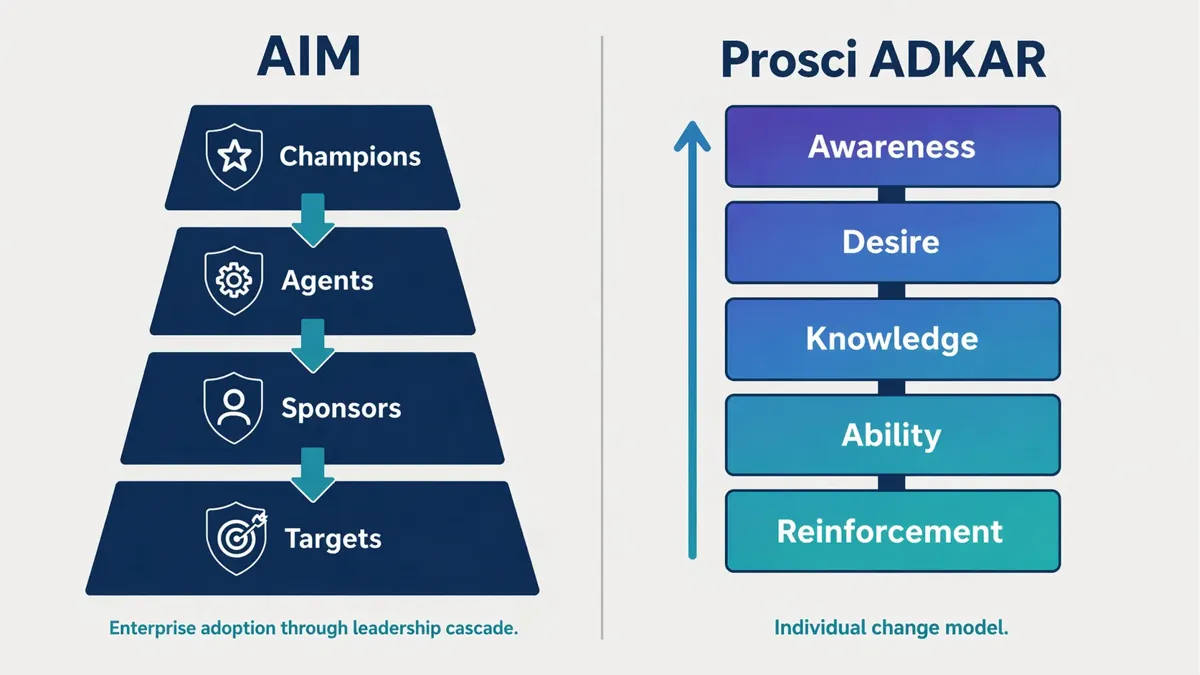
See how AIM stacks up against all three leading change frameworks, or explore the other head-to-head analyses in this series.
Head-to-Head
AIM vs Prosci
You Are Here
AIM vs Kotter
- What is the AIM methodology?
- The AIM implementation roadmap
- AIM toolkit and 35+ validated assessments
- Reinforcement in change management
- The Express-Model-Reinforce framework