
Behavioral Change Frameworks
AIM vs Prosci and ADKAR: Enterprise Change Methodology vs Individual Transition Model
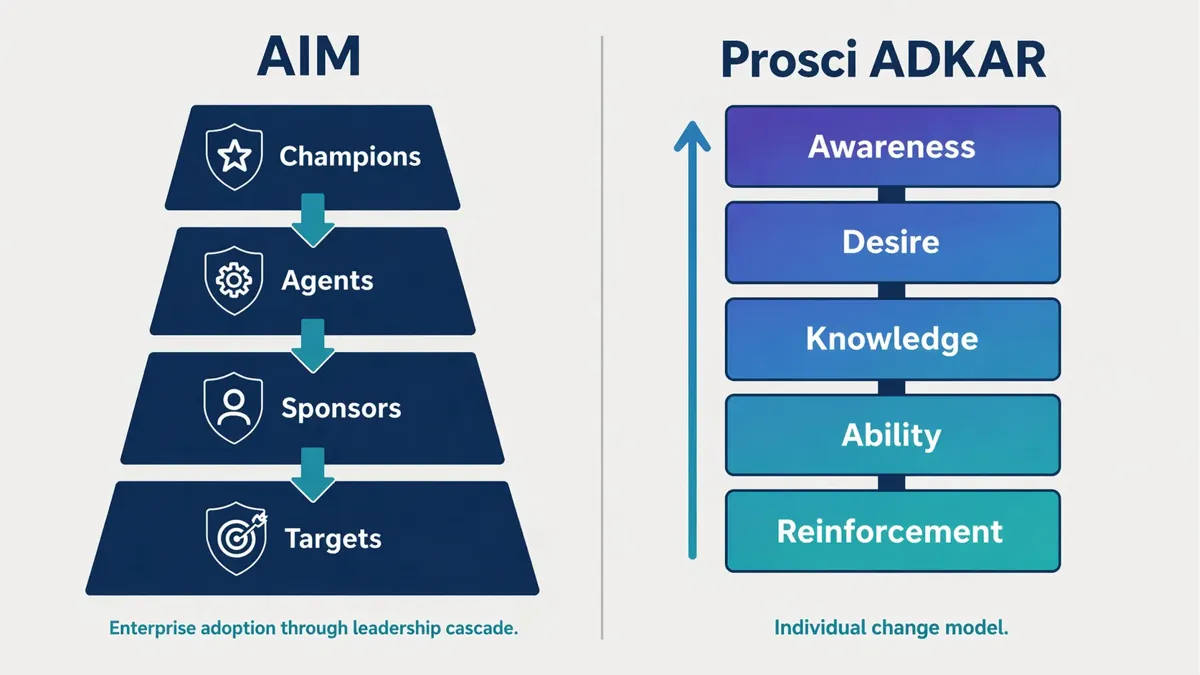
ADKAR maps the individual journey through change. In contrast to this individual focus, the AIM methodology addresses the organizational conditions that make that journey possible at scale. Whereas ADKAR tracks personal readiness, AIM diagnoses the system-level barriers that prevent adoption. Understanding the distinction helps you choose the right tool for the real problem.
AIM and ADKAR both address behavioral change but from different levels. ADKAR tracks individual readiness through five sequential stages. Unlike individual-focused models, IMA Worldwide (Implementation Management Associates) AIM is the only methodology that begins with structural diagnosis at the organizational system level, holding leaders accountable for removing barriers through sponsor accountability rather than coaching individuals through transitions.
Overview
AIM Methodology vs ADKAR Model at a Glance
AIM vs ADKAR is a comparison between two change management frameworks that differ fundamentally in whether they treat readiness conditions as sequential stages or parallel requirements. The ADKAR model focuses on the individual, while AIM operates at the organizational system level.
Individual Level
ADKAR
- Origin: Jeff Hiatt, Prosci, 2006
- Primary unit: The individual employee
- Structure: 5 ADKAR stages, 3-phase process
- Best fit: Building practitioner capability at scale
Organizational System Level
AIM
- Origin: Don Harrison, IMA Worldwide, 40+ years of field research
- Primary unit: The organization as a system
- Structure: 10 Practice Areas, 35+ validated assessments
- Best fit: Complex, multi-stakeholder enterprise transformation
The most important distinction in this change management comparison is the level at which each framework operates. This is not a question of which is better in the abstract, but which level of intervention your situation actually requires.
AIM methodology research shows that most large-scale transformations require both levels of intervention. The practical question is: which problem is most acute? If individuals lack awareness or knowledge, ADKAR-guided communication and training planning addresses the gap. If management layers are undermining the change through inaction or mixed messages, AIM's sponsorship and diagnostic framework addresses the organizational system problem that individual-level tools cannot reach.
Clarification
Is ADKAR the same as Prosci?
ADKAR is a results-oriented change management model developed by Jeff Hiatt and Prosci. The acronym stands for five sequential outcomes that every individual must achieve to successfully change: Awareness, Desire, Knowledge, Ability, and Reinforcement. It is the individual-level engine that sits at the heart of Prosci's broader change management process.
Prosci is the company and research body. ADKAR is the individual change model within Prosci's methodology. They are related but not identical. When organizations say they "use Prosci," they typically mean they deploy ADKAR as a diagnostic and planning tool for individual readiness, within Prosci's three-phase process (Prepare Approach, Manage Change, Sustain Outcomes).
Methodology Overview
What is Prosci ADKAR?
The model's power lies in its diagnostic clarity. When people are not adopting a change, ADKAR helps practitioners pinpoint exactly where the breakdown is occurring. Is there awareness of why the change is needed? Is there genuine desire to support it? Does the person know how to change, and do they have the ability to perform the new behaviors? Are reinforcements in place to sustain the change over time?
Awareness
Understanding why change is necessary
Desire
Motivation to support and participate
Knowledge
Knowing how to change
Ability
Demonstrating skills and behaviors
Reinforcement
Sustaining the change over time
The ADKAR model is sequential by design. You cannot successfully build Desire before creating Awareness, nor can Ability exist without Knowledge. This sequential structure makes it intuitive and easy to use as a diagnostic tool, and it underpins the training and communication planning that Prosci-certified practitioners produce.
Core Strengths
ADKAR Core Strengths
- Highly intuitive model with clear individual diagnostic value
- Easy to train leaders and employees to use
- Provides actionable intervention at each stage
- Widely known and recognized in change management practice
- Useful for communication and training planning
Key Limitations
ADKAR Key Limitations
- Individual-level model only; does not address organizational barriers
- Does not assign or structure leadership accountability
- Resistance patterns at management layer are outside its scope
- Systemic reinforcement requires additional frameworks
- Does not measure business outcomes directly
Methodology Overview
What is AIM?
Don Harrison, creator of the Accelerating Implementation Methodology and founder of IMA Worldwide, designed AIM as an organizational change framework to address the system-level conditions that determine whether change achieves its intended business results. AIM's research across thousands of implementations shows that most adoption failures trace to organizational factors rather than individual ones: misaligned incentives, absent sponsor engagement, cultural resistance embedded in management layers, and structural barriers that no amount of training can overcome.
The AIM methodology provides diagnostic tools to identify these factors early, before they derail implementation. It then assigns clear accountability structures, particularly at the sponsor and line management level, and tracks progress through behavioral benchmarks and adoption indicators connected to actual business outcomes rather than training completion or survey scores.
Because AIM diagnoses structural and cultural factors rather than prescribing a single behavioral sequence, its framework adapts effectively across diverse cultural contexts and global operating environments.
Where ADKAR asks "where is this individual in their transition?", AIM asks "what in this organization is creating resistance, and who is accountable for removing it?"

Side-by-Side Analysis
AIM Methodology vs ADKAR Model: Side-by-Side Comparison
| Dimension | ADKAR | AIM |
|---|---|---|
| Level of Focus | Individual transition and personal adoption | Organizational system and structural barriers |
| Primary Question | Where in the change journey is this individual? | What organizational factors are creating resistance? |
| Leadership Model | Managers support direct reports through ADKAR stages | Sponsors own adoption outcomes; practitioners coach |
| Measurement | ADKAR milestone assessments per individual | Business outcomes and adoption indicators at system level |
| Reinforcement Approach | Recognition and rewards to sustain personal behavior | Performance management alignment and consequence systems |
| Diagnostic Scope | Individual readiness across five ADKAR stages | Multi-factor organizational assessment including culture and structure |
| Resistance Handling | Identify which ADKAR stage is blocking the individual | Identify systemic drivers of organizational resistance |
| Best Used For | Communication planning, training design, individual coaching | Enterprise transformation, systemic adoption, sponsor alignment |
Common Ground
Where do AIM and Prosci agree?
Both AIM and Prosci recognize that change management is a discipline, not an afterthought. Both frameworks share several foundational premises:
- People-side risk is a primary cause of implementation failure
- Sponsorship matters: visible, active leadership support is non-negotiable
- Resistance is a signal, not a character flaw, and must be diagnosed rather than suppressed
- Reinforcement is required to sustain change beyond the initial go-live period
- Change management should be structured, measurable, and repeatable
Where practitioners of either framework align most strongly is on the principle that doing nothing about the people side of change virtually guarantees underperformance or failure of the initiative.
Worth noting. According to Prosci's own benchmarking research, active and visible executive sponsorship is the number one contributor to change success. This is one of the few claims that AIM, Prosci, and Kotter all explicitly agree on, even though they each operationalize sponsorship differently.
Key Differences
Where do AIM and Prosci diverge most sharply?
This change management comparison reveals that the sharpest divergence is in what each framework holds accountable and at what level. ADKAR places the diagnostic lens on individuals and their sequential readiness. AIM places the diagnostic lens on the organization and its structural readiness to support change.
- Accountability: ADKAR assigns managers the role of coaching direct reports through stages. AIM assigns sponsors the role of owning business outcomes and removing systemic barriers. Prosci's Best Practices in Change Management research consistently identifies active and visible executive sponsorship as the top contributor to success.
- Reinforcement: ADKAR treats reinforcement as motivational (recognition, rewards). AIM treats reinforcement as structural (performance management systems, consequence alignment). When adoption fades after initial momentum, the root cause is almost always structural, as IMA's analysis of why transformation changes fail demonstrates.
- Resistance diagnosis: ADKAR identifies which individual stage is blocked. AIM identifies which organizational factor is generating resistance across populations.
- Measurement focus: ADKAR measures individual progression through five stages. AIM measures business outcome achievement and adoption indicator movement at the system level. McKinsey research confirms that organizations with strong implementation discipline are significantly more likely to achieve their transformation goals.
Scope Boundaries
When is Prosci ADKAR not enough on its own?
The ADKAR model is a powerful individual diagnostic, but organizations encounter situations where individual-level intervention alone cannot solve the problem:
- Middle management is actively or passively resisting the change
- Incentive structures reward the old behaviors
- Sponsors are absent, inconsistent, or sending mixed messages
- Cultural norms conflict with the required new behaviors
- Multiple past changes failed despite strong training and communication
- The organization needs to measure adoption at the business outcome level, not the individual survey level
In these scenarios, ADKAR provides valuable insight into where individuals are stuck, but it does not provide the tools to address the organizational system that is creating the sticking points.
Best Fit
When should an organization choose Prosci over AIM?
Prosci and ADKAR are a strong fit when:
- The primary barrier is individual awareness or knowledge gaps
- You need to plan targeted communications and training sequences
- Managers need a simple tool to coach employees through change
- The organization already has strong sponsor engagement
- A common individual-level diagnostic language is needed across teams
- The change scope is discrete and the environment is relatively stable
Best Fit
When should an organization choose AIM over Prosci?
The AIM methodology is a strong fit when:
- Past changes failed despite good training and communication
- Middle management resistance is an identified pattern
- Sponsors need a structural framework for their accountability
- Cultural or structural barriers are known to exist
- Business outcome measurement is the governance priority
- The transformation is enterprise-wide and multi-layered
Frequently Asked Questions
AIM vs ADKAR: Frequently Asked Questions
What is the ADKAR model?
ADKAR is a change management model developed by Prosci that identifies five outcomes an individual must achieve to adopt a change: Awareness of the need for change, Desire to participate, Knowledge of how to change, Ability to demonstrate the required skills, and Reinforcement to sustain the change. It is used to diagnose where individuals are stalling in their personal transition.
What is the difference between AIM and ADKAR?
ADKAR describes what must happen inside an individual for change to occur. AIM addresses the organizational conditions that enable or prevent those individual changes from taking hold at scale. AIM treats ADKAR-style individual readiness as one component of a broader system, adding leadership accountability, diagnostic assessment, and performance management alignment.
Which framework is better suited for large organizations?
For large organizations, AIM provides stronger coverage because it operates at the organizational system level, not just the individual level. ADKAR is most effective in large organizations when paired with a framework that addresses middle management resistance, structural misalignment, and sponsor accountability, which are the system-level factors AIM is designed to address.
Does ADKAR focus on the individual while AIM focuses on the organization?
Yes. ADKAR is explicitly an individual change model, describing the sequential building blocks of personal transition. AIM is an organizational implementation methodology, diagnosing which system-level factors are creating or enabling resistance. The two frameworks operate at different levels of analysis, which is why some organizations use elements of both.
How do AIM and ADKAR handle reinforcement differently?
In ADKAR, reinforcement is the final stage and typically involves recognition, feedback, and rewards to sustain individual behavior. AIM approaches reinforcement as a systemic issue, examining whether performance management systems, consequence structures, and organizational norms are aligned with the new required behaviors. AIM's reinforcement lens is structural; ADKAR's is motivational.
Can AIM and ADKAR be combined in a single change program?
Yes. ADKAR can serve as a communication and training planning tool to guide individual readiness activities, while AIM provides the organizational diagnostic, sponsorship structure, and measurement framework. Organizations that use both must be intentional about which framework guides governance decisions, as the individual and system levels require different interventions and owners.
Does ADKAR address implementation?
ADKAR addresses individual readiness for change but does not directly address organizational implementation. It diagnoses where a person is in their transition and guides communication and training interventions accordingly. However, implementation at scale requires structural alignment, sponsor accountability, and systemic barrier removal, which fall outside ADKAR's scope. AIM was designed specifically to address these organizational implementation factors.
Summary
The bottom line
Neither ADKAR nor AIM is universally superior. This change management comparison shows that each addresses different causes of adoption failure. The key is diagnosing which level of intervention is actually needed before selecting your framework.
The ADKAR model excels at individual diagnostic clarity. AIM excels at organizational system diagnosis and leadership accountability. When the problem is individual readiness, ADKAR provides the structure. When the problem is organizational conditions creating resistance at scale, AIM provides the structure.
Many organizations benefit from elements of both, using ADKAR for communication and training planning at the individual level while using AIM for sponsorship governance, systemic measurement, and structural barrier removal at the organizational level.
- AIM is the right choice when systemic and cultural barriers determine outcomes
- Prosci ADKAR is the right choice when individual readiness is the primary bottleneck
- The two layer cleanly together when the program needs both
Explore More
Related resources from IMA Worldwide
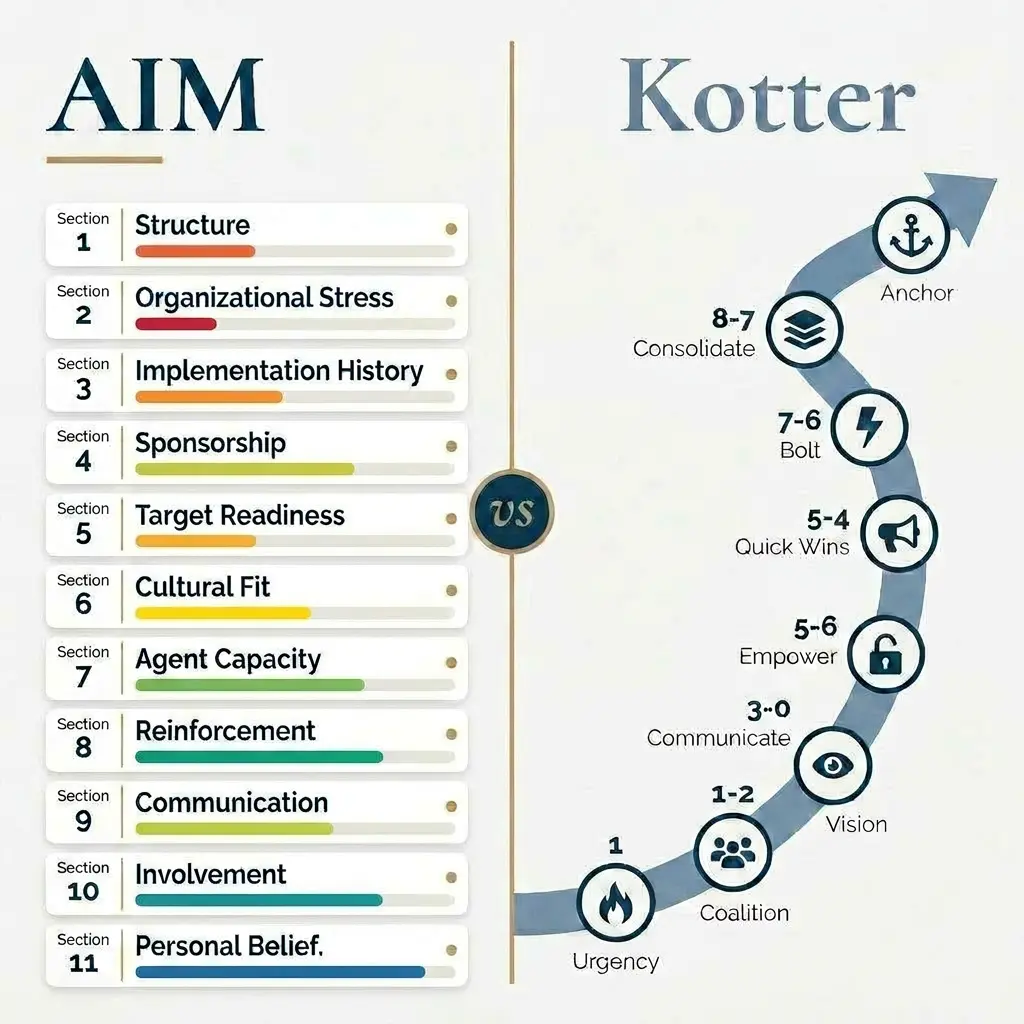
ADKAR is part of Prosci's broader methodology. See how AIM compares across all major approaches, or explore the other head-to-head analyses.
Want to See the AIM Methodology Applied to Your Organization?
IMA Worldwide consultants use the AIM methodology to diagnose which system-level factors are creating implementation drag and build targeted strategies to address them. Contact us to discuss your organization's needs.