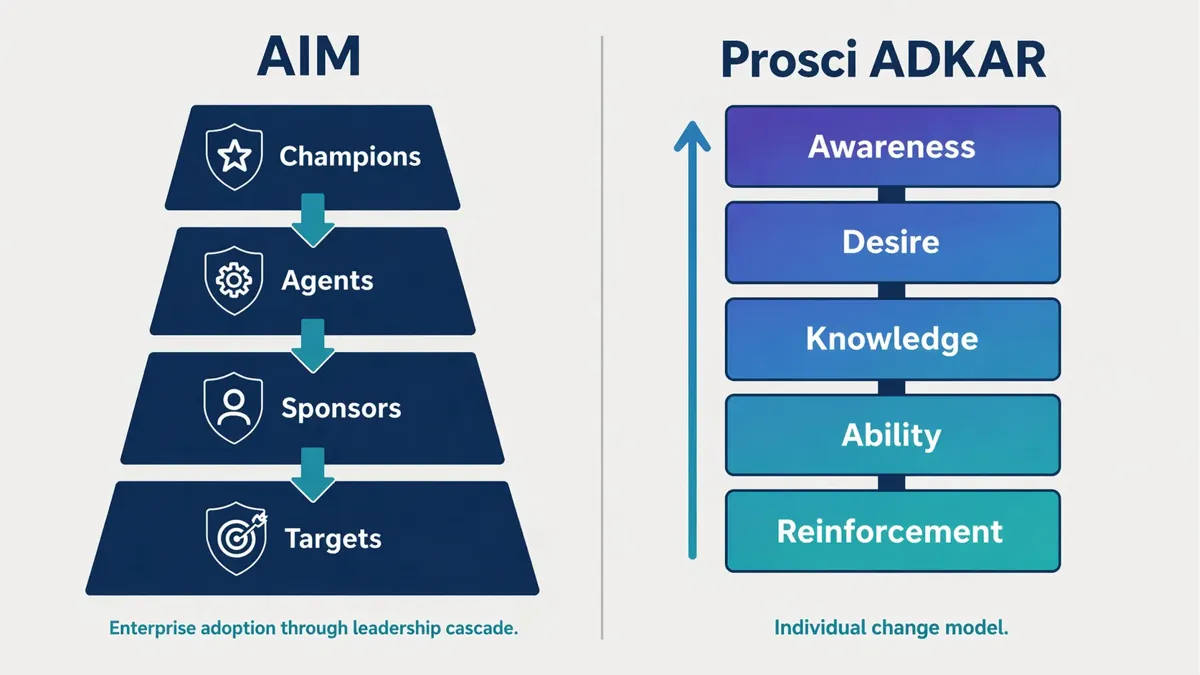

Implementation Methodology vs Emergent Practice
AIM vs Agile Change Management: Implementation Methodology vs Emergent Practice
AIM provides the organizational leadership accountability and reinforcement architecture required to sustain adoption at scale. Agile change management provides team-level flexibility and adaptive practices. They are not competing ideas, and many enterprise transformations use both.
At a Glance
The Two Approaches at a Glance
AIM and Agile change management serve different purposes at different levels of the organization. IMA Worldwide (Implementation Management Associates) AIM is a complete implementation methodology with 10 interdependent practice areas and 35+ validated diagnostic tools, focused on enterprise leadership accountability and reinforcement systems. Agile change management is a collection of team-level practices adapted from Agile software development, providing iterative delivery and adaptive response.
Agile Change Management
- Origin: Agile Manifesto, 2001, and subsequent Lean-Agile communities
- Primary unit: The delivery team
- Structure: Retrospectives, Kanban, sprint ceremonies, servant leadership
- Best fit: Team-level iterative improvement
AIM (IMA Worldwide)
- Origin: Don Harrison, IMA Worldwide, 40+ years of field research
- Primary unit: The organization as a system
- Structure: 10 Practice Areas, 35+ validated assessments
- Best fit: Complex, multi-stakeholder enterprise transformation
Methodology Overview
What is Agile Change Management?
AIM vs Agile change management is a comparison between a structured organizational implementation methodology and an emergent set of team-level practices that differ in whether they address enterprise leadership accountability or team-level adaptive delivery.
Agile change management is a collection of practices adapted from Agile software development principles, including iterative delivery, retrospectives, servant leadership, co-creation, and team-level adaptation. It is not a single formal methodology but rather an emergent set of practices used to manage organizational change with flexibility and responsiveness. These practices are drawn from the Agile Manifesto of 2001 and from Lean principles.
Agile change management excels at the team level: retrospectives expose friction quickly, Kanban makes work visible, and servant leadership creates psychological safety so teams can experiment and adjust without waiting for centralized approval. The limitation is structural. Agile change management does not prescribe the enterprise-level leadership accountability, cascading involvement structures, or reinforcement systems required to sustain adoption across an organization.
Core Agile CM Practices
Iterative Delivery
Deliver change in short cycles, gathering feedback and adjusting the approach rather than executing large pre-planned programs.
Retrospectives
Regular team-level reviews that surface what is working and what is not, enabling rapid adjustment within the team.
Servant Leadership
Leaders remove obstacles, facilitate team autonomy, and create psychological safety so teams can experiment without fear of failure.
Co-creation
Involve employees in designing change interventions rather than delivering change programs designed solely by leadership or practitioners.
Kanban and Visual Management
Make work in progress visible so teams and stakeholders can see what is happening, identify bottlenecks, and coordinate effectively.
Team-Level Adaptation
Teams adapt their approach based on local conditions and feedback rather than following a centralized, one-size-fits-all plan.
Agile CM Core Strengths
- Responsive to feedback within days rather than quarters
- Co-creation builds team ownership and reduces passive resistance
- Retrospectives expose friction quickly at the team level
- Aligns naturally with agile software delivery and DevOps cultures
- Servant leadership creates psychological safety for experimentation
Agile CM Key Limitations
- Does not prescribe enterprise-level leadership accountability
- No structured reinforcement architecture that persists after coaches leave
- Primarily addresses team-level change, not organizational system barriers
- Adoption regresses when coaching relationships end
- No validated diagnostic tools for identifying specific adoption constraints
Methodology Overview
What is AIM?
IMA Worldwide's AIM (Accelerating Implementation Methodology), created by Don Harrison, is a complete implementation methodology with 10 interdependent practice areas, each supported by validated diagnostic tools and behavioral benchmarks. Built on 40+ years of applied research across 12+ industries, AIM treats the organization as a system and makes leadership accountability the primary driver of sustained adoption.
AIM is the only widely used change methodology that prescribes specific non-delegable tasks for sponsors and uses validated diagnostic instruments to measure whether those tasks are actually being performed in the field. When adoption stalls, AIM identifies which specific constraint is blocking progress and provides a structured intervention path.
AIM also takes a distinctive position on resistance. Where Agile change management addresses resistance reactively through co-creation and feedback loops, AIM treats resistance as a predictable, proportional response to disruption. The greater the shift in a person's frame of reference, the greater the resistance. AIM provides validated tools to measure disruption level and predict resistance before it occurs, then designs the implementation approach to match.
Where Agile asks "how can we help teams adapt and improve iteratively?", AIM asks "why is the organization not adopting this change, and who is accountable for fixing that?"
Side-by-Side Analysis
How do AIM and Agile Change Management compare side by side?
| Dimension | Agile Change Management | AIM |
|---|---|---|
| Methodology Type | Emergent practice collection adapted from the Agile Manifesto (2001) | Complete implementation methodology, 40+ years of field research |
| Primary Focus | Team adaptability and iterative delivery | Leader accountability and reinforcement systems |
| Scope of Change | Primarily team-level | Enterprise-wide: leaders, change agents, targets |
| Leadership Role | Servant leadership and obstacle removal | 6 non-delegable leadership tasks structurally enforced |
| Reinforcement | Not formally addressed | Primary lever, 3x impact weight in the EMR framework |
| Resistance Approach | Addressed through co-creation and feedback loops | Predictable, proportional to disruption level |
| Diagnostic Tools | Retrospectives, health checks, team surveys | 35+ validated assessments across 10 practice areas |
| Best Fit | Team-level change and iterative improvement | Complex high-disruption enterprise transformation |
Common Ground
Where do AIM and Agile Change Management agree?
Despite operating at different levels of the change problem, AIM and Agile change management share several foundational beliefs about how organizational change should be approached.
Shared Principles
- Change is fundamentally about human behavior, not just process or technology
- Resistance is information about underlying conditions, not an obstacle to steamroll
- Communication and training alone are insufficient to drive adoption
- Feedback must guide whether the approach is working
- Both have evolved from decades of field experience rather than academic theory alone
Shared Rejections
- Both reject the idea that awareness alone produces lasting behavior change
- Both reject rigid, top-down implementation plans that ignore real-time conditions
- Both reject the assumption that initial planning can anticipate all implementation challenges
- Both reject measuring change success solely through activity completion rates
Worth noting. Many practitioners describe a phenomenon called the coaching cliff: Agile transformations stall or reverse when external coaches disengage because reinforcement systems still reward the old way of working. AIM addresses this by building reinforcement into the leadership structure itself, not the coaching relationship.
The Core Distinction
Where do AIM and Agile Change Management diverge most sharply?
The single sharpest divergence is reinforcement architecture. AIM applies the Express-Model-Reinforce (EMR) framework, which quantifies the relative impact of three leader behaviors: what leaders express has 1x impact, what leaders model has 2x impact, and what leaders reinforce has 3x impact. AIM designs reinforcement into the implementation from day one. Agile change management relies heavily on coaching presence and does not provide a structured reinforcement architecture that persists after the coach disengages. McKinsey research consistently identifies leadership alignment and reinforcement as the top predictors of transformation success.
Agile Change Management Addresses:
- Team-level adaptability through retrospectives and iterative delivery
- Servant leadership that removes obstacles and creates psychological safety
- Co-creation practices that build team ownership of change
- Visible work management through Kanban and sprint ceremonies
- Coaching-driven adoption at the team level
AIM Addresses:
- Enterprise leadership accountability through 6 non-delegable tasks
- Reinforcement systems that reward new behaviors structurally
- 35+ diagnostic tools that identify specific adoption constraints
- Predictive resistance model calibrated to disruption level
- Sponsor cascade that ensures accountability at every leadership level
The second sharp divergence is leadership accountability. AIM defines six non-delegable leadership tasks that only the leader can perform. Agile change management emphasizes servant leadership, which is valuable but does not address the structural leadership tasks that determine whether Agile adoption persists at the organizational level. Prosci's Best Practices in Change Management research confirms that active and visible executive sponsorship is the number one contributor to change success. The third sharp divergence is diagnostic precision. AIM provides 35+ validated assessment tools; Agile change management relies on team retrospectives and qualitative feedback. A retrospective might surface that leadership is not supportive, but AIM's diagnostic tools would identify which specific leadership behavior gap is the constraint and provide a structured intervention path. IMA Worldwide's research on why transformation changes fail quantifies this gap between awareness and sustained behavioral adoption.
Choosing the Right Framework
When should an organization choose AIM or Agile Change Management?
The decision depends on whether the challenge is a team-level practice problem or an enterprise-level leadership and reinforcement problem.
Choose AIM When:
- Agile adoption has stalled beyond the team level
- Leadership reinforcement systems still reward old behaviors despite training
- Coaches have disengaged and adoption is regressing
- Enterprise-wide behavioral change is required, not just team practices
- Resistance is high and disruption level is significant
- You need diagnostic tools that identify where adoption is breaking down
Choose Agile CM When:
- The change is primarily at the team level and the organizational system is healthy
- Leadership reinforcement systems are already aligned with the new way of working
- The organization is mature in Agile and needs continuous team-level improvement
- The primary goal is team empowerment and servant leadership
- Disruption is low and the change is incremental rather than transformational
Integration Approach
How do enterprise teams combine AIM and Agile Change Management?
In enterprise Agile transformations, the combination is often essential. Agile practices at the team level create the conditions for iterative delivery and adaptive response. AIM provides the enterprise-level infrastructure that lets those team practices scale and persist.
Agile CM Contributes:
- Retrospectives, Kanban boards, and sprint ceremonies for team-level flexibility
- Servant leadership that creates psychological safety for experimentation
- Co-creation practices that build team ownership of change
- Iterative delivery that responds to real-time feedback
- Adaptability within teams to improve continuously
AIM Contributes:
- Leadership accountability through the six non-delegable tasks
- Reinforcement systems that reward Agile behaviors rather than waterfall heroics
- Diagnostic tools that identify which leadership gaps are blocking adoption
- Predictive resistance model that designs the approach to match disruption level
- Sponsor cascade that ensures accountability at every leadership level
The Combined Value
Agile creates adaptability within teams while AIM creates the leadership structure that sustains adoption across the enterprise. The combination works because each addresses the level where the other does not operate: Agile at the team, AIM at the organizational system.
Frequently Asked Questions
AIM vs Agile Change Management: Frequently Asked Questions
What is the difference between AIM and Agile change management?
AIM (Accelerating Implementation Methodology) is a complete implementation methodology focused on sustained behavior change and adoption through leadership accountability and reinforcement systems, built on 40+ years of field research at IMA Worldwide. Agile change management is a collection of team-level practices adapted from Agile software development. AIM provides enterprise-level diagnostic tools and a structured reinforcement architecture; Agile change management provides team-level flexibility and coaching-driven adaptation.
Is Agile change management a formal methodology?
No. Agile change management is not a formal methodology. It is a collection of practices adapted from Agile software development and Lean principles, drawn from the Agile Manifesto of 2001. Unlike AIM, which provides 10 interdependent practice areas with 35+ validated diagnostic tools, Agile change management does not prescribe the structural leadership accountability or reinforcement architecture required for enterprise-scale adoption.
Can AIM and Agile change management be used together?
Yes. The combination is often essential in enterprise Agile transformations. Agile practices excel at the team level for retrospectives and iterative improvement, while AIM provides the enterprise-level leadership accountability, reinforcement systems, and diagnostic tools that determine whether Agile adoption persists at scale.
Why do Agile transformations fail even with strong coaching and training?
Coaching and training address awareness and skill but not reinforcement. AIM research quantified that reinforcement, what leaders reward, recognize, resource, or apply consequences to, has 3x the impact of communication alone. When leadership reinforcement systems still reward waterfall behaviors, teams revert to old patterns regardless of how well they were trained or coached.
Which approach is better for enterprise transformation?
For enterprise transformation, AIM is typically the better fit because enterprise-scale change requires structural leadership accountability, reinforcement architecture, and diagnostic precision that team-level Agile practices do not provide. Many enterprise transformations use both: Agile practices at the team level and AIM at the leadership and organizational level.
Summary
The Bottom Line
AIM and Agile change management serve different purposes at different levels of the organization. If your Agile transformation has stalled because leadership reinforcement systems still reward waterfall behavior, AIM is designed for that problem. It identifies the specific leadership behavior gap, provides diagnostic tools to measure it, and gives leaders a structured accountability framework to close it.
If teams need iterative, adaptive practices to improve how they work and leadership is already supportive, Agile change management practices provide that flexibility. The critical question is not which is better. The critical question is whether your challenge is a team-level practice problem or an enterprise-level leadership and reinforcement problem.
- AIM is the right choice when enterprise leadership and reinforcement are the bottleneck
- Agile change management is the right choice when team-level practices are the bottleneck
- The two layer cleanly together when the program needs both
Methodology Comparison Series
Related resources from IMA Worldwide
AIM goes head-to-head with the most widely used change management frameworks. Explore each comparison or see the full overview.