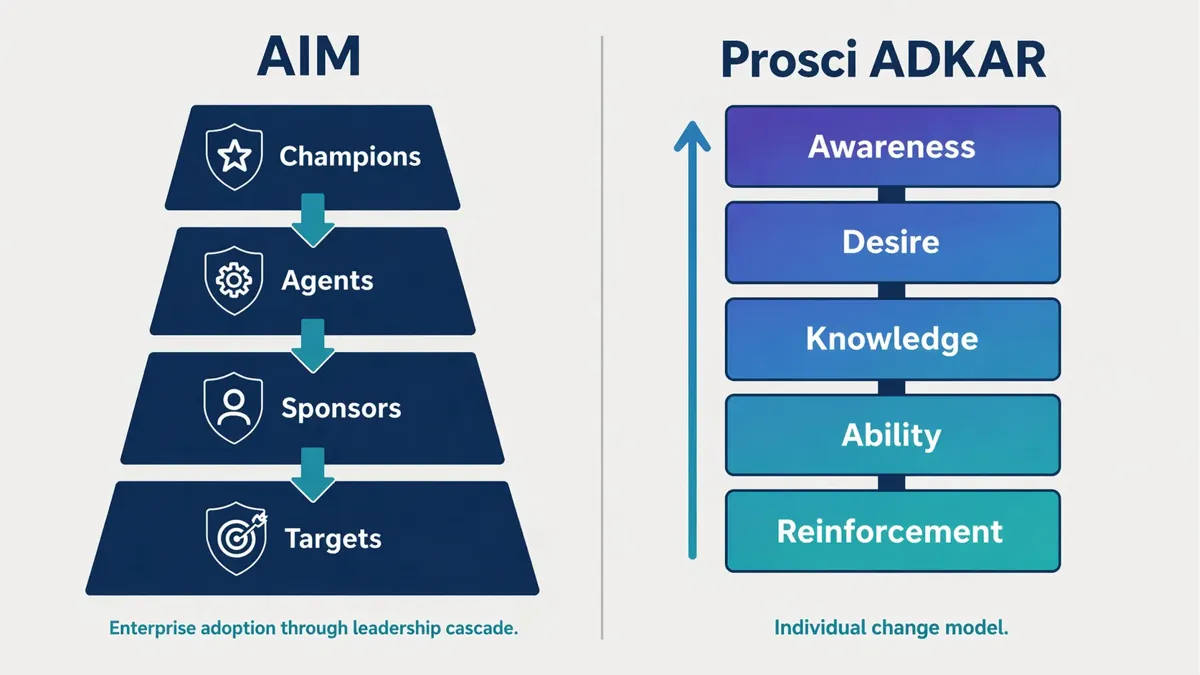
Change Management for Scaled Agile Transformations
AIM vs SAFe: Change Management for Scaled Agile Transformations
SAFe® coordinates agile delivery across teams, programs, and portfolios. The AIM methodology addresses whether the people and organizational systems behind that delivery engine are actually changing. The strongest transformations use both.
At a Glance
AIM vs SAFe for Agile Transformation: The Quick Answer
IMA Worldwide's Accelerating Implementation Methodology (AIM) is a structured change management methodology addressing the human and organizational factors that determine whether transformation is sustained. SAFe (Scaled Agile Framework) is a delivery framework coordinating agile work across Team, Program, Large Solution, and Portfolio levels. The strongest transformations use both.
SAFe (Scaled Agile Framework)
- Origin: Scaled Agile, Inc., first released 2011
- Primary unit: The Agile Release Train and PI cadence
- Structure: Four levels (Team, Program, Large Solution, Portfolio)
- Best fit: Large enterprises scaling agile across many teams
AIM (IMA Worldwide)
- Origin: Don Harrison, IMA Worldwide, 40+ years of field research
- Primary unit: The organization as a system
- Structure: 10 Practice Areas, 35+ validated assessments
- Best fit: Complex, multi-stakeholder enterprise transformation
Framework Overview
What is SAFe as a scaled agile framework?
AIM vs SAFe is a comparison between a structured organizational change management methodology and a scaled delivery framework that differ in whether they address human adoption infrastructure or delivery coordination across agile teams.
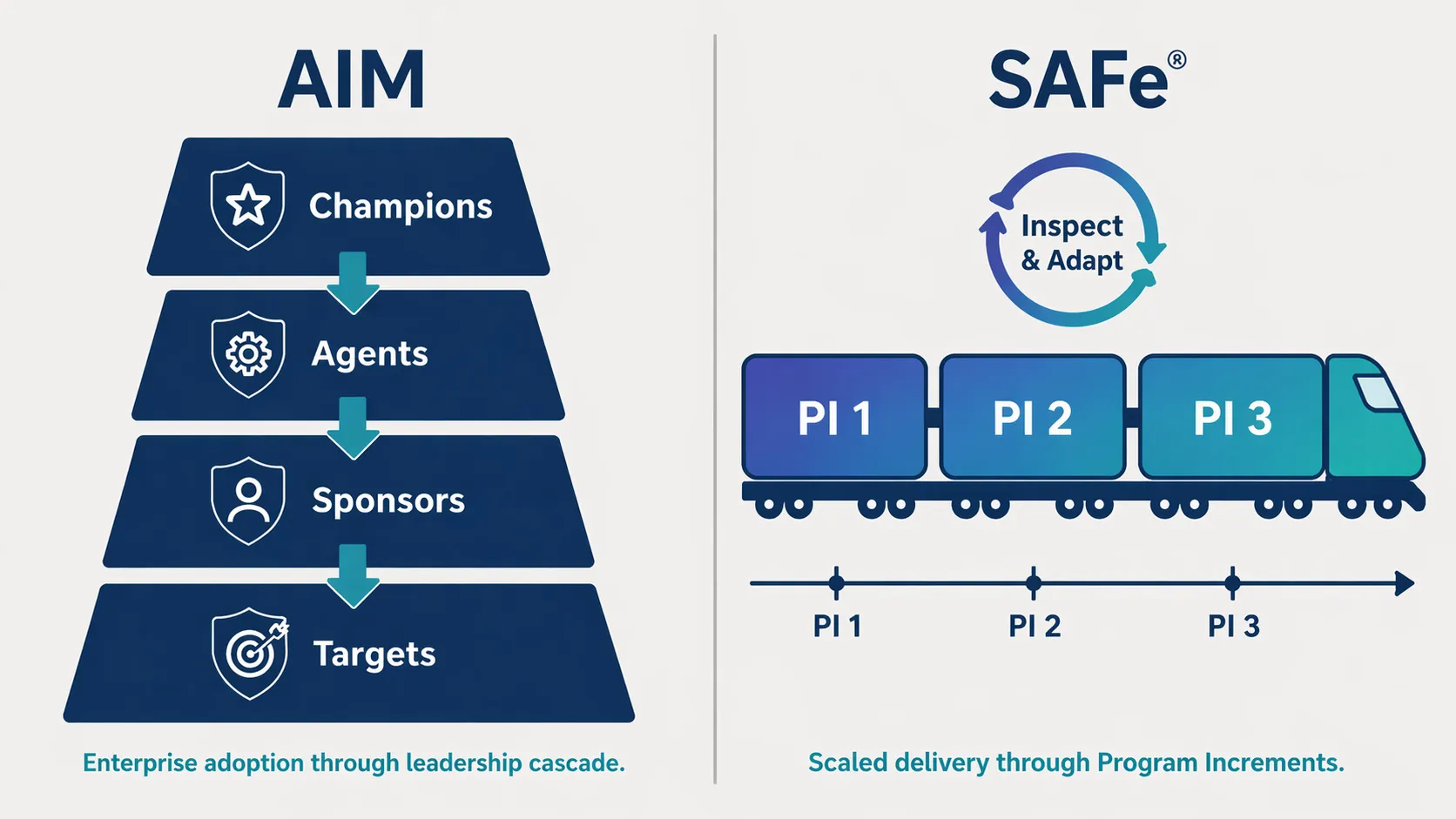
SAFe (Scaled Agile Framework) provides a comprehensive delivery framework integrating agile practices with lean principles across four organizational levels: Team, Program, Large Solution, and Portfolio. It excels at alignment, synchronization, and delivery cadence, primarily through its signature PI Planning (Program Increment) ceremony that brings teams together to coordinate objectives and dependencies.
SAFe has become one of the most widely adopted frameworks for scaling agile beyond individual teams. Its SAFe implementation roadmap provides a structured approach to coordinating complex, multi-team delivery. However, SAFe has documented gaps in human adoption infrastructure as part of this scaled agile approach. It addresses how work is organized and delivered but does not prescribe how organizations should diagnose and remove the leadership, cultural, and reinforcement barriers that determine whether people actually change how they work.
SAFe's Four Levels
Team Level
Individual agile teams delivering work in iterations, using Scrum, Kanban, or XP practices within a coordinated framework.
Program Level
Agile Release Trains (ARTs) synchronize multiple teams through PI Planning, system demos, and shared cadence.
Large Solution Level
Coordinates multiple ARTs and suppliers building large, complex solutions that require cross-train synchronization.
Portfolio Level
Aligns strategy with execution through lean portfolio management, strategic themes, and portfolio-level Kanban.
SAFe Core Strengths
- Provides a comprehensive framework for scaling agile across large organizations
- PI Planning creates powerful cross-team alignment and shared commitment
- Integrates lean thinking with agile delivery at enterprise scale
- Well-documented roles, ceremonies, and artifacts reduce ambiguity
- Strong community, training infrastructure, and certification ecosystem
SAFe Key Limitations
- Does not provide structured change management for the human side of transformation
- No diagnostic framework for identifying organizational barriers to adoption
- Sponsor accountability is assumed but not prescribed or measured
- Cultural and behavioral reinforcement systems are outside the framework's scope
- High failure rates are often traced to organizational environment factors SAFe does not address
Methodology Overview
What is AIM?
IMA Worldwide's AIM (Accelerating Implementation Methodology), created by Don Harrison over more than 40 years of research and practice, is an organizational change methodology built around 10 practice areas and validated by 35+ diagnostic assessment instruments. AIM is the only methodology that prescribes specific non-delegable tasks for sponsors, backed by validated diagnostic tools that measure whether those tasks are being performed.
Where SAFe coordinates how delivery work flows across teams, the AIM methodology diagnoses why people are not adopting new behaviors and assigns structural accountability for removing those barriers. AIM's Express, Model, Reinforce (EMR) framework operates at three levels of intensity (1x, 2x, 3x) based on the complexity and resistance profile of the change, ensuring that leadership investment scales with the actual organizational challenge.
AIM defines 6 non-delegable leadership tasks that sponsors must perform personally. These are not general leadership principles but specific, measurable actions that AIM's diagnostic instruments track throughout implementation. This level of prescriptive sponsor accountability is what distinguishes AIM from frameworks that acknowledge the importance of leadership support without defining exactly what that support must look like. Organizations seeking structured capability development can explore IMA's change management training programs designed to build these leadership skills.
Because AIM targets universal organizational system factors rather than culturally specific process assumptions, it has been applied successfully across industries and geographies, making it adaptable to cross-cultural implementation environments where local management norms vary significantly. Contact IMA Worldwide to discuss how AIM fits your organization's transformation context.
Side-by-Side Analysis
How do AIM and SAFe compare side by side?
| Dimension | SAFe | AIM |
|---|---|---|
| Primary Focus | Coordinating agile delivery across teams, programs, and portfolios | Diagnosing and removing organizational barriers to behavior adoption |
| Origin / Authorship | Dean Leffingwell; synthesizes Lean, Agile, and systems thinking | Don Harrison; 40+ years of implementation research across industries |
| Cultural Change Approach | Culture emerges from adopting SAFe practices and lean-agile mindset | Culture is diagnosed and actively managed through sponsor cascade and reinforcement systems |
| Executive Sponsorship | Acknowledged as important; not prescribed with specific tasks or measurement | 6 non-delegable sponsor tasks, measured by validated diagnostic instruments |
| Training / Support | Extensive role-based training and certification program | Targeted capability building tied to diagnostic findings and adoption barriers |
| Measurement Approach | Delivery metrics: velocity, predictability, lead time, business agility | Adoption outcomes tied to business case; 35+ diagnostic assessments |
| Approach to Change | Framework adoption through a structured SAFe implementation roadmap | Organizational system intervention scaled by EMR intensity (1x/2x/3x) |
| Best Fit | Large enterprises scaling agile delivery across multiple teams | Complex transformations where leadership accountability and behavioral change determine success |
Common Ground
Where do AIM and SAFe agree?
Despite addressing different dimensions of enterprise transformation, AIM and SAFe share several foundational beliefs about how organizations should approach large-scale change.
Shared Principles
- Both are iterative: SAFe through PI cadence, AIM through ongoing diagnostic reassessment
- Both value cross-team alignment and reject siloed implementation
- Both reject single launch events as sufficient for lasting transformation
- Both recognize that enterprise change requires coordinated action at multiple levels
- Both emphasize feedback mechanisms to detect and address problems early
Shared Rejections
- Both reject the idea that training and communication alone produce sustainable change
- Both reject rigid, waterfall-style plans that ignore real-time organizational conditions
- Both reject the assumption that adoption will follow naturally from a good framework
- Both reject measuring success through activity completion rather than outcomes
The Critical Insight
Most SAFe adoption challenges are organizational environment problems, not framework problems. The SAFe framework itself is well-designed for delivery coordination. When SAFe transformations stall, it is almost always because the organizational system, including leadership behavior, cultural resistance, and reinforcement structures, is working against adoption.
Worth noting. Most SAFe adoption challenges are not actually SAFe problems. The framework is sound. What stalls is the organizational environment around the Agile Release Train: performance reviews, promotion criteria, resource allocation, and management expectations that still reward pre-SAFe behaviors.
The Core Distinction
Where do AIM and SAFe diverge most sharply?
The most important distinction between SAFe and AIM is the level of the enterprise they are designed to address. SAFe coordinates delivery. AIM addresses the organizational environment that determines whether delivery transformation is sustained. McKinsey research consistently finds that organizational and cultural factors are the top barriers to transformation success.
SAFe Addresses:
- How agile work is coordinated across teams, programs, and portfolios
- How delivery cadence and PI Planning create cross-team alignment
- How lean portfolio management connects strategy to execution
- How roles, ceremonies, and artifacts provide delivery structure
- How technical practices support continuous delivery at scale
AIM Addresses:
- Which organizational system factors are blocking adoption of new ways of working
- Whether sponsors are performing 6 non-delegable leadership tasks
- Whether management layers are aligned or creating mixed messages about the transformation
- Whether reinforcement systems reward new agile behaviors or still reward old ways of working
- Whether the cultural environment supports or undermines the scaled agile transformation
AIM's EMR Framework
Express
Communicate the business case, the required behavior changes, and what success looks like. At 1x intensity for lower-complexity changes.
Model
Leaders visibly demonstrate the new behaviors. At 2x intensity, sponsors and managers must personally model the change they are asking others to adopt.
Reinforce
Align performance management, incentive structures, and organizational systems to reward new behaviors. At 3x intensity for the most complex, high-resistance transformations.

An organization can implement SAFe's delivery framework flawlessly and still fail to achieve lasting transformation if the organizational system is working against adoption. Prosci's Best Practices in Change Management research confirms that active sponsorship is the top contributor to change success. AIM's 35+ diagnostic instruments identify exactly where those organizational barriers exist and assign accountability for removing them. IMA Worldwide's own research on why transformation changes fail quantifies the gap between framework adoption and behavioral transformation.
Why Transformations Stall
Why do SAFe transformations have high failure rates?
SAFe transformation failures are rarely framework failures. They are organizational environment failures that SAFe was not designed to address. Three gaps account for the majority of stalled SAFe adoptions.
Sponsor Accountability Gap
Executive leaders announce the SAFe transformation and delegate ownership to coaches and program managers. Without sustained, visible sponsor accountability that includes specific non-delegable tasks, the transformation loses organizational authority and middle management defaults to old ways of working.
Behavioral Focus Gap
SAFe addresses how delivery work is organized but not the organizational environment factors that determine whether people actually change how they work. Teams may adopt SAFe ceremonies without adopting SAFe behaviors, producing compliance theater rather than genuine behavioral adoption.
Change Management Infrastructure Gap
SAFe provides no structured diagnostic or reinforcement system for identifying and removing organizational barriers to adoption. Without diagnostic instruments to surface resistance, cultural misalignment, and management-layer obstruction, these barriers persist unseen until the transformation stalls.
Choosing the Right Approach
When should an organization choose AIM over SAFe?
Organizations should choose the AIM methodology when the primary risk to their transformation is organizational rather than technical. Specific indicators include:
Primary Risk is Organizational
The greatest threat to transformation success is not delivery coordination but leadership alignment, cultural resistance, or management-layer obstruction.
Past Agile Rollouts Stalled
Previous attempts at following a SAFe implementation roadmap achieved initial framework adoption but failed to produce sustained behavioral change across the organization.
Sponsors Disengaged After First PI
Executive sponsors were visible during the launch but disengaged after the first Program Increment, leaving the transformation without sustained leadership authority.
Reinforcement Systems Reward Old Behaviors
Performance management, incentive structures, and promotion criteria still reward traditional ways of working, creating structural conflict with the agile transformation.

Integration Approach
How do enterprise teams combine AIM and SAFe?
The AIM methodology and SAFe are not competing frameworks. They address different dimensions of enterprise transformation and produce the strongest results when deployed together with clear intent about what each contributes.
Five Integration Points
PI Planning as Organizational Alignment Checkpoint
Use AIM diagnostics before each PI Planning event to assess whether sponsors are actively reinforcing priorities and whether management layers are aligned or sending mixed signals.
Sponsor Cascade Mapped to SAFe Levels
Align AIM's sponsor accountability cascade with SAFe's four levels so that each organizational layer has clearly defined, non-delegable leadership tasks tied to the transformation.
Diagnostic Assessment at Each SAFe Level
Deploy AIM's 35+ diagnostic instruments at Team, Program, Large Solution, and Portfolio levels to identify where organizational barriers are blocking adoption of SAFe practices.
Reinforcement Systems Aligned to Agile Behaviors
Use AIM's reinforcement systems to ensure performance management, incentive structures, and promotion criteria actively reward the behaviors SAFe requires rather than old ways of working.
Adoption Measurement Beyond Delivery Metrics
Supplement SAFe's delivery metrics (velocity, predictability, lead time) with AIM's adoption measurements that track whether people are actually performing new behaviors and whether those behaviors produce business outcomes.

SAFe Contributes:
- Delivery coordination across teams, programs, and portfolios
- PI Planning cadence that creates natural alignment checkpoints
- Well-defined roles, ceremonies, and artifacts for agile at scale
- Lean portfolio management connecting strategy to execution
- Technical practices supporting continuous delivery
AIM Contributes:
- Organizational diagnostic identifying systemic blockers at every level
- Structured sponsor accountability with 6 non-delegable leadership tasks
- EMR framework scaling intervention intensity to resistance level
- Reinforcement system alignment ensuring structures support new behaviors
- Adoption measurement framework validating behavioral transformation
The Combined Value
SAFe aligns the delivery engine. AIM aligns the leadership behaviors and reinforcement systems that determine whether the delivery engine produces lasting organizational change. Together, they address both the framework and the human system.
Frequently Asked Questions
AIM vs SAFe: Frequently Asked Questions
What is the difference between AIM and SAFe?
AIM is a structured change management methodology that diagnoses and addresses the human and organizational system factors determining whether transformation is sustained. SAFe (Scaled Agile Framework) is a delivery framework that coordinates agile work across Team, Program, Large Solution, and Portfolio levels. AIM focuses on leadership accountability, behavioral adoption, and organizational readiness. SAFe focuses on delivery coordination, synchronization, and cadence. They address different dimensions of enterprise transformation.
Why do SAFe transformations fail?
SAFe transformations most commonly fail due to three gaps: a sponsor accountability gap where executive leaders delegate transformation ownership without maintaining visible, active sponsorship; a behavioral focus gap where the framework addresses delivery processes but not the organizational environment factors that determine whether people actually change how they work; and a change management infrastructure gap where SAFe provides no structured diagnostic or reinforcement system for identifying and removing organizational barriers to adoption.
How does AIM complement SAFe at PI Planning?
AIM complements SAFe PI Planning by ensuring the organizational environment supports what PI Planning coordinates. While PI Planning aligns teams on delivery objectives and dependencies, AIM diagnostics identify whether sponsors are actively reinforcing priorities, whether management layers are aligned or sending mixed signals, and whether reinforcement systems reward the behaviors PI Planning requires. AIM transforms PI Planning from a delivery coordination event into an organizational alignment checkpoint.
Can AIM and SAFe be used together?
Yes, and the strongest scaled agile transformations use both. SAFe provides the delivery framework: team coordination, program alignment, portfolio governance, and cadence-based execution. AIM provides the organizational implementation framework: sponsor accountability, diagnostic assessment, management alignment, behavioral reinforcement, and adoption measurement. Together they address both the delivery engine and the human system that determines whether the delivery engine produces lasting change.
Which is better for scaled agile transformation, AIM or SAFe?
Neither is better in isolation because they solve different problems. SAFe is the right framework for coordinating agile delivery at scale across teams, programs, and portfolios. AIM is the right methodology for ensuring the organization's leadership, culture, and reinforcement systems support the transformation SAFe is coordinating. Organizations that deploy SAFe without AIM often achieve framework adoption but not behavioral transformation. Organizations that deploy both achieve sustained change.
Summary
The bottom line
SAFe and AIM are complements, not competitors. SAFe aligns the delivery engine, coordinating agile work across teams, programs, and portfolios with proven structures and cadences. AIM aligns the leadership behaviors and reinforcement systems that determine whether the delivery engine produces lasting organizational change.
Organizations that deploy SAFe without addressing the human side of transformation often achieve framework compliance without behavioral transformation. The AIM methodology provides the diagnostic, sponsorship, and reinforcement infrastructure that turns SAFe adoption into sustained organizational change. To learn how AIM can strengthen your scaled agile rollout, explore IMA's change management consulting services.
- AIM is the right choice when leadership and reinforcement are the bottleneck
- SAFe is the right choice when delivery coordination across many teams is the bottleneck
- The two layer cleanly together in enterprise scaled agile transformation
Methodology Comparison Series
Related resources from IMA Worldwide
AIM goes head-to-head with the most widely used change management frameworks. Explore each comparison or see the full overview.