
This article is part of our AIM Methodology series.
The Math
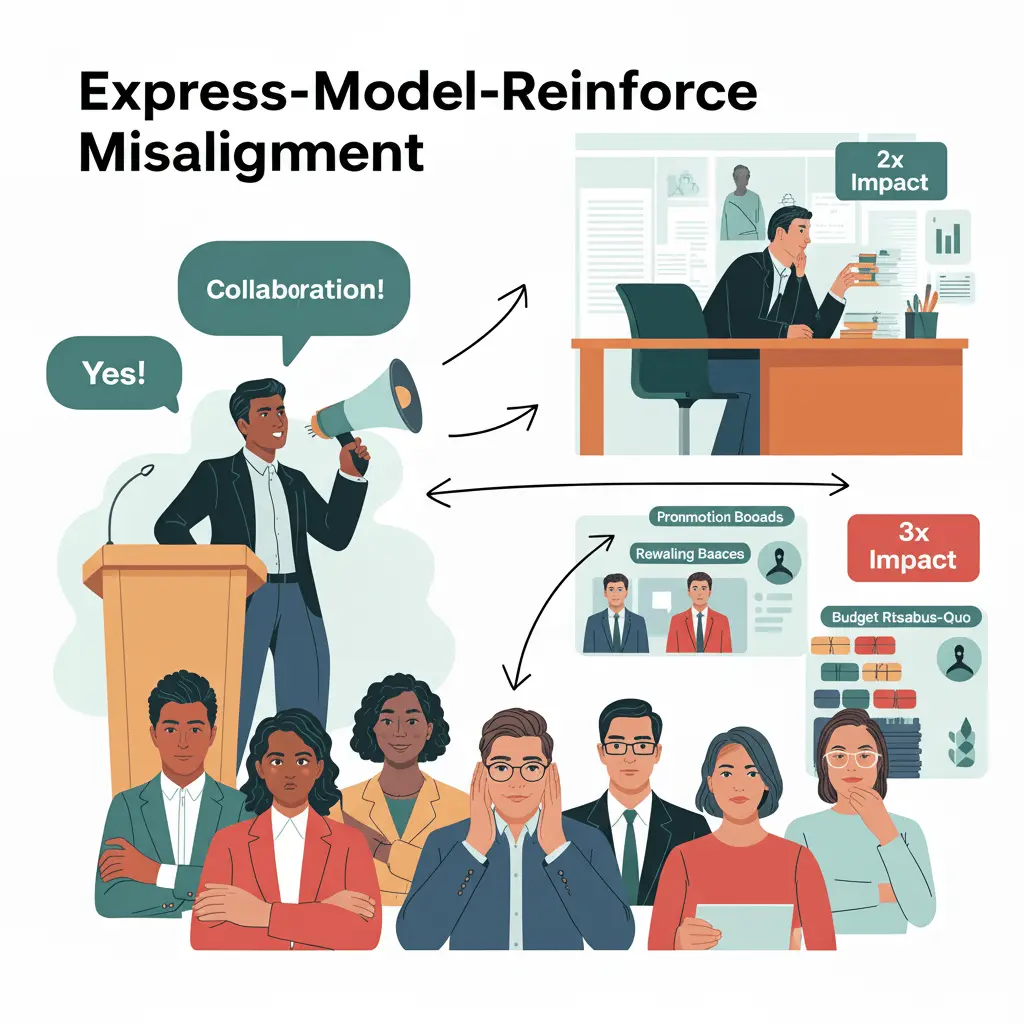
Express = 1x impact. Model = 2x. Reinforce = 3x. When they're misaligned, reinforcement wins every time.
The Problem
Leaders say "yes" to innovation, collaboration, and learning. Then their systems reinforce the opposite.
The Test
Ask: what behaviors got someone promoted in the last 12 months? The gap is your reinforcement misalignment.
The Fix
Pick one behavior. Align what you express, model, and reinforce. Then expand. This is how change sticks.
Why Shonda Rhimes Succeeded: She Controlled Her Reinforcement
Most change efforts focus on what people say and do. Rhimes is a useful example because her story shows what happens when all three elements — saying, doing, and experiencing — line up.
When Shonda Rhimes said "yes" to speaking engagements and actually showed up, she got immediate feedback. The audience responded. She felt satisfaction. New opportunities expanded. Her confidence grew. Those consequences stayed connected to the new behavior — which is exactly why it lasted beyond the 1st engagement, the 5th, and the 50th.
The key insight: Alignment is not perfection. The story includes discomfort, missteps, and setbacks. What made it work is that the consequences kept pointing her forward, not back to the old behavior — for 365 consecutive days.
What she said matched what she did. What she did matched what she experienced. That 3-way alignment is what made the change sustainable — not willpower, not inspiration, not a great message on day 1.
Why Organizations Fail: Systems Say "No" While Leaders Say "Yes"
This is the most common pattern in organizational change — and the most predictable. Once you see it, you will recognize it everywhere.
| EMR Element | What Actually Happens | Weight |
|---|---|---|
| Leaders Express (say) | "We value innovation, collaboration, continuous learning." | 1× |
| Leaders Model (do) | Avoid risk, protect boundaries, stick with what worked before. | 2× |
| Systems Reinforce (reward) | Perfect records, individual metrics, speed over quality. | 3× |
The math is not complicated. People do what gets reinforced — not what gets expressed. When those 2 things point in different directions, reinforcement wins at 3 times the weight of communication alone.
IMA's AIM research across 40+ years and 1,000+ implementations confirms: misaligned reinforcement is the single most common reason change fails after launch — appearing in more than 7 out of 10 stalled transformations.The Express-Model-Reinforce Framework
IMA's AIM assigns a specific weight to each element of sponsor behavior. Understanding those weights is what makes this framework actionable — not just conceptual.
"If you do not change the reinforcement, you do not get the change."
— The core teaching behind 40+ years of IMA implementation researchThis is not a theory. It is a diagnostic. When you know what each element weighs, you can calculate why a change is stalling — and what to fix first. The Reinforce element (3×) dominates because it governs what behaviors survive contact with real organizational pressure.
The Brutal Math: Reinforcement Wins Every Time
Two organizations. Same stated values. Completely different outcomes. The only difference is where the math points.
Scenario A: All 3 elements aligned
Model (2×): Leaders run 3 experiments per quarter. They share failures openly.
Reinforce (3×): Innovators get promoted. Pilot budgets are approved within 30 days.
Scenario B: Expression without reinforcement
Model (0×): Leaders stick with proven approaches. Failures stay private.
Reinforce (−3×): Only perfect records get promoted. Failures are punished.
The math is simple. People do what gets reinforced. When reinforcement points away from what you expressed, reinforcement wins — at 3 times the weight. You cannot write your way past this. You cannot train your way past it. The only fix is changing what gets rewarded.
Projects with actively involved leaders — ones who model and reinforce, not just express — succeed at a 76% rate. Projects with leaders who only express succeed at just 46%. That 30-percentage-point gap is the cost of expression without reinforcement. The math determines the outcome.
Expression without reinforcement is not a theory. It shows up in 4 specific, recurring patterns — and odds are your organization has at least 2 of them running right now. Each one follows the same structure: a 1× message working against a −3× system. Together, they explain why most change stalls after launch — and why more communication never fixes it.
The 4 Most Common Expression-Reinforcement Disconnects
These 4 patterns of expression without reinforcement appear in nearly every organization that struggles with adoption. Each follows the same math: a 1× message canceled by a −3× system. The result is always the same — people stop doing what was asked.
Innovation
- "We value risk-taking and innovation."
- "Fail fast, learn faster."
- Require exhaustive business cases before pilots
- Cancel at the first difficulty
- Never share their own failures
- Promotions go to people with zero failures
- Performance reviews penalize "wasted effort"
- Successful innovations get credited to leadership; failures go to the team
Collaboration
- "We value collaboration."
- "Break down silos. One team."
- Protect departmental turf
- Send representatives instead of attending personally
- Make unilateral decisions
- Performance reviews measure only individual metrics
- Bonuses based on siloed results
- Cross-functional work adds burden without recognition
Continuous Learning
- "Embrace continuous learning."
- "Growth mindset. Never stop developing."
- Never mention their own learning
- Cancel training when busy
- Don't use new skills once learned
- Training gets consumed by meetings — no protected time
- Learning is absent from performance reviews
- Being a beginner is treated like incompetence
Speaking Up
- "Voice your concerns."
- "Speak truth to power. Psychological safety."
- React defensively when challenged
- Shut down debate with position power
- Surround themselves with yes-people
- Problem-raisers get labeled "negative"
- Messengers of bad news face career consequences
- Conformity gets recognized as "alignment"
How to Audit Your Reinforcement System
For each behavior you want to see, answer these 7 questions. The gaps between your intended system and your actual system are your misalignment. Each gap has a cost — because the reinforcement weight is 3×.
| Question | What you want to see | What misalignment looks like |
|---|---|---|
| What does success look like? | Observable behaviors — specific and measurable | Vague aspirations ("be more innovative") |
| How do we recognize this? | Public or private acknowledgment tied to the behavior | Recognition is absent or random |
| What do we reward? | Promotions, pay, and resources linked to the target behavior | Rewards go to the old behavior under a new name |
| What are the consequences? | Clear outcomes for doing it — and for not doing it | No consequence for non-compliance; behavior is optional |
| What do we measure? | Observable behaviors tracked, reported, and discussed regularly | Count is tracked but never discussed or linked to outcomes |
| Where do resources go? | Time protected, budget allocated, tools provided | No time allocated; people told to "fit it in" |
| What do leaders model? | Leaders do this themselves, visibly and regularly | Leaders delegate the behavior they're asking others to demonstrate |
Example audit: "Innovation"
Here is what the innovation audit looks like in an organization where the disconnect is already in place:
| Question | Current reality |
|---|---|
| Behavior | "Submit one improvement idea per month." (vague) |
| Recognition | None — ideas disappear into a database |
| Rewards | No link between innovation and advancement |
| Consequences | Time spent on ideas takes from "real work"; no consequence for not submitting |
| Measurement | Count is tracked but never discussed |
| Resources | No time allocated; no budget for pilots |
| Modeling | Leaders don't submit ideas themselves |
Reinforce: Risk avoidance rewarded at every turn. (−3×)
5 Actions to Fix Reinforcement Misalignment
These are not communication tactics. They are system changes. Each one addresses the 3× reinforcement weight directly.
Make one behavior fully aligned
Do not fix everything at once. Pick one critical behavior and align all three elements around it. Here is what that looks like for AI adoption:
- Express (1×): "Use AI tools daily" — stated clearly and specifically
- Model (2×): Leaders use AI in meetings and share weekly what they used
- Reinforce (3×): Track usage, recognize adopters, include it in reviews, promote users
When all three point in the same direction, the combined weight is +6×. Behavior follows.
Stop rewarding the old behavior — even when results are good
Every time you reward the old behavior, you send a 3× signal that it's still acceptable. 3 things to stop immediately:
- Stop promoting people who don't demonstrate the desired behaviors — even if their numbers are strong
- Stop recognizing results achieved through old methods as if the method doesn't matter
- Stop allowing leaders to delegate the 6 non-delegable tasks — these are behaviors only leaders can model
In most organizations, this shift takes fewer than 30 days to become visible. People watch what actually changes. When 1 promotion goes to someone who demonstrated the new behavior, the signal reaches 10 times more people than any announcement.
Change what you measure — measurement is reinforcement
What gets tracked, reported, and discussed is what people believe matters. 4 requirements for measurement that actually changes behavior:
- Track specific behaviors — not vague concepts like "engagement" or "collaboration"
- Report monthly — not buried in an annual review nobody reads until December
- Tie to consequences — otherwise measurement is just data collection at a cost of hours per week
- Make it visible — people cannot change what they cannot see
Create leader behavioral contracts
Use this format: "I [name] commit to personally demonstrating [behavior] by [doing what], [how often], starting [date]."
Example: "I commit to using AI daily by opening each meeting with what AI helped me prepare."
Make it public. Track it. Hold it accountable. Leaders who sign behavioral contracts are modeling the change — not just expressing it.
Run a quarterly reinforcement review
Every quarter, answer 3 questions:
- What behaviors increased — and what reinforcement caused that?
- What behaviors decreased — and what reinforcement (or lack of it) caused that?
- What are we saying we want but not seeing? Audit the gap and fix it.
The Reinforcement Reality Check
Answer these 5 questions about your organization right now. The gap between your answers and your stated values is your reinforcement misalignment — and it has a cost.
| Question | What the answer reveals |
|---|---|
| What behaviors got someone promoted in the last 12 months? | This is your real reinforcement — not your stated values |
| What behaviors got publicly recognized? | Public recognition signals to everyone what matters |
| What behaviors got additional resources? | Budget allocation is one of the strongest reinforcement signals |
| What behaviors went completely unnoticed? | Ignoring a behavior is a reinforcement choice — it communicates irrelevance |
| What behaviors faced negative consequences? | Consequences (or their absence) define the real rules |
The gap between your answers and your stated values is your reinforcement misalignment. Reinforcement is 3× stronger than anything else you can do. If you do not change what gets reinforced, you will not get the change you are trying to create.
IMA's AIM: The Source of the EMR Framework
The Express-Model-Reinforce framework is central to IMA's AIM (Accelerating Implementation Methodology), created by Don Harrison. The 1× : 2× : 3× weighting comes from 40+ years of field research tracking why organizations succeed or stall during implementation.
That research is consistent across more than 1,000 implementations: projects with actively involved leaders succeed at a 76% rate. Projects with leaders who only express succeed at 46%. The 30-point gap is the measurable cost of expression without reinforcement.
The math is unforgiving. Leaders say 1 thing. They do another. Systems reward a 3rd. The result is always the same: slow adoption, high resistance, and change that stalls at launch.
Fixing reinforcement misalignment requires leaders to personally do 6 specific things — not delegate them, not announce them — but do them. That is exactly what Part 4 covers: the 6 non-delegable leadership tasks that no change agent can perform on a leader's behalf.
Ready to Align What You Say, Do, and Reinforce?
Peacock Hill Consulting applies IMA's AIM to help leaders close the gap between expressed values and reinforced behavior — so adoption actually sticks.