
TL;DR
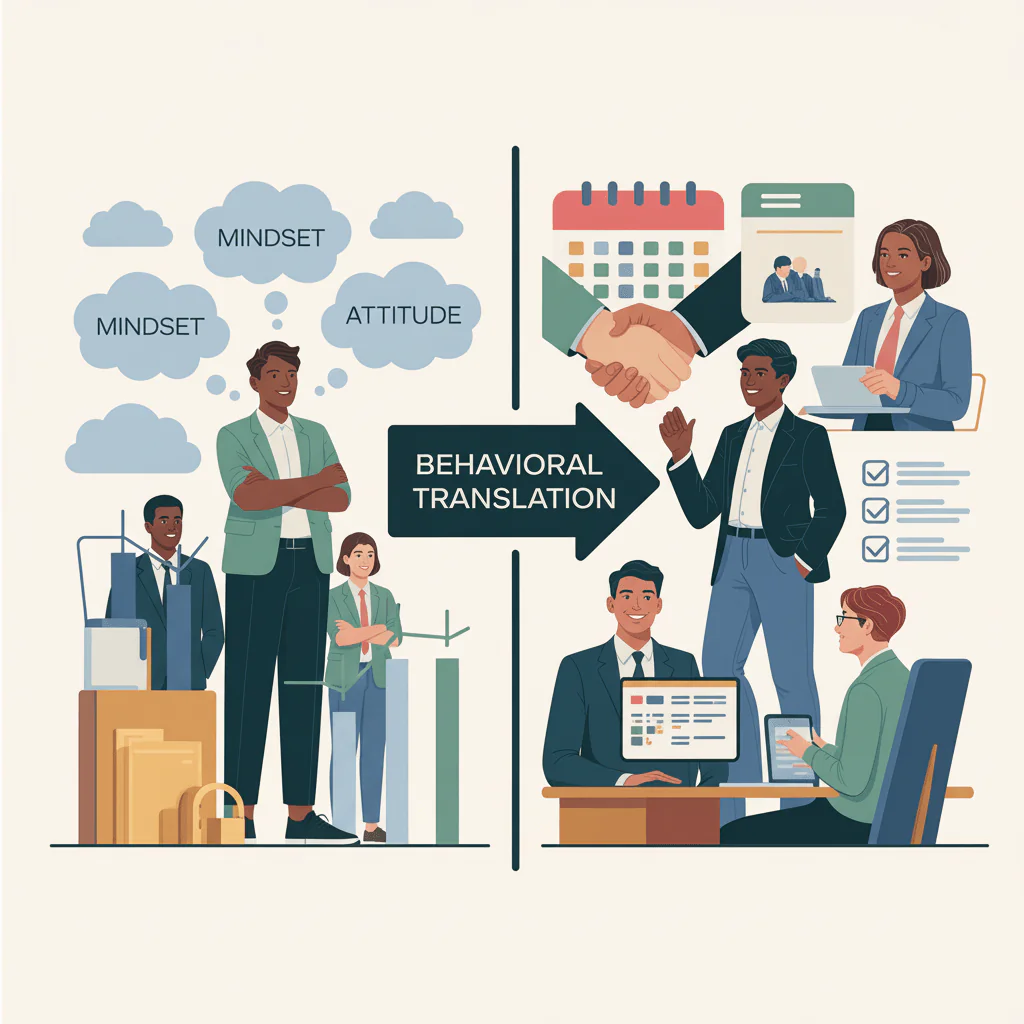
"Be innovative." "Value collaboration." These are concepts, not behaviors — and you can't measure, reinforce, or change concepts. This post shows how to translate abstract goals into observable actions. Because if you can't see it from across the room, you can't measure it, and you can't reinforce it.
This article is part of our AIM Methodology series.
In Part 1, we explored what Shonda Rhimes learned from her Year of Yes — and why willingness alone does not drive organizational change. Willingness is only one of five readiness elements, and individual attitude cannot overcome systemic barriers.
But here is the next challenge: even when people are willing, organizations fail to define what yes actually looks like from a behavior perspective.
You Can't Measure a Concept
"The only thing you can measure on a daily basis when it comes to human beings in your organization is behavior."
Not attitudes. Not mindsets. Not values. Behavior — what people DO that others can observe.
Yet organizations keep asking for:
- "Be more innovative"
- "Value collaboration"
- "Embrace agility"
- "Foster growth mindset"
These are concepts, not behaviors. No one can observe you "being innovative." They can only observe what you DO.
And here's the real problem: everyone already thinks they're doing it. Ask five people what "collaboration" means and you'll get five different answers. You cannot measure concepts. You cannot reinforce concepts.
You Can Measure Behavior
Consider how Rhimes approached her commitment. When she committed to her "Year of Yes," she skipped vague aspirations and defined a concrete action: say yes to things that scared her. This was observable and measurable — you could count how many times she said yes.
But here's the nuance: "yes" didn't always mean doing something. Sometimes the thing that scared her was saying no — so her "yes" to growth meant declining. The behavior looked different, but the commitment was the same.
Not every "yes" is the right yes. If a change doesn't align with your values, your needs, or who you are, then thoughtful commitment might mean saying no.
How to Translate "Yes" Into Observable Behaviors
Here's the five-step process:
First, start with your abstract goal. For example: "We want innovation."
Next, ask what you'd actually SEE. What would people be doing differently?
Then, define specific, observable actions:
- Submit one improvement idea per month
- Test one new approach per quarter
- Share failed experiments with lessons learned
After that, make behaviors measurable. Count ideas submitted. Track pilots launched.
Finally, specify by role. Innovation looks different for executives than for individual contributors. So define what each level does.
Organizational Translation: Common Scenarios
Scenario 1: "We Want Innovation"
Vague: "Everyone should be more innovative"
Behavioral Translation by Role:
Senior Leaders:
- Allocate 10% of budget to pilots
- Attend quarterly innovation showcases personally
- Publicly recognize failed experiments that produced learning
Middle Managers:
- Hold monthly "what if?" sessions
- Allow team members 2 hours/week for improvement work
- Share both successes and failures at leadership meetings
Individual Contributors:
- Submit one improvement idea monthly
- Volunteer for at least one pilot per year
- Provide feedback on others' ideas within 48 hours
Now you have observable, measurable, role-appropriate behaviors.
Scenario 2: "We Value Collaboration"
Vague: "Work together more effectively"
Behavioral Translation:
Cross-Functional:
- Respond to other departments within 24 hours
- Include one person from another function in planning
- Share draft work for feedback before finalizing
Within Teams:
- Share information within 24 hours
- Offer help when teammate struggles
- Document work so others can continue
Measurable: Response times, cross-functional participation, information sharing frequency
Scenario 3: "Embrace Continuous Learning"
Vague: "Develop growth mindset"
Behavioral Translation:
Formal Learning:
- Complete one course per quarter
- Attend one conference per year
- Read one business book per month
Informal Learning:
- Ask one clarifying question per meeting
- Request feedback from manager monthly
- Shadow someone in different role quarterly
Application:
- Use one new skill within 30 days
- Share learning with team weekly
- Teach skill to one other person
Measurable: Courses completed, questions asked, skills applied
Scenario 4: "Say Yes to Change"
Vague: "Be positive about transformation"
Behavioral Translation:
Engagement:
- Attend all implementation meetings
- Complete training by deadline
- Try new tools/process/etc. within first week
Adoption:
- Use new system/process/etc. for X task starting [date]
- Stop using old workaround by [date]
- Document issues in tracking system
Communication:
- Explain change accurately to team
- Address rumors with facts
- Share successes with new approach
Measurable: Attendance, training completion, system usage logs, process compliance
The "Throw Yourself Into the Future" Exercise
The Setup: "It's 24 months from now. Your transformation succeeded. What do you SEE people doing? What do you see DIFFERENTLY?"
Example: AI Transformation
Executives are:
- Using AI daily in visible ways
- Asking "what AI approach did you try?" in reviews
- Allocating budget based on AI capability
Managers are:
- Experimenting with AI for team tasks
- Sharing use cases in team meetings
- Recognizing early adopters
Individual contributors are:
- Using AI tools for routine tasks
- Sharing prompts with colleagues
- Documenting AI-enabled improvements
What STOPPED:
- Manual data entry for routine reports
- Waiting for "perfect" AI solutions
- Punishing AI mistakes during learning
Translate these observations into behavioral expectations for TODAY.
Common Translation Mistakes
Mistake 1: "Negative" Behaviors Only
- Wrong: "Stop being resistant"
- Right: "Voice concerns in implementation meetings"
Mistake 2: Still Too Abstract
- Wrong: "Think about customer needs"
- Right: "Contact customer within 24 hours of request"
Mistake 3: Unmeasurable Modifiers
- Wrong: "Communicate regularly"
- Right: "Send status update every Friday"
Mistake 4: One-Size-Fits-All
- Wrong: Everyone does same thing
- Right: Different roles demonstrate differently
Mistake 5: Forgetting to Stop Behaviors
- Wrong: Only adding new
- Right: "Stop using old system by [date]"
10 "Yes" Behaviors Leaders Can Define Today
- Attendance: Attend [specific meeting] every [frequency]
- Communication: Send [specific update] every [timeframe]
- Tool Adoption: Use [tool] for [task] starting [date]
- Learning: Complete [training] by [date]
- Feedback: Submit issues through [channel] within [timeframe]
- Helping: Answer teammate questions within [timeframe]
- Recognition: Acknowledge [achievement] publicly
- Problem-Solving: Propose solution when raising problem
- Accountability: Report [metric] every [timeframe]
- Modeling: Demonstrate [behavior] in [context] (Leaders only)
Replace every bracket with specific content for YOUR change.
Making Behavioral Specificity Stick
Document It: Create "Behavioral Definition Document" with observable behaviors by role, measurement approach, timeline, recognition plan.
Communicate It: Don't just announce — teach. Show examples. Demonstrate in meetings. Share success stories.
Observe It: Leaders must watch for behaviors. Attend meetings. Review metrics. Ask "what did you DO this week?"
Reinforce It: What gets recognized and rewarded is what gets repeated. Part 3 covers reinforcement in depth.
Personal Application: Your Behavioral "Yes"
My Abstract Commitment: [Your general goal]
Observable Behaviors I Will Do:
- [Specific action with timeframe]
- [Specific action with timeframe]
- [Specific action with timeframe]
How I'll Measure: [How you'll track]
When I'll Review Progress: [Date/frequency]
Who Will Observe: [Who will see you doing these]
Conclusion: From Words to Action
Shonda Rhimes transformed by defining specific behaviors, executing them repeatedly, building evidence through action.
Organizations succeed the same way: Not by announcing "we value innovation," but by defining what innovation looks like in observable actions.
The formula:
- Start with abstract goal
- Ask "what would we SEE?"
- Define specific, observable behaviors
- Make measurable
- Specify by role
- Reinforce what you see
"You can't define your initiative in terms of 'better customer service' because nobody knows what that looks like. Customer service may have to be defined down to 'the phone must be answered by the third ring.'"
That specificity feels uncomfortable. But that specificity is what makes change real.
Challenge Yourself to Say Yes
You can't control the change. You can control your response.
When facing AI rollouts, restructures, or shifting priorities, the people who thrive aren't the ones who "stay positive" — they're the ones who get clear on what's actually changing, what it means for their work, and what support they need. Start there.
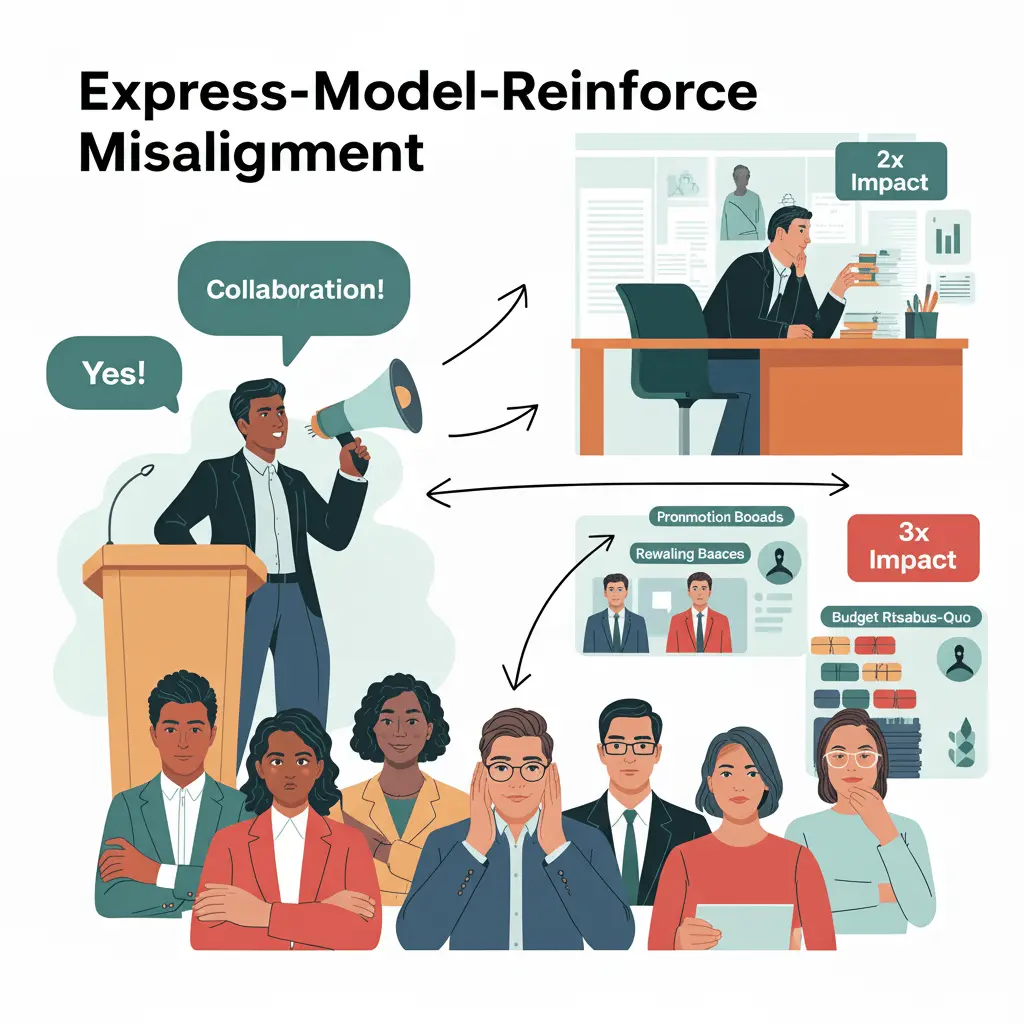
Next: Part 3 – Express-Model-Reinforce Misalignment
You've defined "yes" behaviorally. People know what to do. But they're not doing it.
Why? Because what your organization SAYS doesn't match what it DOES or REWARDS. Express = 1x, Model = 2x, Reinforce = 3x. When these misalign, reinforcement wins every time.