
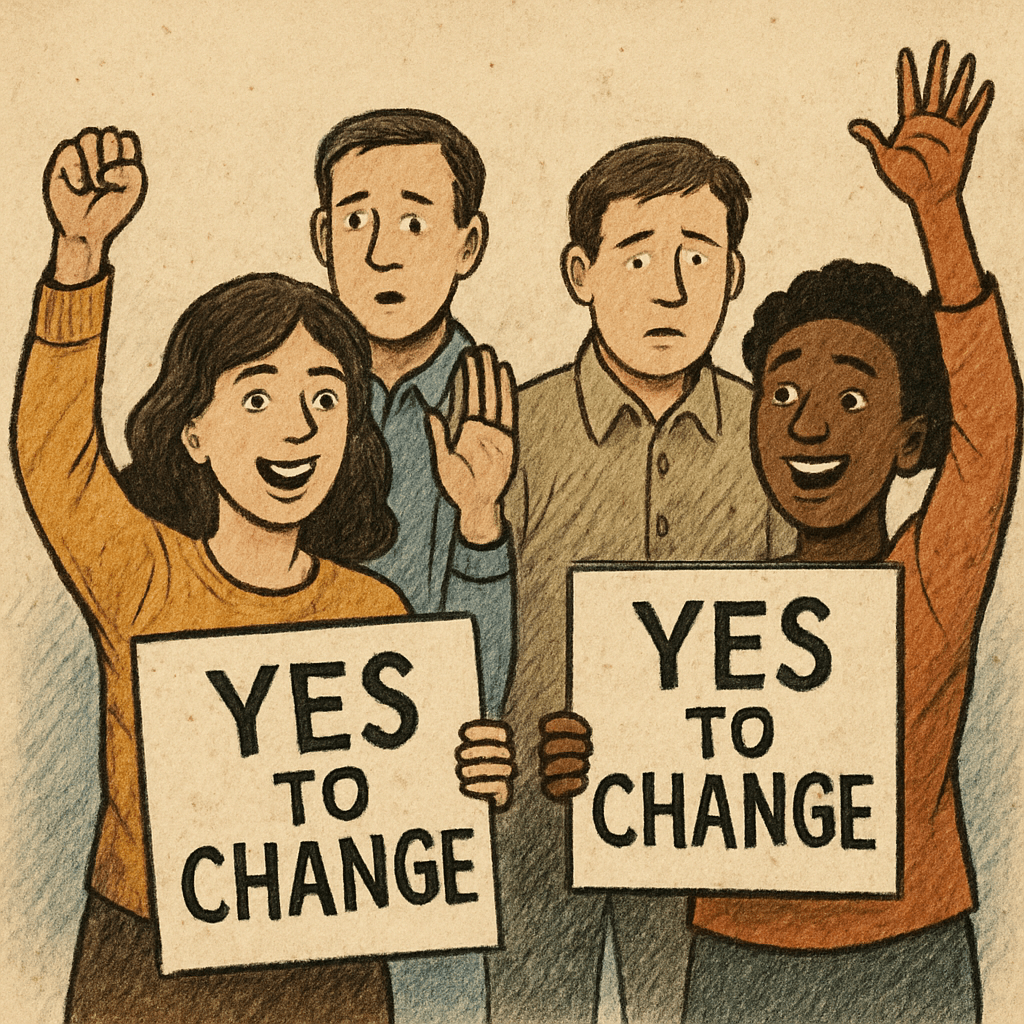
TL;DR
Shonda Rhimes transformed her life by saying "yes" to opportunities that scared her — but organizational change requires more than positive attitude. People don't resist because they're negative — they resist because change disrupts their Frame of Reference (how they work, what they're good at, what they're rewarded for). IMA's AIM research shows willingness is only one of five required readiness elements. Success requires behavioral specificity, visible leadership involvement, aligned reinforcement (3x weight), and each person taking responsibility for their own adaptation. You can only change your own life — but organizations must create conditions where "yes" can succeed.
This article is part of our AIM Methodology series.

The Shonda Rhimes Story
I was catching up on podcasts listening to Mel Robbins interview Shonda Rhimes — creator of "Grey's Anatomy," "Scandal," and "How to Get Away with Murder." She described the Thanksgiving when her sister muttered: "You never say yes to anything."
That observation sparked Rhimes' "Year of Yes." She committed to specific, observable actions: accepting speaking invitations, appearing on talk shows, attending events. This behavioral specificity made her transformation real — she acted differently, repeatedly, visibly.
Her 2015 book chronicles profound results: expanded opportunities, personal growth, confidence building, and a fundamentally transformed relationship with possibility.
Her story caught my attention as a change agent because of the way she responded and chose to change. This is the same challenge we constantly face at work — the decision we must also make: to change or not to change. Wishing you a Happy Thanksgiving!
Understanding Frame of Reference: The Lens That Shapes Everything
Was Shonda Rhimes negative before transformation? No. She was protecting what worked for her. She'd built success as an introvert who controlled her environment. Saying "yes" disrupted her established patterns.
IMA's AIM research reveals: Resistance is a function of disruption, not understanding or attitude.
Your Frame of Reference (FOR) is the mental lens through which you view your world:
- What you've learned from past experiences
- What currently makes you successful
- What you're rewarded for
- What you believe you're good at
- How you maintain control
When change threatens any FOR element, resistance surfaces — even when you genuinely want to support change.
People Act Logically Within Their Frame of Reference
IMA's Founder Don Harrison: "Your logic and their logic are two different things."
Example: Manager "resisting" agile transformation
- In their FOR: Success came from detailed planning and control
- Agile asks them to: Embrace uncertainty, iterate without complete information
- From their FOR: This looks like chaos leading to failure
- Their resistance is: Logical protection of what made them successful
IMA's AIM: "You can always anticipate the most resistance from those who have the highest vested interest in the situation remaining the same."
The people who succeeded most in the current system have the most to lose.
Why Personal "Yes" Works Differently Than Organizational "Yes"
Here's what made Rhimes' transformation possible: she controlled every variable.
When she said "yes" to a speaking engagement, she owned the decision completely. No approval process. No competing priorities. She managed her own calendar, experienced immediate reinforcement from audience response, and watched her opportunities expand with each successful event.
But organizational transformation operates under completely different rules.
When your organization asks you to "say yes to change," you face a far more complex reality:
You're juggling competing priorities across multiple initiatives. Reinforcement systems reward the old way of working while demanding you adopt the new. Leaders announce change enthusiastically — then continue modeling the exact behaviors they're asking you to abandon. You're missing critical information about what's actually expected. You lack the capabilities needed to succeed. And structural barriers beyond your control block every path forward.
This is exactly why positive attitude alone never drives organizational change. Your individual "yes" crashes into systemic "no" at every turn.
Why "Just Be Positive" Doesn't Work
Organizations may treat implementation as an attitude problem rather than a disruption problem.
This fails because:
1. It Ignores Real Disruption
Change disrupts how people work, what they're good at, what they're rewarded for, their control, their career trajectory. "Be positive" dismisses legitimate concerns.
2. It Provides No Behavioral Direction
"Be positive" isn't an action. No one can observe you "being positive." They can only observe what you DO.
3. It Ignores System-Level Barriers
Individual attitude cannot overcome systemic "no." You can say "yes" to innovation while performance systems punish any failure, or "yes" to collaboration while metrics measure only individual performance.
The system says "no" at 3x the weight of what leaders say.
IMA's Express-Model-Reinforce framework:
- Express (1x): What organizations say through communication
- Model (2x): What leaders personally demonstrate
- Reinforce (3x): What systems actually reward and resource
When Express says "yes" but Reinforce says "no," Reinforce wins every time.
The Five Elements of Readiness: All Required
IMA's AIM identifies five elements. All five are required. Willingness — the "yes" part — is only one element.
1. INFORMATION
What specifically is changing? Why? What does it mean for my role?
Missing: Confusion, rumors, anxiety
2. WILLINGNESS
Am I willing to make this change?
This is the "yes" element — but insufficient alone.
Missing: Active resistance, opposition
3. ABILITY
Do I have skills, tools, resources, time?
Missing: Stress, overwhelm, errors
4. CONFIDENCE
Do I believe I can succeed?
Missing: Risk avoidance, self-doubt
5. CONTROL
Do I have any voice in how this affects me?
Missing: Passive-aggressive resistance, victimhood
You cannot compensate for missing elements with more of others. More communication doesn't fix missing skills. Increased training doesn't fix unwillingness. More encouragement doesn't create confidence without successful experience.
The Quote and Its Layers
Shonda Rhimes: "The only person that can change your life is you."
Profoundly true for personal transformation. In organizational transformation, this has layers.
What Individuals Own:
- Your choice to engage or resist
- Your effort to build capability
- Your perspective on change
- Your behavioral response
What Individuals Don't Own:
- System-level reinforcement
- Leadership modeling
- Resource allocation
- Structural barriers
IMA's AIM holds both truths:
Truth 1: The person affected by change has primary responsibility for helping themselves through change.
Truth 2: Organizations must create conditions where individual "yes" can succeed.
Effective change happens when:
- Individuals take responsibility for adaptation
- Leaders perform six non-delegable tasks
- Reinforcement systems match what's asked
- All five readiness elements are provided
- Disruption is acknowledged honestly
Why Truth Over Comfort Is Essential for Change Management
Most implementations fail — not because people lack positive attitudes, but because organizations don't:
- Translate "yes" into specific behaviors
- Provide all five readiness elements
- Change reinforcement systems to match what they're asking
- Have leaders remain visibly involved
- Acknowledge and address real disruption
Acknowledging difficulty doesn't decrease success — it increases it. When you name what's difficult, people feel seen, trust builds, real barriers can be addressed.
IMA's AIM approach: Name what's difficult. Demand action anyway. Provide real support.
Your "Yes" Starts Here: What You Control
Despite organizational complexity, Rhimes' insight remains true: the only person who can change your life is you.
What you control:
Your Choice — Risk and growth vs. safety and possible irrelevance. Your choice. Your consequences.
Your Behavioral Response — Do you attend meetings or skip them? Try tools or avoid them? Behavior is what others see.
Your Capability Building — Organizations provide training. You must do learning.
Your Resistance Management — Name what's being disrupted for YOU. Hidden fears grow. Named fears can be addressed.
Your Requests — Ask for what you need: training, information, time, help removing barriers.
Conclusion: "Yes" Is the Beginning, Not the Solution
Shonda Rhimes' "Year of Yes" inspires because she paired mindset with action — specific, visible, repeated behaviors.
IMA's 40+ years of research about implementation reveals:
- Resistance is driven by disruption, not negativity
- Frame of Reference shapes how people experience change
- Willingness is only one of five required readiness elements
- Individual "yes" cannot overcome systemic "no"
- Behavioral specificity matters more than positive messaging
- Leadership involvement and reinforcement systems determine success
- Truth over comfort builds trust
The foundation for organizational "yes":
For individuals: Take responsibility for adaptation. Choose engagement. Build capability. Name what's difficult. Ask for support.
For organizations: Provide all five readiness elements. Change reinforcement systems. Have leaders remain visibly involved. Define "yes" behaviorally. Acknowledge disruption honestly.
Neither alone is sufficient. Together, they create conditions where "yes" can become real change.
Next: Part 2 – Turning "Yes" Into Action
Rhimes didn't decide to "be more open." She accepted specific speaking invitations. Organizations fail constantly — asking for "innovation," "collaboration," "agility" without defining what these look like in observable actions.
Part 2 explores how to translate "yes" into specific, measurable behaviors. If you can't see it, you can't measure it. If you can't measure it, you can't build reinforcement systems around it.