

Measuring Change ROI with AIM by IMA Worldwide
Calculating the return on investment (ROI) of change management efforts is crucial for organizations aiming to maximize their effectiveness during transitions. Understanding how to measure ROI not only helps in justifying investments but also in refining strategies for future initiatives. This article delves into the methodologies and metrics that can be employed to accurately assess the ROI of change management efforts, particularly through the lens of the AIM methodology. Many organizations struggle with quantifying the impact of their change initiatives, leading to uncertainty in resource allocation. By implementing structured approaches to ROI calculation, businesses can ensure that their change management efforts yield tangible benefits. We will explore the definition of ROI in change management, the AIM methodology’s role in enhancing ROI calculations, step-by-step processes for calculating ROI, and the tools and metrics that can accurately measure success.
Key Takeaways
- Understanding and calculating ROI in change management is essential for justifying investments and improving future initiatives.
- The AIM methodology offers a structured approach that enhances the accuracy and impact of ROI calculations.
- Measuring key metrics such as employee engagement, productivity, and financial performance is critical to assessing change management success.
- Certification programs like AIM Change Management Certification empower change agents to drive higher ROI through effective implementation.
- Real-world case studies demonstrate the tangible benefits and improved outcomes achieved through disciplined change management practices.
What Is ROI in Change Management and Why Is It Critical?
Return on investment (ROI) in change management refers to the financial return gained from investments made in change initiatives relative to their costs. This metric is critical as it provides a clear picture of the effectiveness of change management strategies and their impact on organizational performance. By measuring ROI, organizations can identify successful initiatives and areas needing improvement, ensuring that resources are allocated efficiently.
Defining Return on Investment for Change Initiatives
ROI for change initiatives is calculated by comparing the net benefits of the change against the costs incurred. The formula typically used is:
This calculation allows organizations to quantify the financial impact of their change efforts, making it easier to justify expenditures and refine future strategies.
The Business Impact of Effective Change Management
Effective change management can significantly enhance business outcomes. Research indicates that organizations implementing disciplined change management achieve 143% of their expected ROI, compared to only 35% for those that do not. This stark contrast underscores the importance of structured change management processes in driving successful outcomes.
How Does the AIM Methodology Enhance ROI Calculation?
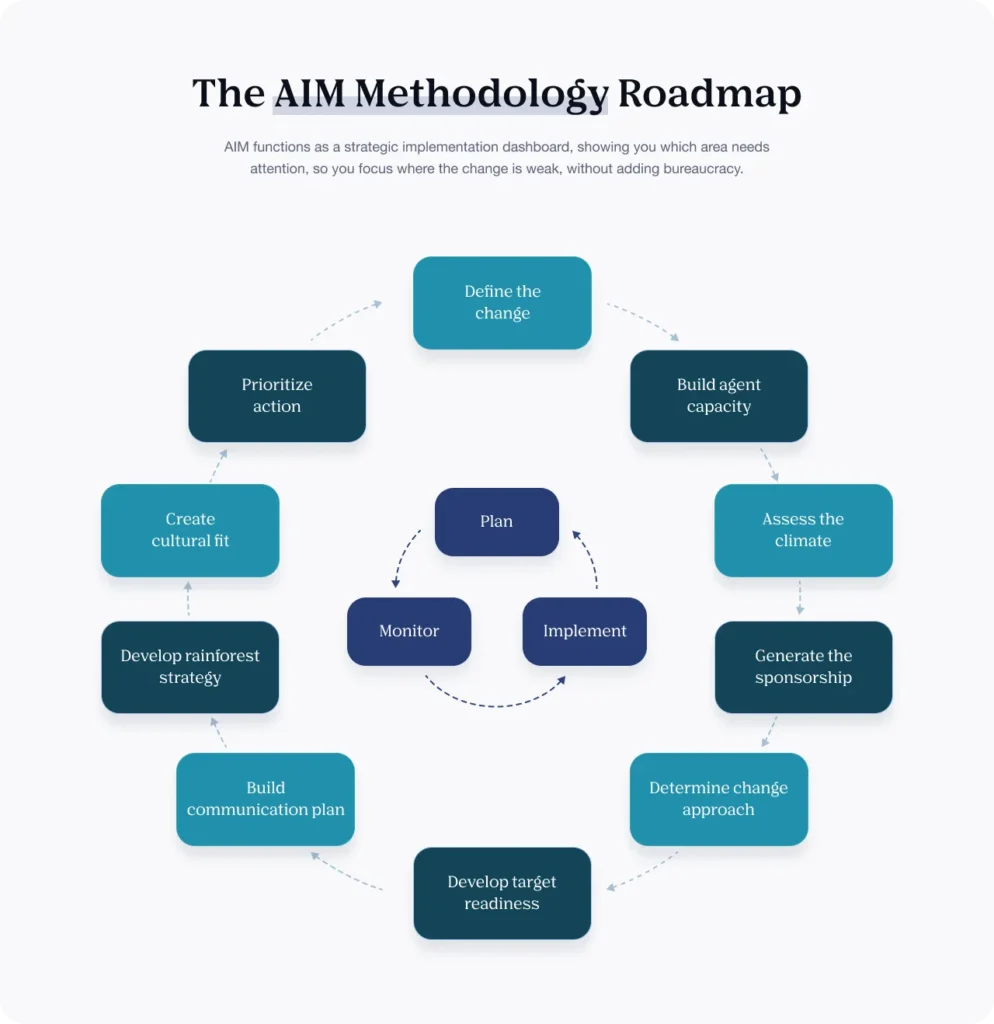
The AIM (Accelerating Implementation Methodology) methodology provides a structured framework for managing change effectively. By focusing on key principles, AIM enhances the ability to calculate and maximize ROI from change initiatives.
Core Principles of the AIM Change Management Methodology
AIM is built on several core principles, including stakeholder engagement, cultural awareness, and reinforcement systems. These principles ensure that change initiatives are not only implemented but also sustained over time, leading to better outcomes and higher ROI.
Linking AIM Methodology to Measurable ROI Outcomes
By applying the AIM methodology, organizations can link their change management efforts directly to measurable outcomes. For instance, case studies have shown that organizations using AIM principles report higher employee engagement and productivity, which in turn translates to improved financial performance.
What Are the Step-by-Step Processes to Calculate Change Management ROI?
Calculating ROI for change management involves a systematic approach that includes identifying key metrics, gathering data, and applying appropriate formulas.
Identifying Key Metrics and Data Sources for ROI Calculation
Key metrics for ROI calculation in change management include employee productivity, engagement levels, and financial performance indicators. Data sources may include employee surveys, financial reports, and performance metrics, which provide the necessary information to assess the impact of change initiatives.
Applying ROI Formulas with Practical Examples
To illustrate the ROI calculation process, consider a scenario where a company invests $100,000 in a change initiative that results in $300,000 in net benefits. The ROI would be calculated as follows:
This example highlights how effective change management can lead to substantial financial returns.
Which Tools and Metrics Accurately Measure Change Management Success?
Various tools and metrics can be employed to measure the success of change management initiatives. These tools help organizations track progress and assess the effectiveness of their strategies.
Quantitative Metrics for Change Adoption and Business Performance
Quantitative metrics such as adoption rates, performance improvements, and cost savings are essential for evaluating the success of change initiatives. These metrics provide concrete data that can be analyzed to determine the overall impact of change management efforts.
Leveraging Technology and Analytics in ROI Measurement
Technology plays a crucial role in measuring ROI for change management. Advanced analytics tools can help organizations gather and analyze data more effectively, providing insights that drive better decision-making. By leveraging these technologies, businesses can enhance their ability to measure and maximize ROI.
How Do Certification Programs Improve Change Management ROI?

Certification programs, such as the AIM Change Management Certification, equip change agents with the skills and knowledge necessary to implement effective change strategies. These programs can significantly enhance the ROI of change management efforts.
Benefits of AIM Certification for Change Agents and Organizations
AIM certification provides change agents with mastery of AIM tools and methodologies, ensuring they are well-prepared to lead change initiatives. This expertise translates into more effective change management practices, ultimately improving ROI.
Data-Driven Examples of Successful Change Initiatives
Data-driven examples illustrate how organizations have successfully implemented change management strategies to achieve significant ROI. These case studies often highlight the importance of structured methodologies and stakeholder engagement in driving successful outcomes.
Lessons Learned and Best Practices for Maximizing ROI
Organizations can learn valuable lessons from successful change initiatives, including the importance of clear communication, stakeholder involvement, and continuous improvement. By adopting these best practices, businesses can enhance their change management efforts and maximize ROI.
If you have any questions or would like to learn more about how AIM can help your organization, please contact us today.
| Metric | Description | Value |
|---|---|---|
| Employee Engagement | Measures the level of employee involvement in change initiatives | High |
| Productivity Improvement | Assesses the increase in output following change implementation | 20% |
| Financial Performance | Evaluates the overall financial impact of change initiatives | $300,000 |