
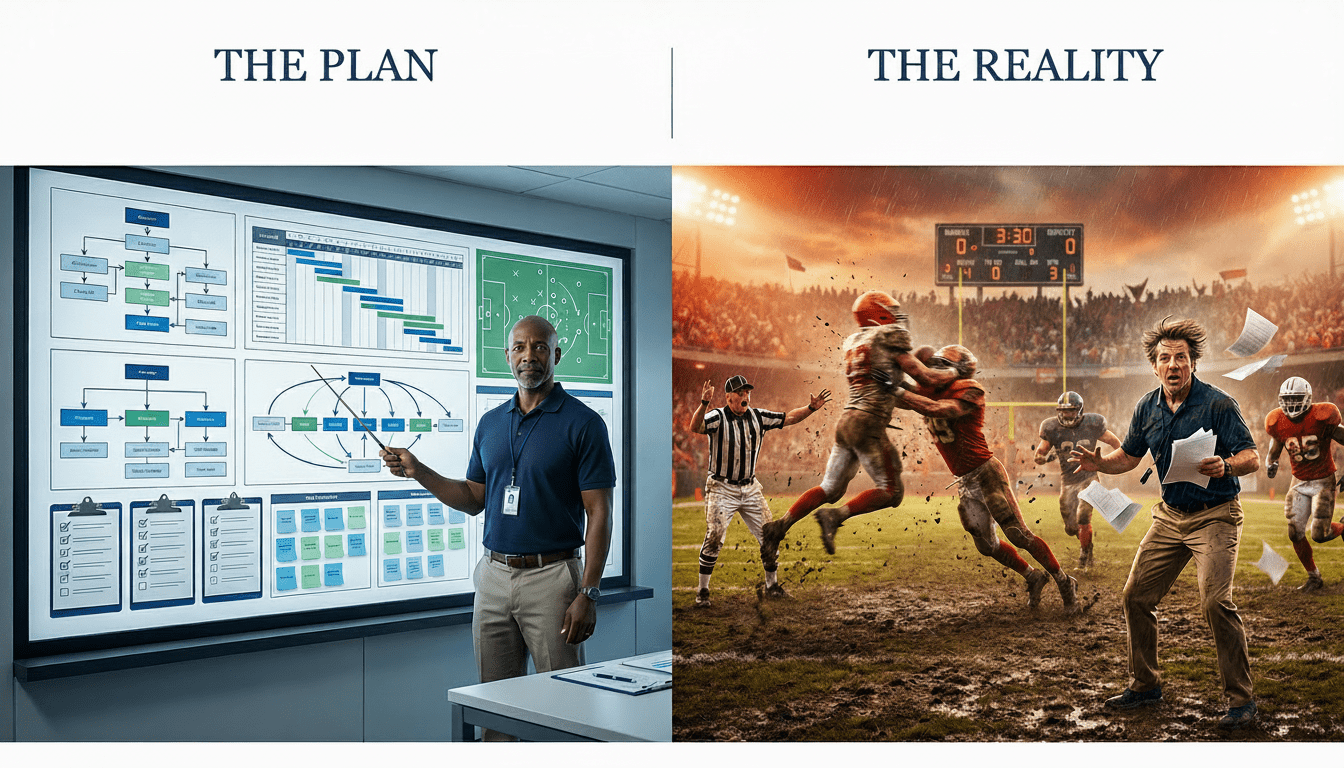
TL;DR: In football, nobody expects a game to follow a rigid script—great coaches plan to adapt. In business transformations, we often do the opposite: we treat timelines like predictions and call deviations “failures.” The real failure is not missing the plan—it’s failing to build the readiness and reinforcement needed for people to adopt the change.
Welcome to the Fantasy World of Perfect Planning
Imagine, if you will, an alternate universe where football coaching works the way corporate project management does.
It’s Sunday at Arrowhead Stadium. The Kansas City Chiefs are about to face the Buffalo Bills in the AFC Championship. Andy Reid steps up to the whiteboard with his coaching staff six days before kickoff. They have created, as all good coaches do, a detailed 127-play game plan.
Every single play has been scripted. First play: Mahomes to Kelce, 12-yard slant. Second play: Pacheco up the middle for 4 yards. Third play: Mahomes scrambles right, hits Rice on a 23-yard corner route.
Every play. Every yard. Every second. All planned out in advance.
The Chiefs invested up to the NFL salary cap of roughly $255 million in player salaries alone. Factor in coaching, facilities, analytics teams, medical staff, travel, and the endless infrastructure of professional football, and the total investment approaches well beyond player salaries alone.
Roughly $10 billion in total player compensation league-wide.
So, here’s the question: Should Andy Reid be fired for “planning failure” when his 127-play script doesn’t unfold exactly as written?
The Absurdity of Perfect Play-by-Play Predictions
In our fantasy world, the owner calls go like this:
Owner: “Coach Reid, on play 47, you scripted a 15-yard completion to Rashee Rice. Instead, Mahomes threw to Kelce for 8 yards. That’s a 7-yard variance from plan. How do you explain this deviation?”
Fantasy Reid: (frustrated) “Well, you see, the Bills adjusted their coverage in ways we didn’t anticipate. Our analytics team projected a 73% probability of a zone defense, but they came out in man coverage with a safety cheating toward Rice…”
Owner: “But that’s not what the game plan said would happen. It clearly stated: Play 47, 3rd and 6, shotgun formation, Rice runs a dig route, completion for 15 yards.”
Fantasy Reid: (now visibly distressed) “I understand, but the defense—”
Owner: “Coach, our variance tracking shows that 94 of your 127 plays deviated from the original script. That’s a 74% failure rate. The board will need an explanation for this level of plan non-compliance.”
You’re laughing. Of course you are. This is absurd.
No one holds football coaches accountable for play-by-play prediction accuracy because everyone understands a fundamental truth about competitive sports:
As one of my friends once told me: “That’s why we play the game. To see who wins.”
Thanks, Andy!

How Real Football Actually Works
The NFL has become one of the most data-driven industries on earth. Teams use Next Gen Stats tracking, machine learning models, and sophisticated analytics to inform every aspect of their preparation.
But here’s what makes coaching masterful: all that preparation serves adaptation, not prediction.
Bill Belichick, widely considered one of the greatest coaches in NFL history, built his legacy on exactly this principle. Teams use data to understand their opponents’ weaknesses and adjust their strategy accordingly—not to create a rigid script that cannot change.
Good game plans include multiple contingencies:
- If the defense lines up in Cover 2, we do this.
- If they blitz, we do that.
- If our running game isn’t working, we shift to this package.
The plan isn’t a prediction of what will happen—it’s a framework for how to respond to what does happen.
Coaches must navigate through real-time factors that transcend mere numbers on a spreadsheet, particularly in high-pressure situations where split-second decisions matter. Football isn’t played out solely on paper or screens; it unfolds dynamically with emotions, adrenaline, and unforeseen circumstances shaping outcomes.
Now Let’s Talk About Your Implementation Timeline
Your organization is about to implement a major transformation—maybe an ERP system, an AI platform, an Agile transformation, or a post-merger integration. The team has created a detailed timeline:
- Week 3: Leadership alignment complete
- Week 8: Change agent network trained and deployed
- Week 12: Pilot group fully adopting new behaviors
- Week 20: Organization-wide rollout complete
- Week 24: Full adoption achieved, benefits realized
Sound familiar?
Then Week 5 arrives. A key leader unexpectedly leaves. IT discovers a compatibility issue that delays the technical deployment. The pilot group’s feedback reveals that the new process doesn’t work well for 30% of customer scenarios. A competitor launches a product that requires an immediate strategic response, pulling executive attention elsewhere.
And suddenly, you’re in the postgame press conference explaining your “plan deviations.”
“We’re now three weeks behind schedule. This represents a planning failure.”
But was it really? Or did you just discover that in human systems—just like in football—you have to play the game.
The Real Planning Failure No One Talks About
Think about it: NFL teams don’t fail because their play-by-play predictions were wrong. They fail when the other team scores more.
Maybe they didn’t prepare for contingencies. Maybe they didn’t have the right people in position. When they can’t adapt to what’s actually happening on the field.
What the Best Coaches—and Leaders—Actually Plan For
Andy Reid doesn’t walk into Arrowhead Stadium with a 127-play script that must execute perfectly. He walks in with:
- A clear objective: Win this game to advance to the Super Bowl.
- The right people in position: Players ready to execute and adapt.
- Multiple contingency plans: If they do X, we respond with Y.
- Decision frameworks: When to go for it on 4th down based on situational probabilities.
- Real-time assessment capabilities: What’s working? What isn’t? How do we adjust?
This is what implementation planning should look like too.
IMA’s AIM methodology identifies five elements people need to adopt change:
- Information (do they understand?)
- Willingness (are they motivated?)
- Ability (do they have the skills?)
- Confidence (do they believe they can succeed?)
- Control (do they have ownership?)
These aren’t things you predict on a timeline. They’re things you build capacity to create.
The Tactical Shift: From Prediction to Response Capability
Here’s what changes when you stop treating implementation timelines like play-by-play predictions:
Instead of:
“Leadership alignment will be complete by Week 3.”
Plan for: What specific behaviors must leaders demonstrate? How will we know when alignment exists? What do we do when individual leaders are at different stages of readiness?
Instead of:
“Training complete by Week 8.”
Plan for: What capabilities must people have? How will we measure actual skill development versus attendance? What happens when certain groups need more time or different approaches?
Instead of:
“Full adoption by Week 24.”
Plan for: What does adoption actually look like in observable behavior? How will we reinforce new behaviors when competing priorities emerge? What are our contingencies when adoption happens unevenly across the organization?
Just like NFL coaches have shifted to data-driven decision-making that emphasizes situational awareness over rigid scripts, organizations should shift to implementation approaches that emphasize behavioral readiness over timeline compliance.
The Real Cost of Getting This Wrong
Organizations collectively invest trillions in change initiatives each year—digital transformations, AI implementations, process improvements, cultural shifts. Often cited figures suggest 70–90% fall short.
Most of them had detailed timelines. Many hit their milestone dates.
They still failed.
Because they confused installation with implementation. They achieved the technical deployment dates while missing the human adoption that creates actual business results.
It’s like a football team celebrating that they ran exactly 127 plays as scripted—while losing 41–13 because they never adapted to what was actually happening on the field.
The Coach’s Mindset for Implementation Leaders
Andy Reid won’t be fired if play 47 doesn’t go exactly as scripted. He’ll be evaluated on whether his team wins—and whether his preparation gave them the best possible chance to win by adapting to actual game conditions.
The same standard should apply to implementation leaders:
- Stop measuring timeline variance and start measuring readiness.
- Stop celebrating milestone completion and start celebrating behavioral change.
- Stop demanding explanation for deviations and start demanding the adaptive capacity that makes deviation management possible.
Because here’s the truth that four decades of implementation research keeps confirming: in every change initiative, the people affected by the change get a vote.
“Everyone has a plan until they get punched in the mouth.”
– Mike Tyson
The best football coaches and the best implementation leaders share the same fundamental understanding: planning is essential, but plans are not predictions. They’re preparation for response.
Stop holding people accountable for play-by-play variance. Start building the adaptive capability that turns any game situation into an opportunity.
Next up: If you can tell me who will win March Madness, call me!
Outcomes.