
What Is Change Management?
Change management is the structured discipline of helping people adopt new ways of working so that organizational changes deliver their intended results. The change management process addresses three systems most programs ignore: active leadership sponsorship, reinforcement that rewards new behaviors, and diagnostic tools that identify where adoption is stalling. It is the difference between installing a change and implementing it — between going live and getting results.
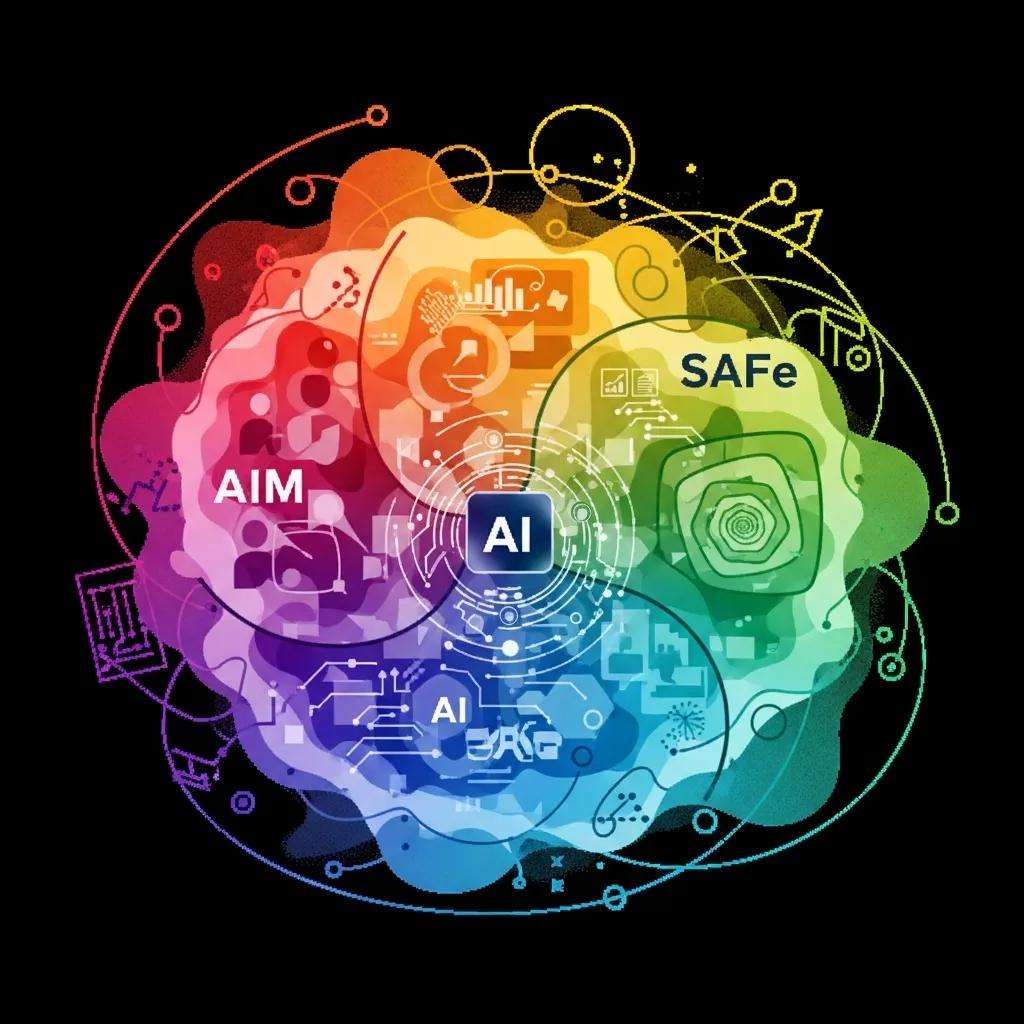
Change Management Research Data
Change Management Definition: Implementation, Not Communication
Change management is the discipline of closing the gap between deploying a solution and achieving sustained adoption. It applies across every type of organizational change — technology implementations, process redesigns, operating model shifts, AI adoption, and cultural transformation. The change management definition that matters is this: it is implementation work, not a communication exercise.
What Does Change Management Mean in Business?
In a business context, change management means ensuring that strategies, systems, and structures deliver value by helping people adopt new behaviors. Every organizational change — an ERP rollout, an operating model shift, a merger integration — is ultimately a people change.
The technical deployment is installation. The behavior change is implementation. Without a structured change management process, organizations get the first but not the second. Studies show that only 34% of organizational changes are considered successful by their own stakeholders (Gartner, 2024).
The most common mistake is treating change management as a communication exercise. Research shows that communication alone accounts for only one-sixth (approximately 17%) of the leadership impact on adoption.
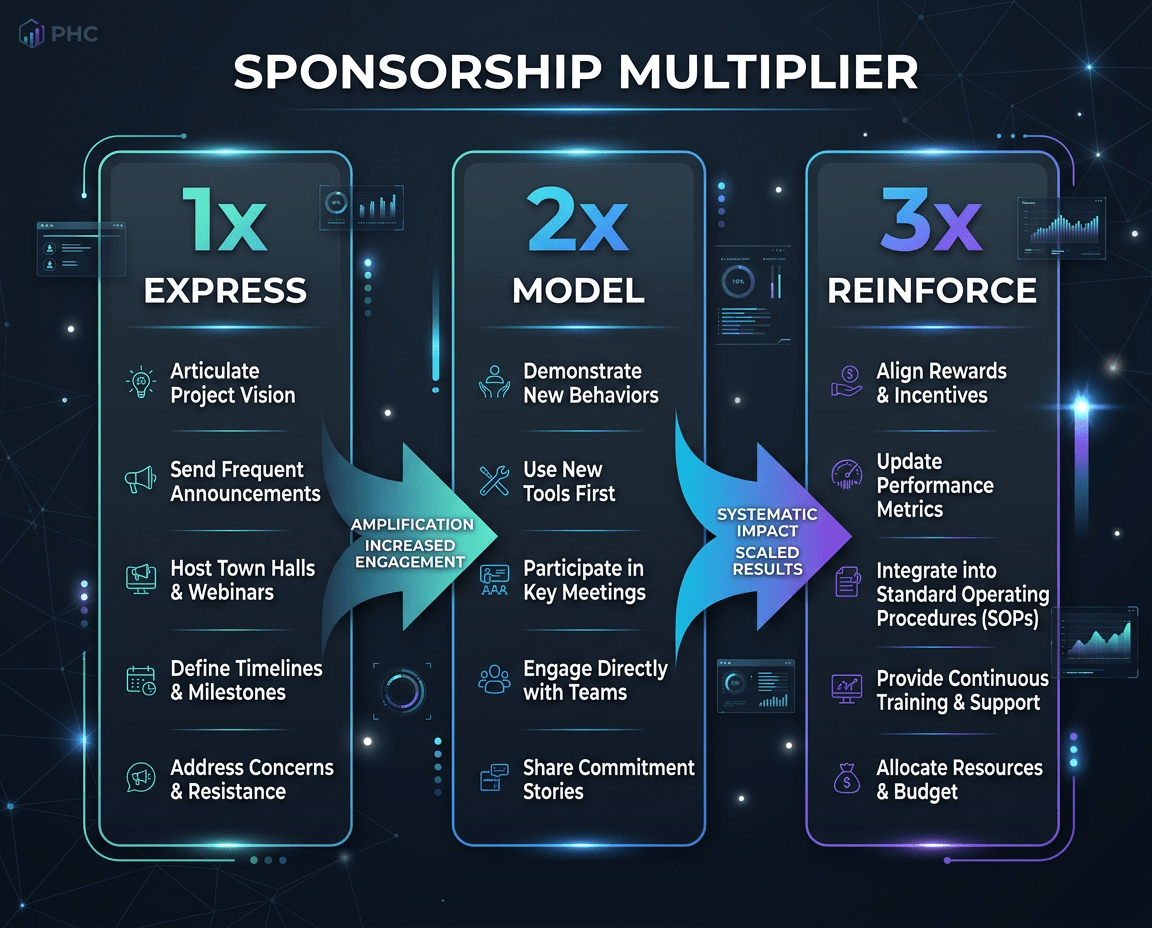
The Express-Model-Reinforce (EMR) Framework
What leaders personally model carries twice the weight (33%) of what they say. What leaders reinforce — through incentives, promotions, and performance metrics — carries three times the weight (50%).
- Express (17% impact) — communicate the business case, goals, and expectations
- Model (33% impact) — personally demonstrate the new behaviors leaders expect from others
- Reinforce (50% impact) — align incentives, promotions, and performance metrics to reward adoption
This framework explains why organizations with active sponsors achieve a 76% success rate versus 46% without (PMI Pulse of the Profession).
What Effective Change Management Addresses
Effective change management addresses three organizational systems simultaneously:
- Active leadership sponsorship — leaders who Express the business case, Model the new behaviors, and Reinforce adoption through consequences and rewards
- Reinforcement system alignment — incentives, performance metrics, and promotion pathways that reward new behaviors rather than legacy practices
- Target readiness — building the five elements every person needs to adopt change: awareness, desire, knowledge, ability, and reinforcement
Why Most Organizations Get Installation, Not Implementation
Installation means the system or process has been deployed and is technically operational. Implementation means people are using it correctly, consistently, and in ways that drive intended business outcomes. The gap between these two phases is where organizations either capture or lose transformation value.
Most organizations declare success at go-live but never achieve sustained behavior change. They measure installation metrics — system uptime, training completion rates, go-live dates — while ignoring the metrics that actually matter.
Implementation metrics track what happens after launch: adoption rates, speed to proficiency, and ROI realization. Genuine behavioral transformation typically requires 12–18 months of sustained attention beyond go-live. Culture-level change takes 3–5 years. Yet fewer than 25% of organizations continue active change management past the 90-day mark.
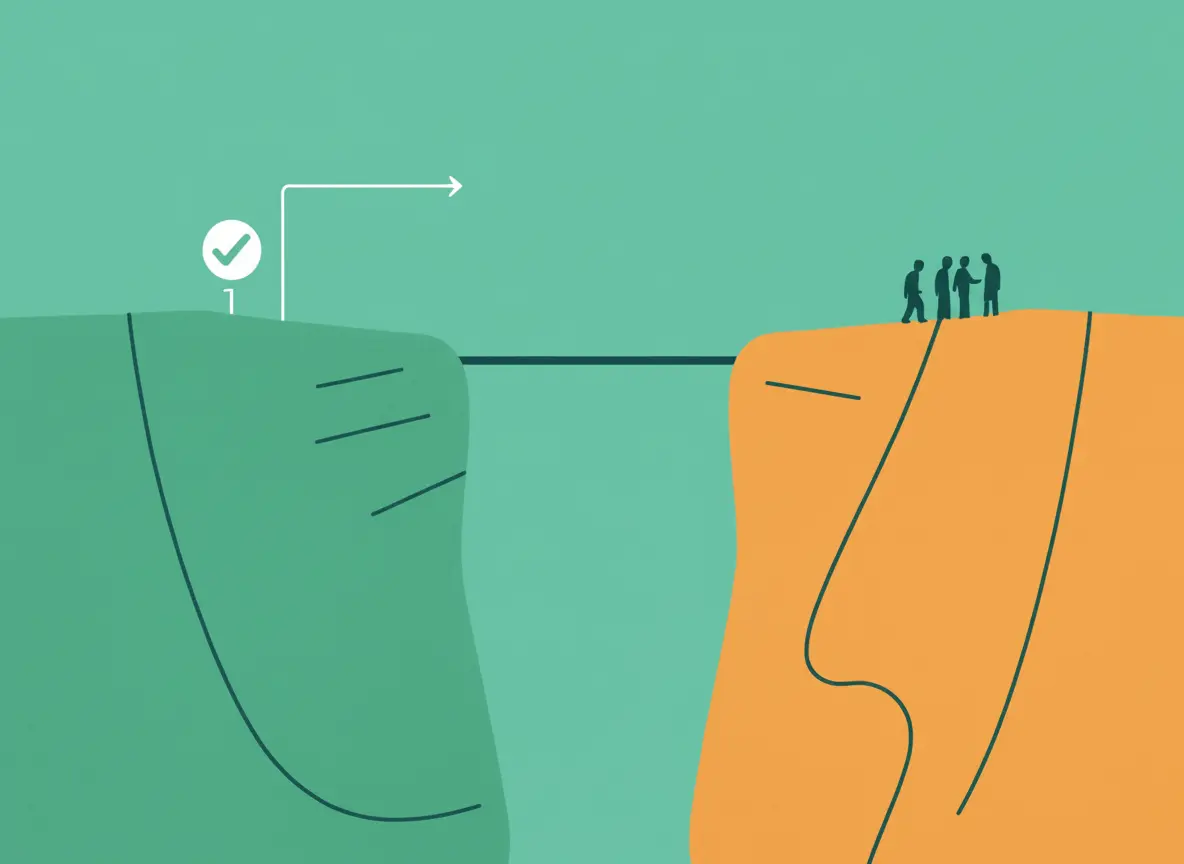
Closing this gap requires three interventions that most change programs skip:
- Redesigning reinforcement systems to reward new behaviors instead of legacy practices
- Activating a sponsor cascade from executive leadership through middle management to frontline supervisors
- Building ongoing diagnostic capability to identify where adoption is stalling and why
| Metric | Installation (What Most Measure) | Implementation (What Matters) |
|---|---|---|
| Timeline | Go-live date achieved | 12–18 months of sustained adoption |
| Success measure | System uptime, training completion | Adoption rates, speed to proficiency |
| Leadership role | Approve budget and timeline | Express, Model, and Reinforce daily |
| Reinforcement | None — old incentives remain | Metrics and rewards aligned to new behaviors |
| ROI realization | Projected at go-live | Measured at 6, 12, and 18 months post-launch |
The Four Roles That Drive Organizational Change
Every successful change requires four roles operating in alignment. When any role is absent or poorly executed, adoption stalls. These are not job titles — they are functions that must be performed for change to move from announcement to behavior.
Sponsors (Leaders)
Own the change. Perform the six non-delegable leadership tasks: establish the business case, set expectations, allocate resources, cascade sponsorship, apply reinforcement, and monitor progress. Without active sponsors, nothing moves.
Change Agents
Support implementation but do not own it. Prepare leaders for their sponsorship tasks, surface resistance, coach champions, and translate the change into role-specific impact. Their defining constraint: responsibility without authority.
Champions
Reinforce change locally. Champions are peers who model new behaviors within their teams, answer day-to-day questions, and sustain adoption after launch energy fades. Their influence comes from credibility, not authority.
Targets
Anyone whose behavior must change. Targets are not passive recipients — they must build their own readiness across five elements: awareness, desire, knowledge, ability, and reinforcement. No one can change another person.
Change Control vs. Change Management
Organizations often confuse change control with change management. They solve different problems and operate in different domains. Both are necessary, but they are not interchangeable.
| Dimension | Change Control | Change Management |
|---|---|---|
| Focus | Protects system stability | Enables behavior adoption |
| Scope | Manages scope and risk | Manages readiness and reinforcement |
| Driver | Approval-driven | Sponsorship-driven |
| Domain | Technical governance (ITIL, ITSM) | People implementation |
| Key Question | Should we make this change? | How do we help people adopt this change? |
The Change Management Process: 10 Integrated Practice Areas
The most effective change management process addresses organizational systems, not just individual readiness. The Accelerating Implementation Methodology (AIM) organizes the change management process into 10 practice areas, each supported by 35+ validated diagnostic assessments built on 40+ years of field research. Unlike linear step-by-step models, these practice areas operate concurrently — because real implementations do not follow a predictable sequence.
Define the Change
Clarify what is changing, who is impacted, and what adoption looks like in observable behaviors. Without a clear definition, teams talk past each other and measure different outcomes. AIM uses a structured Change Definition tool that maps each change to specific roles, behaviors, and success criteria — reducing ambiguity by up to 60% in the first 30 days.
Build Change Agent Capacity
Equip agents with the skills, credibility, and capacity to support leaders and targets effectively. Research shows that 72% of change agents report being assigned the role without formal training. AIM addresses this through structured agent development that builds competency in stakeholder analysis, resistance diagnosis, and sponsor coaching.
Assess the Climate
Understand organizational stress, implementation history, and capacity to absorb this change. Organizations running more than 3 concurrent changes see adoption rates drop by 40% per additional initiative. AIM’s climate assessment identifies saturation risks before they derail implementation.
Generate Sponsorship
Activate leaders to Express, Model, and Reinforce the change at every level of the organization. Sponsorship is the #1 predictor of adoption — yet 38% of initiatives lack an active executive sponsor (PMI). AIM’s sponsor cascade model ensures sponsorship flows from the C-suite through middle management to frontline supervisors.
Determine the Approach
Select tactics based on impact level, resistance risk, and target readiness assessment data. Not every change requires the same level of intervention. AIM categorizes changes into 4 impact tiers, each with a calibrated set of tactics — preventing both over-engineering and under-investment.
Develop Target Readiness
Build the five elements people need to adopt change: awareness, desire, knowledge, ability, and reinforcement. Each element is measurable through AIM’s diagnostic assessments. Skipping any one element drops adoption rates by an estimated 25–35%, because people cannot sustain behaviors they do not understand or feel equipped to perform.
Build the Communication Plan
Help people understand what the change means for them — role by role, not just organization-wide. Generic announcements reach less than 20% of targets with actionable clarity. Effective communication plans segment messages by role, translate organizational goals into individual impact, and use multiple channels over 5–7 touchpoints.
Develop Reinforcement Strategy
Align incentives, metrics, and consequences to reward new behaviors and extinguish old ones. Organizations where reinforcement systems conflict with the change see 3x higher resistance rates. AIM audits existing reward structures, performance metrics, and promotion criteria to identify and close reinforcement gaps.
Create Cultural Fit
Align the change with how success is defined, measured, and rewarded in the organization. Changes that conflict with deeply held cultural norms take 3–5 years to embed versus 12–18 months for culturally aligned changes. AIM’s cultural alignment assessment identifies friction points before they become adoption barriers.
Prioritize Action
Sequence initiatives to reduce overload, change fatigue, and compounding resistance across the portfolio. Organizations averaging 5+ concurrent changes per employee see completion rates below 30%. AIM’s prioritization framework helps leaders sequence, defer, or consolidate initiatives based on organizational capacity data.
Why Is Organizational Change Management Important?
People do not resist change itself. They resist the impact of change on their success.
Organizational change management matters because without active sponsorship and skilled change agents, resistance grows and old behaviors remain reinforced. The result: organizations invest millions in new systems, processes, and structures that never deliver their intended value. According to McKinsey, large-scale transformations that include disciplined change management deliver 143% of expected ROI, while those without it deliver only 35%.
The three factors research identifies as most predictive of sustained adoption are:
- Active leadership involvement — organizations with active executive sponsors achieve a 76% success rate versus 46% without (PMI Pulse of the Profession)
- Reinforcement system alignment — what gets reinforced gets sustained; what gets ignored gets abandoned
- Diagnostic capability — the ability to identify where adoption is stalling and intervene with targeted actions rather than generic communication
Change management is not optional overhead. It is the implementation discipline that determines whether strategic investments deliver their promised ROI. Organizations that treat it as a communication exercise get installation; organizations that treat it as an implementation discipline get results.

Frequently Asked Questions About Change Management
What is change management in simple terms?
Change management is the structured discipline of helping people adopt new ways of working. It goes beyond communication and training to address three organizational systems: active leadership sponsorship, reinforcement that rewards new behaviors, and target readiness across awareness, knowledge, and ability. Without all three, adoption stalls and organizations get installation without implementation.
What is the difference between change management and change control?
Change control manages scope and risk through approvals and governance, protecting system stability. Change management manages behavior and readiness through sponsorship and reinforcement, enabling adoption. Change control asks "Should we make this change?" Change management asks "How do we help people adopt this change?" Organizations need both, but they solve different problems.
Why do most change management initiatives fail?
Research shows 88% of transformations have room to strengthen their adoption approach (Bain, 2024). The primary cause is the installation-vs-implementation gap: organizations declare success at go-live but never achieve sustained behavior change. Three factors predict failure: absent executive sponsorship (38% of initiatives lack it per PMI research), misaligned reinforcement systems that reward old behaviors, and treating change as a communication exercise rather than an implementation discipline.
What does a change agent do in an organization?
A change agent prepares leaders for their non-delegable sponsorship tasks, translates the change into role-specific impact for targets, surfaces and manages resistance before it escalates, supports local champions, and monitors implementation risk. The defining constraint of the change agent role is responsibility without authority: they facilitate adoption but cannot mandate it. Effective change agents work through sponsors and champions rather than around them.
What is the best change management methodology for enterprise transformations?
For enterprise-scale transformations, the most effective methodologies address organizational systems, not just individual readiness. AIM (Accelerating Implementation Methodology) targets the three factors research identifies as most predictive of sustained adoption: active leadership involvement, reinforcement system alignment, and cultural fit. AIM provides 10 integrated practice areas and 35+ diagnostic assessments built on 40+ years of field research, making it particularly effective for complex, multi-initiative environments like ERP implementations, AI adoption, and operating model changes.
How do you measure change management success?
Effective change management measurement focuses on observable behaviors, not sentiment surveys. Key metrics include adoption rates (percentage of targets using new processes correctly and consistently), speed to proficiency (time from go-live to competent performance), reinforcement alignment (whether incentives and performance metrics reward new behaviors), sponsorship activity levels, and business outcome realization. The critical distinction is measuring implementation, not just installation.
What is change management in project management?
In project management, change management is the discipline that addresses the people side of a project. While project management focuses on tasks, timelines, and deliverables, change management focuses on helping the people affected by the project adopt new behaviors. The two disciplines are complementary: project management gets the solution built and deployed (installation), while change management gets people using it correctly and consistently (implementation). Without both, projects deliver on time and on budget but fail to achieve their intended business outcomes.
What is the installation vs. implementation gap?
Installation means a system or process has been deployed and is technically operational. Implementation means people are using it correctly, consistently, and in ways that drive intended business outcomes. The gap between these two phases is where organizations either capture or lose transformation value. Closing this gap requires active sponsorship, reinforcement system redesign, and sustained attention 12–18 months beyond go-live.
Ready to Close the Gap Between Installation and Implementation?
Whether you are launching a new technology platform, redesigning processes, or leading a cultural transformation, AIM provides the diagnostic tools and leadership systems to achieve sustained adoption.
AIM & Why Changes Fail IMA Worldwide
What Is AIM?
The complete overview of Accelerating Implementation Methodology — 10 practice areas, diagnostic tools, and the leadership system that drives adoption.
ResearchWhy Transformations Fail
The structural causes behind implementation failure — and the sponsorship, reinforcement, and readiness gaps that predict whether a change will sustain.
LeadershipLeadership Involvement in Change
The six non-delegable leadership tasks, the EMR framework, and the sponsor cascade model that drives adoption from the top down.
AdoptionResistance to Change
Why resistance is a symptom of system failure, not an employee problem — and how to diagnose and address the root causes that block adoption.